Most training programs are just a list of exercises stapled to a calendar.
Do these movements, in this order, on these days. That holds up right until your knee starts hurting mid-session, or a work trip eats your schedule, or a movement that felt fine last week feels wrong today.
An exercise list has no answer for those days. A method does.
The Praxis Protocols are the method underneath every GMB program. The same logic runs from a single repetition up to a decade of training, and once you can see it, you can use it to make your own training decisions.
That is the actual goal here: physical autonomy. The ability to read what your body is telling you, choose what to do about it, and keep applying capability in the real world for decades. Programs give you the material. The method teaches you to make the calls yourself.
One Loop, Five Scales
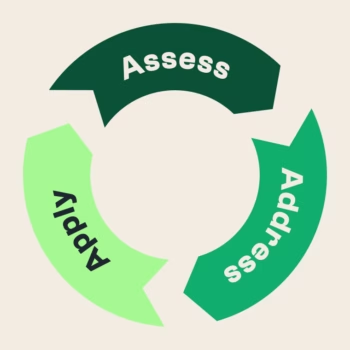
Strip away the vocabulary and the whole system is a single improvement loop: Assess, Address, Apply.
Assess what is going on and pick the one thing most worth working on. Address it through training and through the small lifestyle changes that shift your baseline. Apply what you built by testing it, in low-stakes play and in the real demands of your life. Then assess again. We call it the Continuous Improvement Cycle, and it never stops turning.
The reason it works at every level is that it runs at every level. The same loop governs a single movement attempt, a full session, a training block of several weeks, a season of several months, and the multi-year path through the curriculum. Learn to run the loop at one scale and you recognize it at all of them. That nesting is the part no exercise list can copy.
“For me, AAA. It’s the foundation for everything else, and it can be applied to any type of learning.”
— Andrew Healy, GMB Trainer
Start where the method is built in
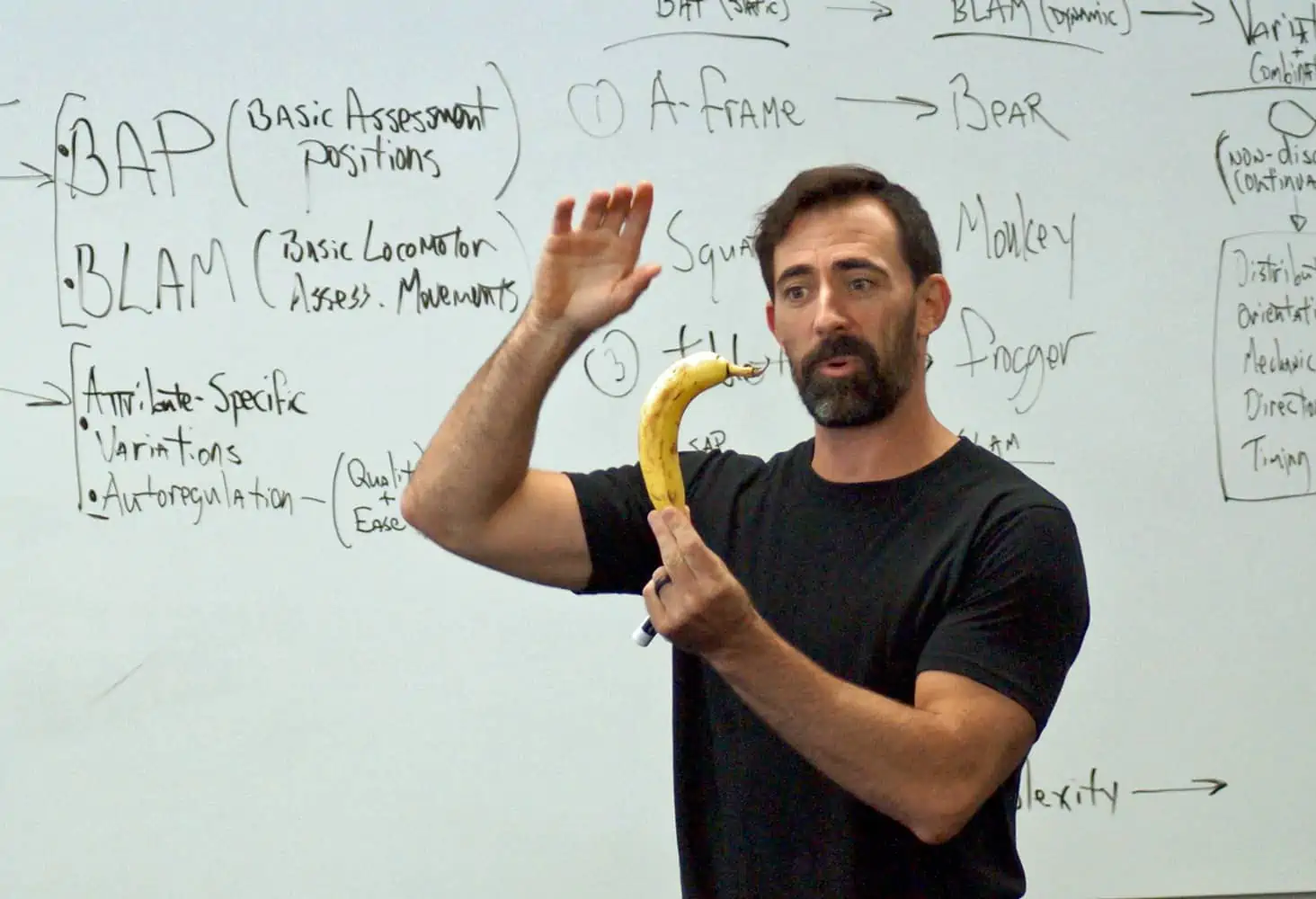
Elements is the home program. It builds your base of strength, mobility, and control, and it teaches you the method itself, the ratings, the autoregulation, the whole loop, while you train.
Four Capacities, Four Clocks
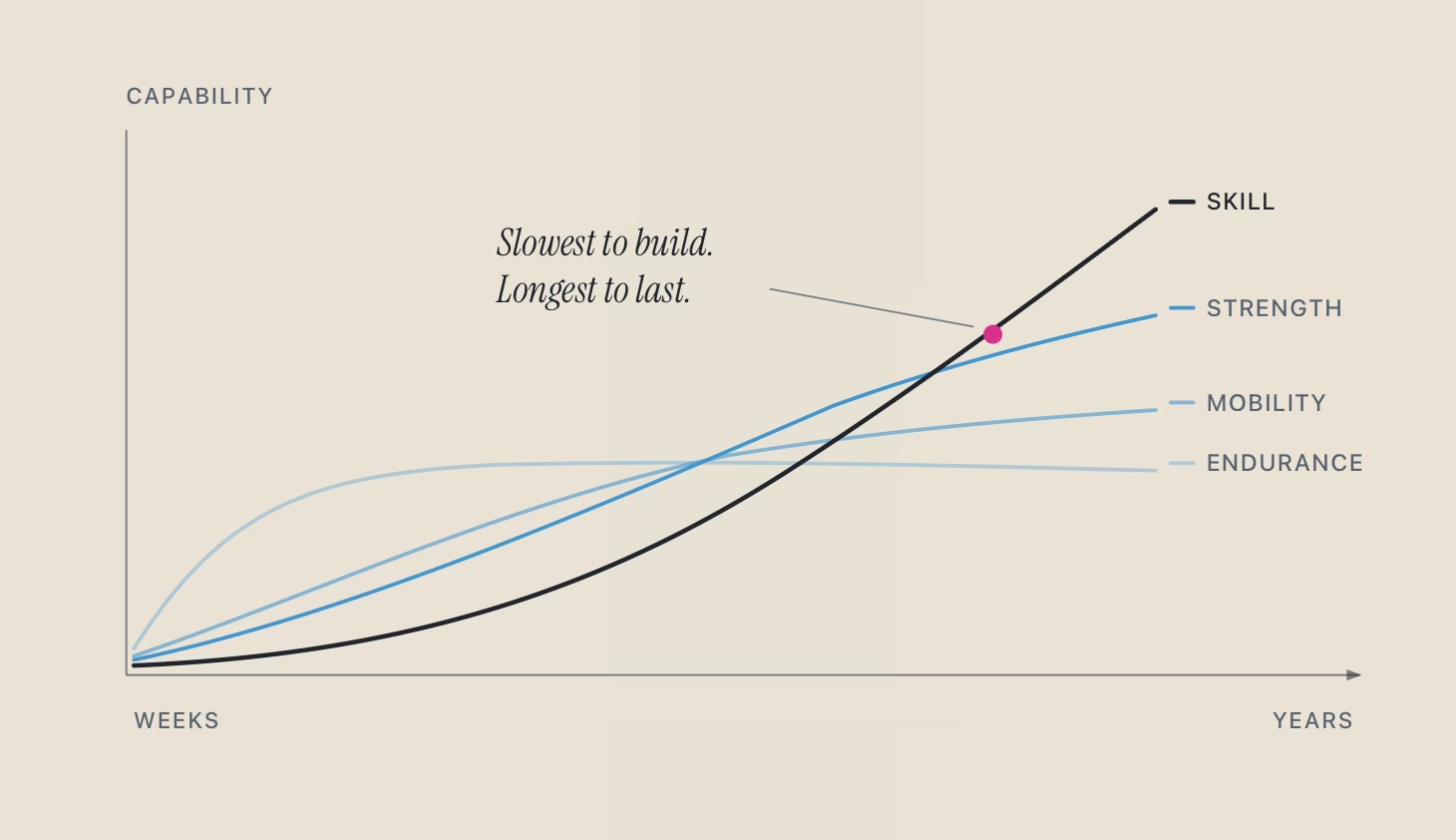
Your body does not adapt all at once. Different capacities build and fade on different clocks, and the method is paced around that fact.
Endurance comes fast and leaves fast without upkeep. Strength takes longer to build but holds for weeks and is cheap to maintain. Mobility needs consistent attention to keep. Skill is the slow one and the durable one: it takes many reps to develop, arguably slower than raw strength, and once it is grooved it stays with you for years. You cannot push all four at their fastest at the same time, which is exactly why training emphasis rotates instead of grinding everything flat.
The same timing gap explains most training injuries. Muscle and enthusiasm run ahead of what tendon and bone have had time to tolerate, and the space between them is where people get hurt. The method’s pacing, the timed sets, the cycle lengths, the wrist and joint preparation built into Elements, all exist to keep those clocks in sync.
None of this is our invention. Full-range training produces greater strength and size gains than partial-range work, which is why we load the deep positions instead of avoiding them (Pallarés et al., 2021). Varied practice, the kind that feels messier in the moment, produces better retention than clean repetition (Czyż et al., 2024). And the durability of skill is not a young person’s privilege: adults aged fifty to sixty-seven who learned to juggle over three months grew measurable gray matter in the movement-processing regions of the brain (Boyke et al., 2008). Capability compounds, and the brain that builds it stays plastic well past the age most programs write off.
Inside a Session: the 5Ps
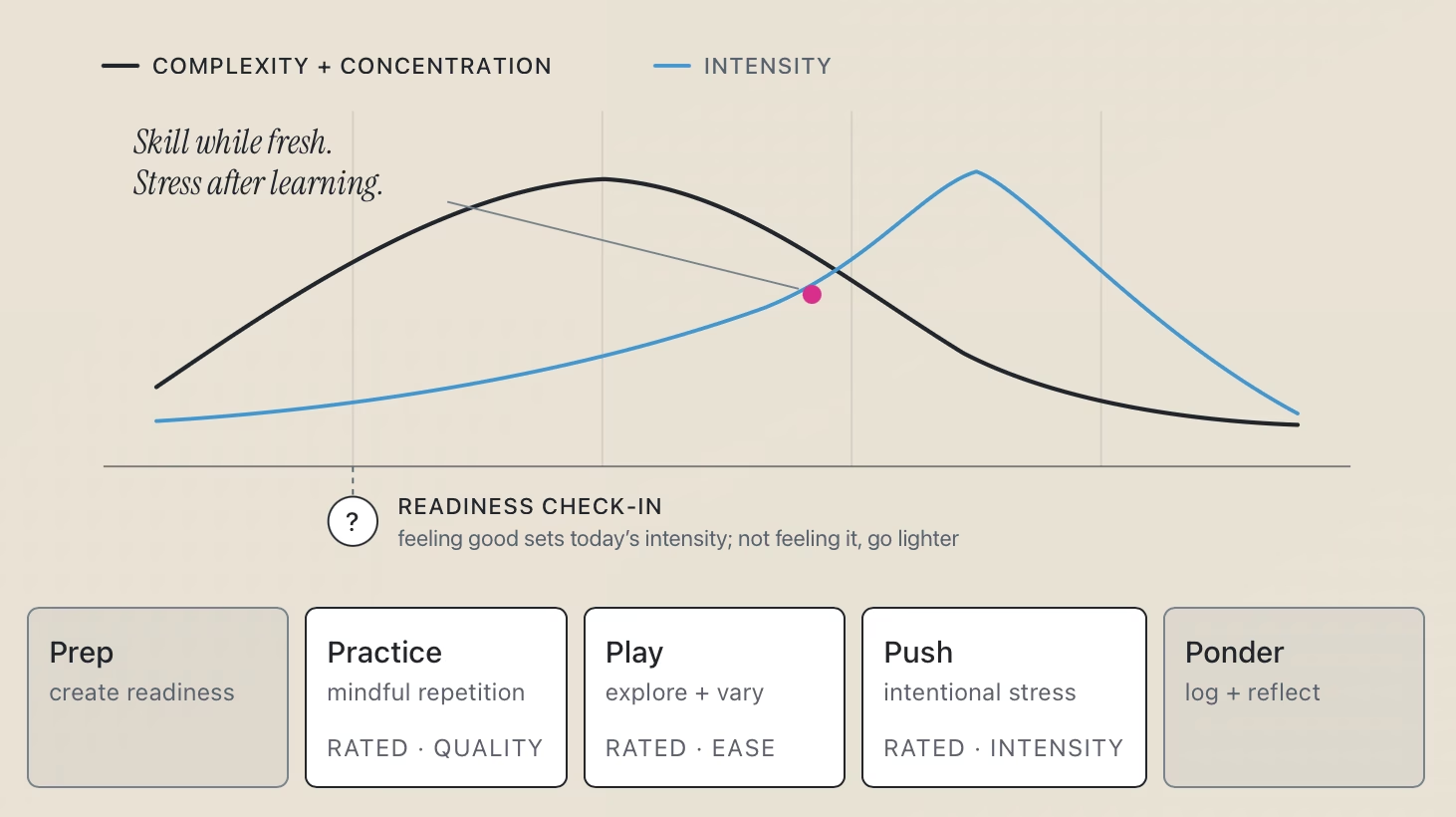
A session runs a deliberate gradient. Complexity and concentration climb early and fall off as you go, while intensity rises the other way. You do the thinking work while you are fresh and the hard work after the learning is done. Most programs run this backwards and put the heaviest effort first, when your attention is sharpest and least needed there.
Five phases, in order:
- Prep. Bring the joints and the nervous system online and set up the patterns for the day. You end Prep more capable of moving than when you started.
- Practice. Mindful, constrained repetition of the day’s movements with fresh attention. Rated for Quality.
- Play. Explore and vary the patterns, change direction, change tempo, let a little controlled chaos in. This is where the movement becomes yours. Rated for Ease.
- Push. Intentional stress on simplified patterns, applied after complexity has dropped so effort can rise while your technique holds. Rated for Density.
- Ponder. Close by picking the movement that challenged you most and the one where you felt the most control, tagging the session, and noting anything worth remembering. This is where the whole improvement loop gets its raw material.
There is one decision point built into every session. After Prep, you check in with yourself. Feeling good sends you into the full session. Not feeling it sends you to a lighter version. The plan bends to the day, every time.
Here is a full Elements session, start to finish, so you can see the gradient in practice:
The 5P-session flow is an elegant way to model a training structure across almost any method.
How You Know It’s Working
We rate sessions with words. The things worth tracking in skill work, whether your key points held, how much a movement cost you to coordinate, how hard you worked and how much you rested, do not survive being crushed into a score out of ten. A number invites you to inflate it. A label just describes where you are.
Three sets of labels, one for each working part of the session:

- Quality, after Practice (Clunky, Smooth, Snappy, Rough): how consistently you hit the movement’s key points.
- Ease, after Play (Relaxed, Natural, Mechanical, Cautious): the coordination cost of improvising.
- Density, after Push (Chill, Steady, Heavy, Intense): how hard you worked and how much rest you took.
Every label has a legitimate use. Clunky is what learning looks like early on. Chill is the right tool on a recovery day. Read across weeks, the labels start to show patterns: Quality holding while Ease falls points to accumulating fatigue, and Steady Density at Natural Ease is the signature of progress that lasts. Your felt experience is data. Giving it a vocabulary is what makes it usable.
Ponder adds the rest: your two movement picks, a few tags, and your notes, all sitting next to your labels in the session log. Here’s how Ponder works.
The Method Adapts to You
Two mechanisms make the whole thing responsive instead of rigid.
The first is autoregulation. Before and during training you gauge where you are and adjust scope, intensity, and complexity to match. Well recovered, you push the boundaries. Ordinary day, you run the plan. Under stress, you shrink to maintenance. Badly beat up, you drop to Prep and light practice, or you rest, and recovery counts as training. Timed sets bake this right into the program design: the prescription stays fixed while the density scales to your capacity, so the same session self-adjusts across a good day and a bad one. Your Density label records how that day went.
The second is guardrails. Every movement is defined by a small set of key points, the boundaries execution has to stay inside. Within those boundaries, you self-organize. Your limb lengths, your training history, and your own style produce real and legitimate variation, and the nervous system finds efficient solutions when you give it room to search. This is why we cue the outcome of a movement rather than micromanaging your body parts, an approach with deep support in the motor-learning literature: external focus produces better learning and more efficient movement than internal, body-part cuing (Chua et al., 2021). Rigid rep counts and constant correction get replaced by a standard that travels with you.
Ryan shows what that looks like when a real body gets in the way, working around old injuries and hardware without abandoning the movement:
“Genuine autoregulation is a real game changer. People take it as knowing when to back off, because the industry is always saying push harder. But it’s more than that. It’s knowing yourself well enough in the moment to know what you need to do to get where you want to go, and that self-knowledge goes way beyond building guns and buns.”
— Dillon Beyer, GMB Trainer
The Long Game: Blocks and Seasons
Zoom out from the session and the loop keeps running.
Between the session and the year, training moves in blocks. A focus block runs one core program toward one priority, usually six to twelve weeks, chosen against your current bottleneck. A shorter transition block shifts the emphasis between focus blocks, into exploration, targeted mobility, or recovery, without stopping the practice. Every block targets the single constraint that, addressed now, buys the most capability downstream. Train everything at once and the complexity itself becomes the obstacle.
Zoom out further and training moves through seasons. Each one names the purpose of your training right now.
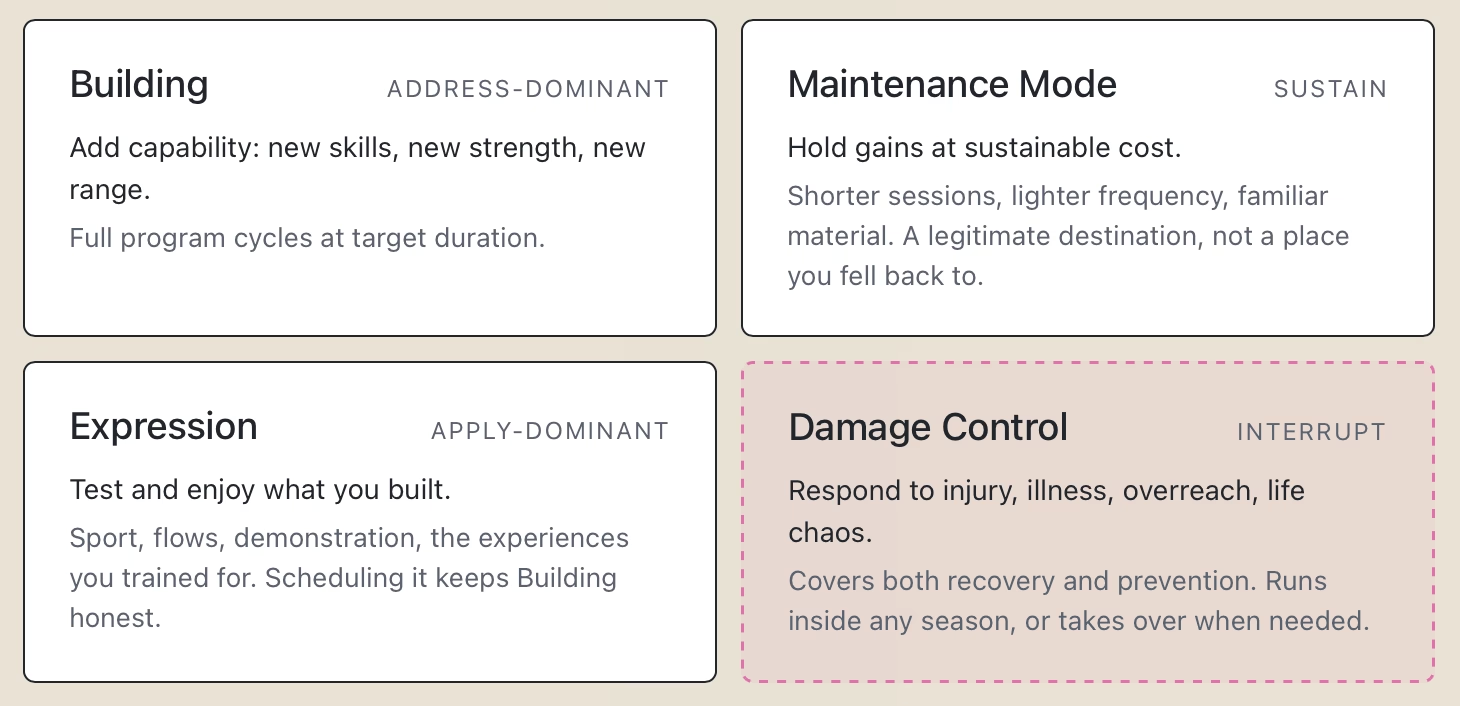
Building adds capability. Maintenance Mode holds your gains at a sustainable cost, which is a real destination and not a place you fell back to. Expression is where you test and enjoy what you built, and scheduling it is what keeps Building honest. Damage Control is the odd one out: a mode that responds to injury, illness, overreach, or plain life chaos, and it can run inside any season or take the whole thing over when it needs to. Most methods only know Building. Naming all four gives you language for decisions you were already making, usually badly.
The Curriculum: One Path, Cycled for Years
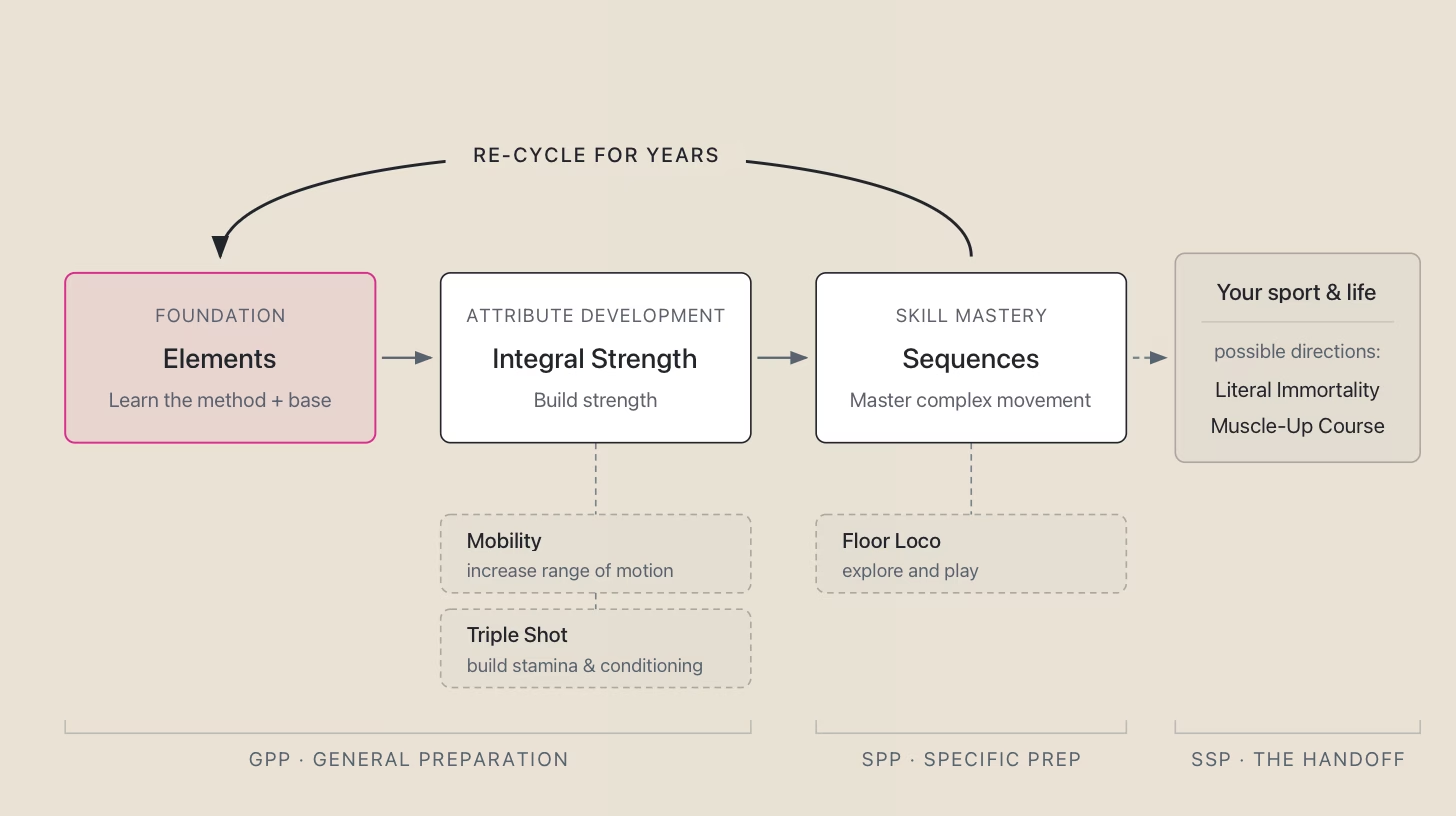
The programs are not a pile of products. They are a path.
The first pass runs the line: Elements for foundation, where you learn the method and build the base; Integral Strength for the strength attribute, with Mobility and Triple Shot alongside for range and conditioning; then Sequences for skill mastery, where the attributes get integrated into complex, reactive movement. That progression walks you from general physical preparation into skill that is specific to moving well.
Then it hands off. Past a certain point, the specific preparation belongs to you, to your sport, your pursuits, and the demands of your actual life. We build the base and the bridge. You own the destination.
Completion is a milestone, not the end. The long arc is rotation. Veterans cycle these programs across seasons for years, and the same program is a different tool in a different season. Elements in Maintenance Mode is not Elements in Building. Mobility on its sixth pass is not Mobility on its first. A program lasts weeks. The practice lasts as long as you do.
The Whole Method on One Grid
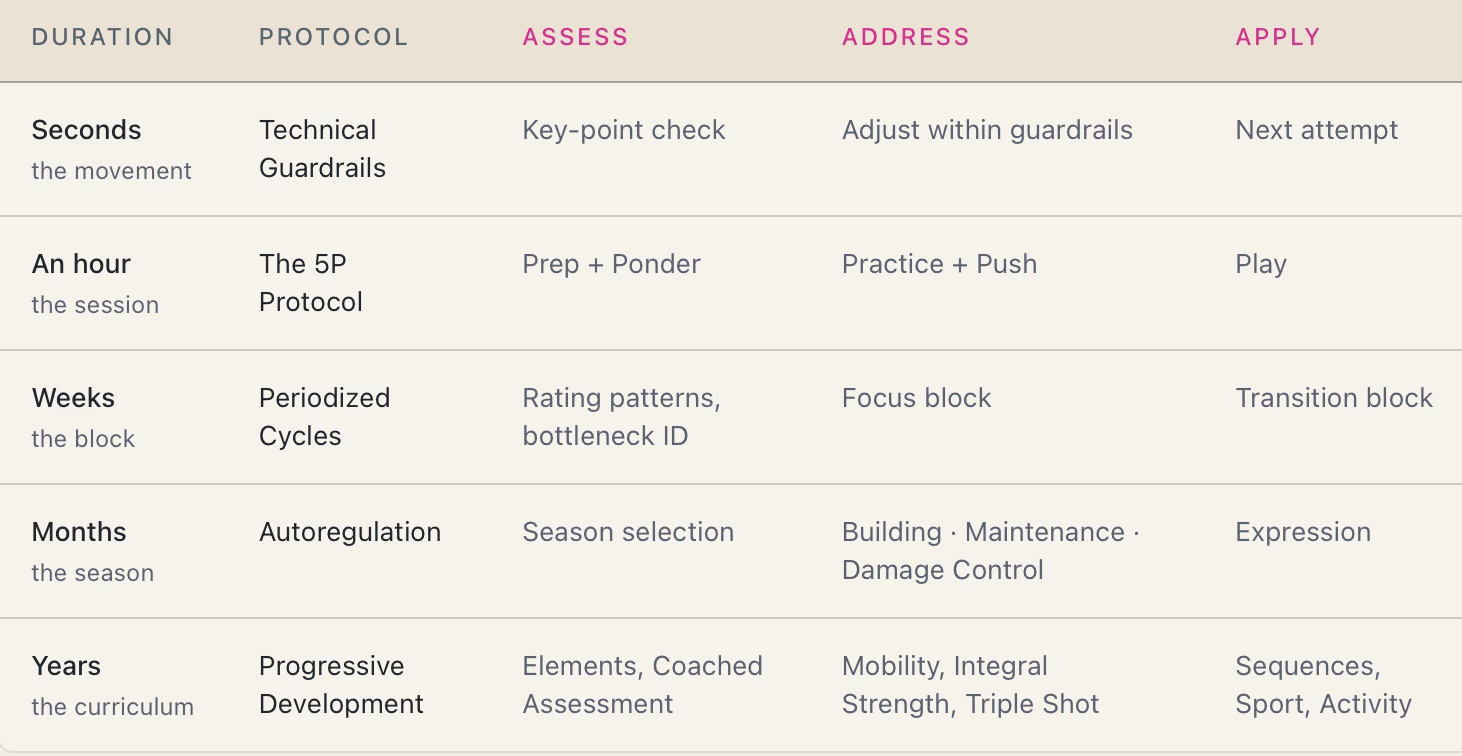
One loop, five scales, one page. Every cell feeds the ones above and below it. Your session notes aggregate into how you read a block. Block outcomes inform which season you choose. Seasons accumulate into the multi-year rotation. Learn the loop once, at any scale, and you have learned it everywhere.
Where This Comes From
This was not assembled in a marketing meeting. It is the distilled result of decades of coaching, a clinical practice, and a mountain of real training data.
Ryan Hurst has spent close to three decades coaching movement, most of it in Japan, with a background that runs from competitive gymnastics through Iaido and judo. Dr. Jarlo Ilano earned his post-professional Doctor of Physical Therapy in Musculoskeletal Management in 2026, adds his PT, DPT, and OCS credentials to the clinical side of the method, and has practiced martial arts for most of his life. Their coaching does not stop at our own walls: GMB’s work carries continuing-education recognition through MovNat, and coaches from many other methods have come to our seminars and used our programs.
Behind the individuals sits the evidence base most programs never accumulate. More than 129,000 people have trained with GMB. They have logged millions of sessions and had tens of thousands of coaching conversations with our team. The ratings, the pacing, the season logic, all of it has been pressure-tested against what happens when real adults with real lives try to get better over years, not weeks.