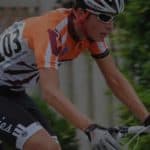
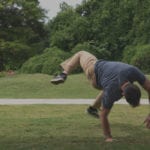
Vaidė (pronounced VIE-duh) could run a marathon. She could swim. She could cycle. What she couldn’t do was hang from a bar or balance on her hands without her wrists and shoulders shaking.
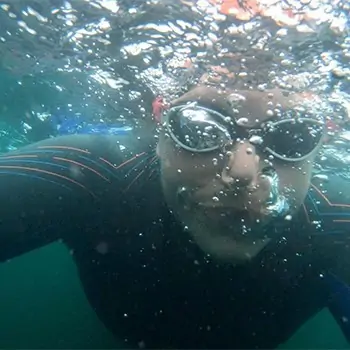 That’s the thing about sport-specific training. The more you focus on one discipline — putting your body through the same motions with the same loads, week after week — the deeper the gaps it leaves everywhere else. Those gaps show up as tightness, pain, and weak links that eventually start limiting the sport you love.
For Vaidė, triathlon training had built serious endurance. It had also left her with painful shoulders from swimming, unstable wrists, a fractured ankle that never fully recovered, and an upper body that couldn’t keep up with the rest of her.
After finishing her marathon, she said to herself: “I need something to actually fix these little things.”
That search led her to Elements. Here’s what happened.
How a Self-Described Sports Hater Became a Triathlete
Vaidė is originally from Lithuania and lives in the United Kingdom. For most of her life, she said she hated sports. “I always struggled with weight and I realized I want to be healthy, I want to be there for my children.”
So she started running. The first run was torture. Something clicked on the second one, and nine weeks later she finished a 5k. She added swimming and cycling, discovered she loved the combination, and eventually completed a full marathon.
But all that training highlighted what her body was missing.
“My wrists were weak. My shoulders were hurting from swimming. I had fractured an ankle, so that had problems,” she said. “And I knew my upper body was quite weak.”
She’d tried filling rest days with YouTube pilates videos. Same routine every time. Boring, and it wasn’t addressing the actual problems.
“Reading the Elements description where it says wrists, shoulders, lower back, hips, knees, and ankles, I thought, ‘I need everything.'”
Filling the Gaps That Triathlon Left Behind
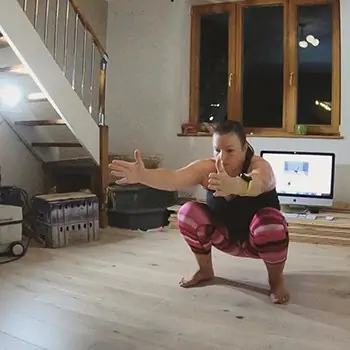 Vaidė started using Elements on her active recovery days — the days between triathlon sessions where her body needed work that wasn’t more swimming, cycling, or running.
This turned out to be a smart fit. Each Elements session works through targeted mobility and then progressive locomotor movement patterns that build strength, flexibility, and control through the areas that take the most abuse — shoulders, hips, back, wrists, ankles. Exactly the joints that repetitive sport training wears down.
“It just supplements all those little things that it’s so easy to neglect when you do repetitive sports, day in and day out,” she said.
She used Elements alongside physical therapy to address her specific problem areas. For her shoulders, her physio identified a strength imbalance — some rotator cuff muscles were strong, others were weak. “And it’s interesting that without really noticing, I think what Elements is doing is actually strengthening all the little muscles there.”
For her wrists: “I know my wrists are stronger. I know some pains are gone. They don’t hurt that much now when I work on the computer with a mouse, for example.”
For her ankles: “When it comes to running, it’s the ankle flexibility that I need to work on because of my fracture and over-pronation problem. So I know it helps me with all the deep squats and bear walks.”
“Elements just supplements all those little things that it’s so easy to neglect when you do repetitive sports, day in and day out.”
From Shaky Wrists to a Crow Pose
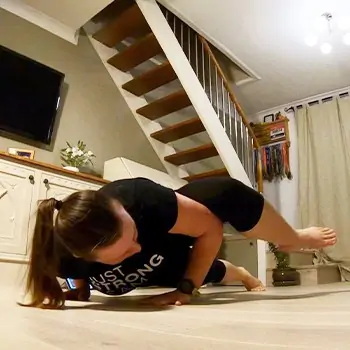 The pain relief and joint health improvements were the goal Vaidė came in with. The strength gains caught her off guard.
Early in Elements, even basic variations of movements like Bear and Frogger were hard. “One of my notes was, ‘I can barely lift my legs off when I do the Frogger,'” she said. Running the program a second time, she noticed those same movements felt manageable. “And I know probably doing the third or fourth time, it’s going to be even easier on the things that I struggle with now.”
Here’s how she describes it:
But the clearest measure of her progress was the crow pose.
“The very first time I couldn’t even lift my feet off the floor. My head’s on the pillow. My shoulders were so shaky and my wrists were so unstable. I couldn’t even balance at all.”
Fast forward a couple of months: she held it for 10 seconds.
“Looking back at that video I see my shoulders are not that shaky, my wrists are more stable. That stability, that strength — that’s the biggest thing for me. Especially for my upper body, which was totally weak before.”
What Changed Beyond the Numbers
The joint health and the crow pose are measurable. The thing that mattered most to Vaidė isn’t.
“The confidence that I can actually do things and even I can set little goals or bigger goals. Like I’d love to do a pull-up one day. A couple of years ago I couldn’t even hang on the bar. My wrists were that weak. I can hang on the bar now. And obviously the pull-up is far on the horizon, but I know it is possible. So the confidence that it gives me, I think that’s important.”
That shift — from “my upper body can’t do this” to “it’s far away but I know it’s possible” — is what progressive training actually builds. Each session proves your body can do slightly more than it could last time. String enough of those together and you stop thinking in terms of limitations.
“When it comes to my kids, they see all this and I know that inspires them too,” she said. “I’ve always said to people, if I can do this then you can do it too. Because all my life I said I hated sports and look at me now. I’m actually enjoying it.”
“It’s not always like you’re trying to do the perfect, the unachievable. You actually see we are all in this together. All people of different shapes, of different flexibility, with different pains — they can do this.”
Build the Movement Capability You Actually Need
Elements builds strength, mobility, and body control together through progressive locomotor training — wherever you’re starting from.
Hi, I'm Andy Fossett 👋
A lifelong martial artist and former schoolteacher, Andy’s deeply concerned with autonomy and fitness education. As CEO of GMB Fitness, he’s dedicated to providing an open, accessible culture for both clients and staff to enjoy exploring more of what they’re truly capable of.
He's best known for his wildly off-topic rants on the GMB Podcast and spends the majority of his time eating burgers, sipping bourbon, and reading books.