A friend calls on Saturday morning and asks if you want to try the climbing gym. You say yes without running a mental inventory of your shoulders.
Your kid’s jiu-jitsu class needs a partner for a demo and you get down on the mat without thinking about how you’re going to get back up.
A trail you haven’t hiked in years sounds good, so you go, and your knees are fine on Monday.
That’s what GMB training produces. The kind of physical capability that shows up when you need it, across situations you didn’t specifically train for. Stronger joints, better range of motion, and the body control to actually use them in real life.
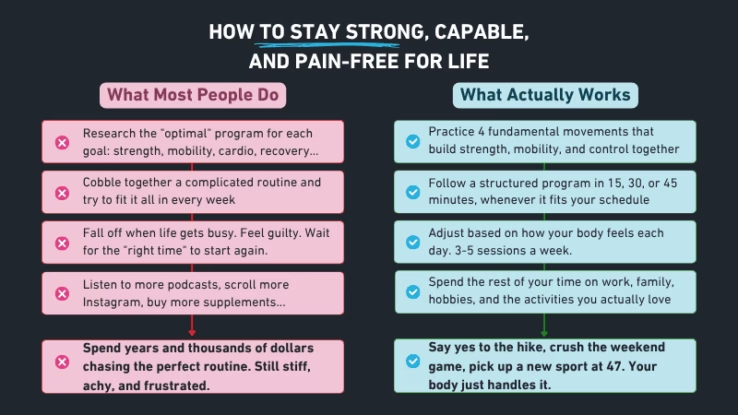
We’ve spent fifteen years building a progressive movement curriculum, refined through more than 125,000 clients, drawing from experience in physical therapy, martial arts, gymnastics, and yoga.
The programs are structured, the progressions are deliberate, and everything runs through a training platform called Praxis that tells you exactly what to do every session.
You bring 15 to 45 minutes and a patch of floor.
Most programs hand you a collection of exercises. Ours teach your body how to move.
A Curriculum, Not a Collection of Workouts
GMB programs follow a clear progression, and everyone starts at the same place.
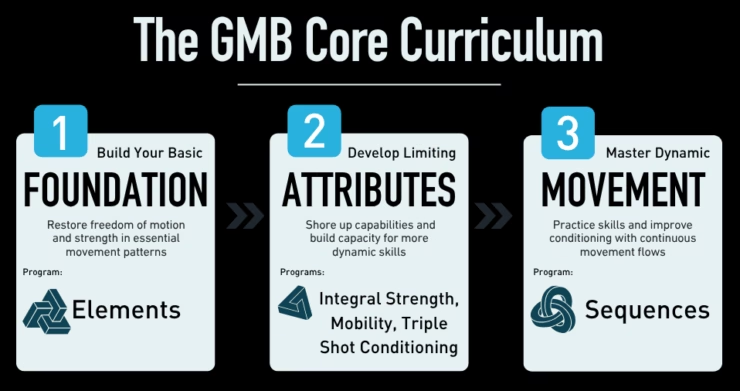
Foundation: Elements. This is where you build the base everything else depends on. Four locomotor movements that develop strength, mobility, and body control through your entire body. It scales to your level with three separate tracks (Gradual, General, and Accelerated), so it works whether you’re returning from a long layoff or you’ve been training for decades and want to address the gaps your current program is missing.
Attributes: Integral Strength, Mobility, and Triple Shot. Once the foundation is solid, these programs develop specific qualities. Practical calisthenics-based strength. Full-body flexibility that transfers to active movement. Conditioning and stamina. Take one, two, or all three depending on what your training needs.
Mastery: Sequences. Where everything comes together. Dynamic, fluid movement that combines the strength, mobility, and control you’ve built into continuous flow. This is the payoff of all the earlier work.
Programs like Resilience, Recovery, and Respiration are side dishes you can add alongside any main program when you want to address something specific. They complement the curriculum without complicating it.
The rest of this page is about Elements, because that’s where your first session happens.
What a GMB Session Actually Looks Like
You log in to Praxis from whatever device you have handy (phone, tablet, laptop). You choose your session length: 15, 30, or 45 minutes. You hit start.
That’s the setup. It takes about thirty seconds. Then the session walks you through five phases, in order.
1. Prep
Each session starts with targeted mobility work specific to whatever you’re practicing that day. Wrist circles, spinal rotations, squat prep. These prime the exact joints and ranges of motion you’re about to use. This is deliberate preparation, chosen to match the day’s movements. By the time you’re done, your body feels more ready to move than when you started.
2. Practice
This is the core of the session. You’re working on locomotor movements (in Elements: Bear, Monkey, Frogger, or Crab) with focused attention on how well you can execute them. A tutorial video shows the movement and its key cues. A timer gives you a set duration to work within.
You do a single rep as well as you can. You rest when you need to. You go again. You’re working for quality inside a time window, so you never have to chase a rep count or grind out ugly reps because a program told you to do twelve.
Every movement has scaling options. If something doesn’t feel right, you adjust it until it does. Hips lower on the Crab. Hands closer on the Bear. The program gives you the movement; you find the version of it that’s honest for your body today.
3. Play
You’ve practiced the movement. Now you experiment with it. What happens if you go slower? Faster? Lead with a different foot? Combine two movements you’ve already learned?
This might feel unfamiliar. Most fitness programs don’t include anything like it. But play is where the movement starts becoming yours. You stop replicating what you saw in the tutorial and start discovering how your body actually wants to do it. That’s where real body awareness and motor control get built.
4. Push
The part that feels most like a workout. You’re working with movements you’re already comfortable with, done at higher effort. Your heart rate goes up. You sweat. The key difference is that you’re pushing intensity on patterns your body already knows, so you can work hard without quality falling apart.
5. Ponder
The session ends with a quick reflection. You rate how the movements felt. Was the quality smooth or clunky? Did play feel natural or mechanical? How hard did you push? You log what you noticed. This takes a minute or two.
These ratings feed your next session. And over weeks of doing them, something more useful happens: you develop the ability to read your own body and make good decisions about when to push and when to back off. We call that autoregulation, and it’s the most transferable skill the program teaches. It applies to every physical thing you’ll do for the rest of your life.
That’s one session. Fifteen minutes, a patch of floor, and you’re done. Do it again tomorrow or the day after, and the compound effect starts building.
Here’s What’s Under the Hood
There’s a reason this structure works faster than what you’ve probably tried before. Three things are happening simultaneously, and they reinforce each other.
You’re building multiple capacities at once
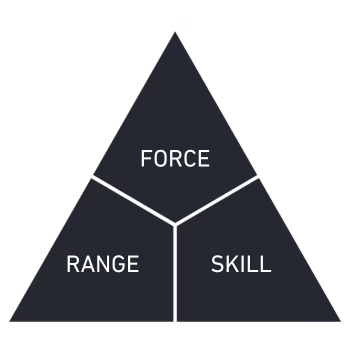 When you practice a complex movement like Bear or Crab, you’re training Force Generation (strength), Range of Motion (flexibility and mobility), and Skill (coordination and control) in context.
Your shoulders, hips, spine, and wrists are all working together under real-world load patterns. You’re building the raw materials (the physical attributes) and training your nervous system to actually use them in concert.
That’s why the results transfer to your sport, your hobby, and your Tuesday morning. The transfer is built into the practice.
Timed sets let you train at your actual level
A set of “do 12 reps” assumes every rep is equivalent. It isn’t. Rep seven and rep twelve are different movements in terms of quality, and most people spend the back half of a set reinforcing sloppy patterns.
Timed sets change the incentive. You have a window of time. Your job is to fill it with the best-quality movement you can produce, resting as needed. As you get stronger, you naturally do more high-quality reps in the same amount of time. Your training density increases without you having to manage it. The progression is automatic if you keep showing up.
The self-rating system trains your judgment, not just your body
The Ponder phase after each session isn’t journaling for fun. It builds a feedback loop between your body and your brain. Over weeks, you start to notice the difference between a day when you feel sluggish at the start but perform well once you’re warm, versus a day when you feel great but your movements are sloppy. Those are different situations that call for different decisions, and most programs treat them the same way: “just do the workout.”
Autoregulation means you train based on what’s actually happening, not what a spreadsheet says you should do.
Some days you push. Some days you cruise. Either way, you showed up and practiced, and consistency at a sustainable level beats sporadic intensity every time.
These three things work together. Skill-based movements build multiple capacities at once. Timed sets let you work at your real level. Autoregulation keeps you consistent without burning out. The compound effect over weeks and months is what produces the results.
Very Different Starting Points, Same Process
Gardner was already fit. His body was still falling apart.
 Gardner Burg had spent years as a competitive triathlete. Lean, strong, could outrun most people without trying. Under the surface, his body was sore all the time and breaking down from the repetitive demands of his sport.
He looked at the early Elements movements and thought they were too simple for someone at his level. This time, instead of jumping ahead, he slowed down and paid attention. A floating tabletop cue from week one turned out to be the key that later let him stick a tuck handstand for the first time. He went from a claustrophobic deep squat to controlled near-handstands in a matter of weeks, earning what one of our trainers called “silky smooth” movement.
Kamomi hadn’t really trained before. She started at 48.
 Kamomi spent thirty years as a graphic designer hunched over a computer. Aching shoulders, tight back, stiff neck. She’d never been athletic. She found Elements, started with 15-minute sessions in a one-bedroom New York apartment, and focused on finding the version of each movement that was honest for her body.
A little over a month in, the chronic shoulder and back pain she’d carried for decades had meaningfully reduced. She could deep squat comfortably for the first time in her life. She kept going, and at 50, she started training martial arts.
Gardner and Kamomi started from completely different places. One was a competitive athlete who thought the movements were too easy. The other had barely exercised and wasn’t sure she could start. They used the same process, and both built capability they didn’t think was available to them.
Build the Strength, Mobility, and Control Your Body Has Been Missing
Elements gives you a progressive, structured training practice you can do in 15 to 45 minutes, on your schedule, with nothing but a patch of floor. Lifetime access. Start wherever you are.