
A lot of us have been training for years and if you’re anything like me, you’ve had plenty of ups and downs along the way.
Stalled progress, nagging injuries, and more than a few false promises from online loudmouths.
But if we want to keep going and continue making progress, we have to settle into the fundamentals of good training and avoid getting sidetracked by either grand abstract theories or the promise of quick fixes.
It may be the information age but we don’t need even more info, we need a better way to make better choices.
Why Advice Without a Framework Fails
 If you spend any time scrolling through fitness online, you’ll start to notice it swings between two extremes.
On one end, you’ll hear big ideas about “optimal movement” and “holistic wellness.” They sound thoughtful and are wrapped in impressive language, but at your next workout it’s not always clear what you’re actually supposed to do with them.
At the other end, you’re hit with hyper-specific instructions and warnings.
“This exercise is dangerous!”
“The one mistake that’s holding you back!”
“Follow this exact protocol or you’re wasting your time!”
It’s loud, confident, and often fear-based. It’s also wrong.
Neither extreme helps you make good decisions. Big ideas don’t tell you how to adjust when your schedule shifts or something starts to feel off. And “one weird trick” advice ignores context; your history, your goals, and what you actually need right now.
Both approaches imply certainty yet what they don’t offer is real guidance. And without that, it’s easy to bounce from idea to idea, hoping the next one will finally be the answer.
What Most People Actually Need (and Don’t Have)
 When something falls flat, it’s usually not because the information itself is bad. It’s because there wasn’t a clear way to implement it. What’s missing for most people isn’t another program, exercise, or expert opinion. It’s a framework: a way to take information, weigh it against your situation, and decide what to do next.
A good framework gives you a process for making choices that will actually work for you.
At its simplest, that process looks something like this:
- Gather relevant information
- Decide what actually matters right now
- Take action
- Reassess and adjust
That last step is arguably the most important. You’ve probably heard of the saying “The only constant is change.” Our bodies change, schedules change, stress levels change. Life is change!
What worked six months ago might not be (and very likely isn’t) the right choice today.
It doesn’t mean you made a mistake, that’s just the nature of it all. Which is why we will always need a way to re-evaluate rather than starting over from scratch.
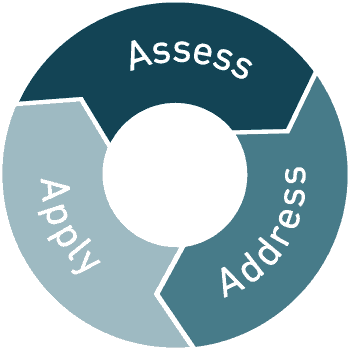
At GMB, this way of thinking has always been central to how we approach training. It’s at the heart of our Assess → Address → Apply model. That’s our framework for organizing your decision making. You assess what’s actually going on, address the most relevant gaps or limitations, and apply that work to real movement and real life.
The specifics may change from person to person, but the framework doesn’t. Once you have it down you’ll have an actionable process for evaluating all the info that’s thrown at you and be able to make better choices.
Podcast: Training Smarter, Not Louder with Dr. Jason Silvernail
 This article was partly inspired by my chat with Dr. Jason Silvernail for the GMB Podcast.
Listen as we discuss how using a framework plays out in real training decisions, long-term health, and life outside the gym.
Train for the Life You Want, Not the Identity You’re Holding On To
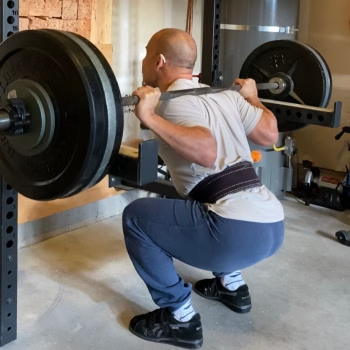
A heavily loaded squat is great, until your hips don’t feel too good the next morning
Jason shared a turning point that will feel familiar to anyone with some years of training under their belt. He’s tall, big-framed, and spent years building impressive barbell strength. It served him well, for work and for life, right up until it didn’t.
He started waking up with hip stiffness, a classic early sign that heavier loading was becoming less beneficial than it once had been. The issue wasn’t that strength training was wrong. It was that the application needed to change, and that it was no longer enough on its own.
Realizing that he couldn’t just keep going with what he was already good at, he placed more attention to the gaps that would matter not just now, but later in life. More time spent on mobility work that was practical, efficient, and carried over into the world outside of the gym.
The takeaway is simple: training shouldn’t be about protecting an identity. It’s done to build the capacities that support the life you want to keep living. Saying you want to “stay strong” isn’t enough.
You have to define what strong actually means for you right now, and understand that the definition changes over time.
That’s where a framework keeps you in the game:
- Assessment reveals the gaps
- Addressing them drives adaptation
- Applying that work to real movement keeps it relevant
A Framework Is How You Cut Through the Noise
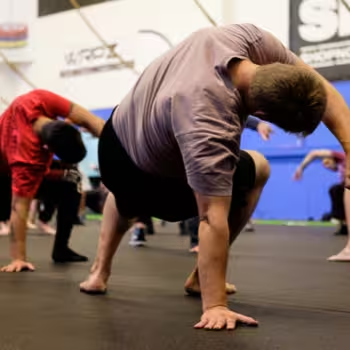 It’s very clear we don’t really have a fitness advice problem. You can’t swing a stick without hitting someone trying to tell you what to do. The real problem is actually figuring out what will be best for you.
There’s more information available than ever before, and that isn’t inherently bad. Different approaches will resonate with different people at different times. But not every new idea should treated as equally important, equally urgent, and equally applicable.
Without a framework, that’s exactly what happens. A framework gives you a filter. When new information comes along your first response won’t be “Is this right or wrong?”
You’ll be asking more useful questions:
- Does this address a real gap for me right now?
- Does it support the life I’m training for?
- Does it fit my current capacity, schedule, and stress level?
When you look at it through that lens, a lot of the noise fades away. This is also where a lot of frustration disappears because you’ll stop bouncing from method to method. Instead, you’ll make fewer, but better, choices and feel freer to adjust them as conditions change.
That’s what a good framework is for. You want a clarity of purpose, not complete certainty.
Train for the Long Game
 If we can give you one thing to take away from all this, it’s that you don’t need perfect information to train well. You need a way to make good choices over time. A framework helps you do that by giving a process for deciding what matters now, adapting when things change, and staying focused on the capacities that actually support your life. Start by answering these:
- What do I want my body to be able to do over the next 10 years?
- What’s the biggest gap getting in the way of that right now?
- What’s one change I can realistically sustain?
That’s how your training becomes a practice you can carry forward, no matter how your goals, body, or circumstances evolve.
A Practical Start
Apply this framework to your own training with Elements. It’s a clear structure that supports long-term capability; something you use not just for a few weeks, but for the rest of your training life.

Hi, I'm Jarlo Ilano PT, DPT 👋
Jarlo Ilano, PT, DPT, OCS has been a Physical Therapist since 1998. He earned his Doctorate of Physical Therapy in Musculoskeletal Management from Evidence In Motion, was board certified as an Orthopedic Clinical Specialist with the American Board of Physical Therapy Specialties, and is a certified Therapeutic Pain Specialist through EIM/Purdue University.
In addition to cofounding GMB, Jarlo has been teaching martial arts for over 30 years, with a primary focus on Filipino Martial Arts. He designed our Train Without Pain guide and our knee and shoulder restoration programs.