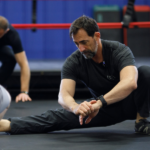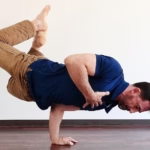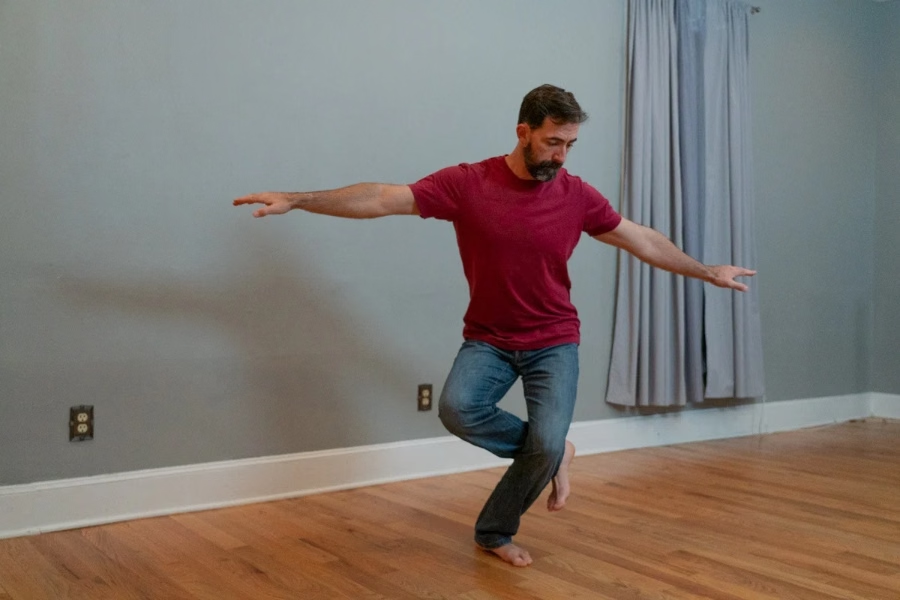

Nobody thinks about their balance until they suddenly lose it!
Balance is definitely a lot more than just being able to stand on one leg. Our stability happens through continuous small corrections, not holding your breath and gritting your teeth trying to stay as still as possible.
Think about the last time your foot caught a root on a trail run, or you hopped over something on the sidewalk and had to cut the other way immediately, or you simply stumbled walking up the stairs. You didn’t plan that recovery; it was too fast for conscious action.
Your body sensed the drift and corrected it before you had time to think. That constant losing and regaining of position is what we call “dynamic equilibrium.”
This isn’t something to start worrying about when you turn 65. Balance is the foundation for how hard you can pivot, land and react appropriately today.
Balance training may be an important tool for rehab, but it’s also an integral part of sports training used to improve athletic performance (especially power), and prospective studies have shown it helps prevent ankle and knee injuries.
📑 Taube et al. 2008, Spinal and supraspinal adaptations associated with balance training
And if you only remember one thing about what we’ll talk about here, it’s that this dynamic equilibrium is a skill that can be practiced and refined throughout your whole life.
- Balance isn’t one skill. It’s four separate ones, and being good at one doesn’t make you good at the others.
- You get better at the balance tasks you actually practice, so train each type directly.
- Keep the challenge just past comfortable, and change the task often.
- Balance training isn’t just for later in life. It supports how you perform today.
Try This First: A 3-Minute Balance Self-Test
Before we get into the research, test yourself. You’ll want a clear space and something sturdy nearby to grab if you need it.
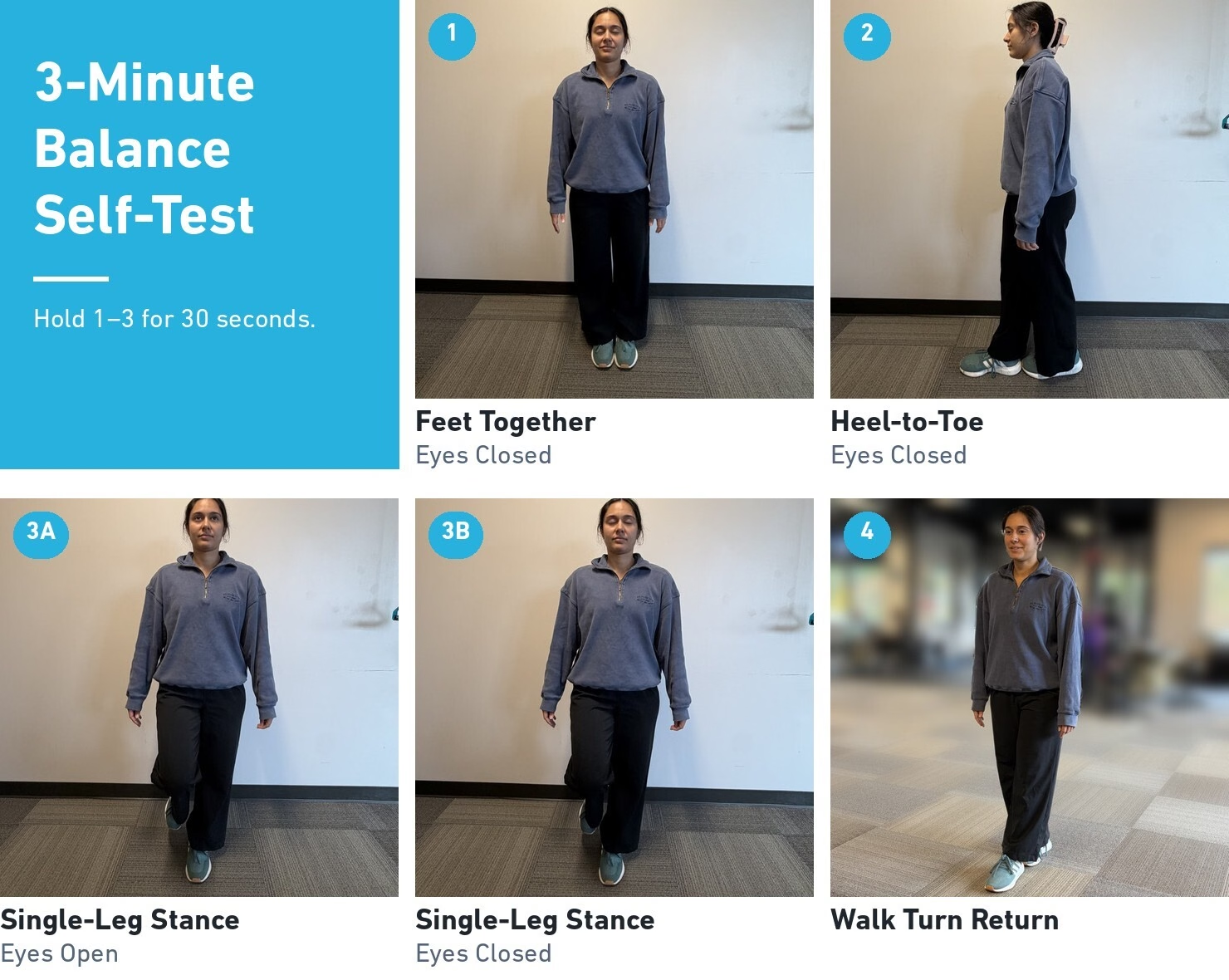
- Feet together, eyes closed: Stand with your feet touching, close your eyes and hold for 30 seconds.
- Heel-to-toe, eyes closed: Put one foot directly in front of the other, close your eyes and hold for 30 seconds.
- Single-leg stance: Stand on one leg for 30 seconds with your eyes open, then do it again with your eyes closed. Switch legs and repeat.
- Walk, turn, return: Walk heel-to-toe along a line for about 10 steps, turn 180°, and walk back.
Notice where you wobbled and where you felt solid, you might think one test is way too easy and another seems impossible. This is just a benchmark to see where you’re at now and what you need to work on the most.
Balance Isn’t One Skill
Most of us picture balance as one thing you either have or you don’t. Researchers who study postural control break it into four types, and each one shows up differently in training and daily life:
- Static steady-state: This is simply holding still. Standing on one leg to pull on a sock, or standing on a moving bus without grabbing the rail.
- Dynamic steady-state: This is keeping steady while you’re moving around. Running a trail over rocks and dirt mounds, or carrying a kid on your shoulders on a hike.
- Proactive: This is adjusting ahead of something you can see coming. Planting and cutting on a court, or hopping across rocks on a creek crossing.
- Reactive: This is recovering from a disturbance you didn’t see coming. Getting bumped going up for a rebound, a training partner off-balancing you on the mat, or your foot rolling on uneven ground mid-run.
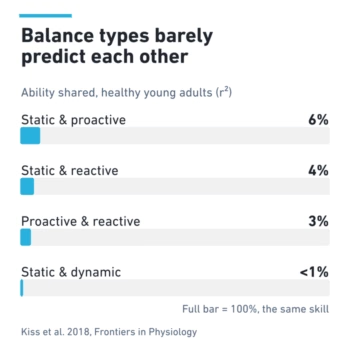 They are all a part of being able to balance, but unfortunately being good at one doesn’t automatically mean being good at another.
A 2018 meta-analysis pooled 26 studies of healthy people from age 6 up and found only weak to modest correlations between the balance types. Static and reactive balance had a poor correlation; how steady you stand explains only about 4% of how well you recover from a push.
The authors concluded that balance looks task-specific rather than a general ability.
📑 Kiss et al. 2018, Associations between types of balance performance across the lifespan
You can be better at one than the other. And they won’t improve unless you train them specifically.
You need to do a bunch of things!
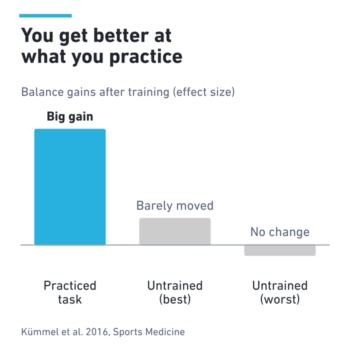 When balance training studies tested both the task people practiced and tasks they didn’t, the practiced task improved a lot, and the untrained tasks barely moved. That makes sense: you get better at what you practice.
But in one study, even very similar tasks didn’t improve after two weeks of training.
📑 Kümmel et al. 2016, Specificity of balance training in healthy individuals
📑 Giboin et al. 2015, Task-specificity of balance training
And take note of who was in these studies: healthy people, not patients. You’ll also notice some studies further down were done in older adults. That’s just the nature of balance research, but the principles hold at any age, and I’ll point out when a finding is age-specific.
This applies to you whether you’re 25 or 65, sedentary or training hard. We all benefit from good, structured balance work.
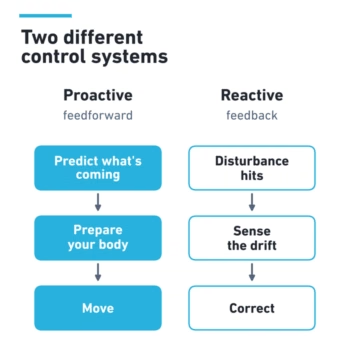 There’s a good reason balance is so specific. Proactive balance runs largely on feedforward control: your nervous system predicts the disturbance and prepares for it.
Reactive balance runs on feedback: you sense the disturbance after it happens and then correct it.
So a good single-leg stance tells you little about how you’ll handle a slip or a shove. You need to change the variables up to gain real, practical dynamic balance.
What That Means for Your Training
If balance were one general ability, you could pick a single drill, do it a lot, and call it done. It isn’t, so that approach leaves big gaps.
Don’t leave anything on the table; no type of balance substitutes for another. Standing practice won’t build your balance on the move, and neither one prepares you for a shove. Give each type a steady dose of work and you’ll be better off.
Train a Little Harder Than You Need
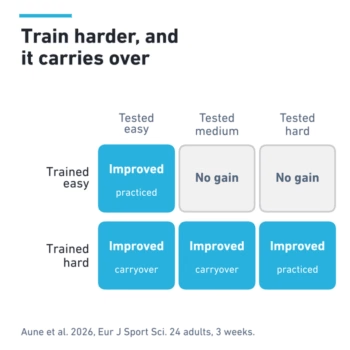 A 2026 study had people train on either an easy or a hard balance board, then tested everyone on easy, medium and hard boards.
Both groups got better at the board they practiced on, but only the hard-board group also improved on the easier boards; the easy-board group didn’t get better at harder ones.
You have to challenge yourself to improve!
📑 Aune et al. 2026, Balance training and the overload principle
It’s just one short study on one device, but it fits what any good coach knows: if you only practice what’s comfortable, you only get good at being comfortable.
Keep Changing the Task
This one was great, and it’s something we’ve talked about in our motor learning article. A 2024 meta-analysis found that people improved most of their skill on a given balance task within the first one to three sessions, then leveled off. More reps of the same drill gave diminishing returns.
📑 Bakker et al. 2024, Neural correlates of balance skill learning
So progress comes from new challenges, not from rehashing the old ones. Change positions, add a turn, add a reach, take away a support.
In other words, you need to play to get better!
Make It Look Like Real Life
Transfer depends on how similar the trained task is to the one you care about.
If you want to stay steady landing off a box, catching a throw mid-stride or changing direction on a trail, practice moving and reaching while your weight shifts, not just standing still on a wobbly pad.
How to Train Each Type (and the Skills That Use Them)
Get started with understanding and training the four types. Then there are the everyday skills that combine them: turning, landing, getting up and down from the floor, moving your head, and balancing on your hands.
Here’s how to train each one, and what the research says about why you should care.
Static and Dynamic Steady-State
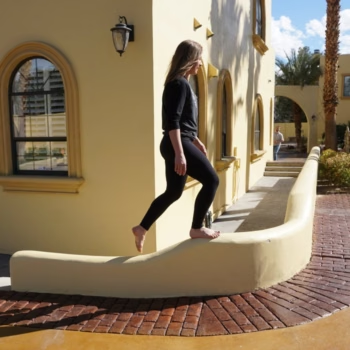 What to practice: single-leg stances and scales for holding still; heel-to-toe, cross-step, walking backward and sideways for staying steady while moving.
Balance training improves both. Because they’re separate skills, train them separately rather than assuming one covers the other.
It protects you, too. In a randomized trial of 765 high school soccer and basketball players, the group that did a balance program had fewer ankle sprains than the group doing standard conditioning (6.1% vs 9.9%). The benefit was clearest for players who’d already rolled an ankle; for them, the program cut the risk roughly in half.
Proactive Balance
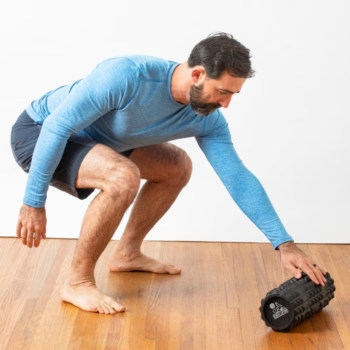 What to practice: reaches from a single-leg stance or a squat, step-downs, single-leg squat variations like the shrimp and skater squat, and side-to-side squats like the Cossack.
You are shifting your weight on purpose and working to stay organized while you do it. That’s what lets you plant hard and change direction, or reach for a ball without losing your base.
It had the biggest training effect of any balance type in a meta-analysis of healthy older adults.
📑 Lesinski et al. 2015, Effects of balance training in healthy older adults
Reactive Balance
What to practice: anything with a partner or unpredictability, like light nudges, lean and release, sparring and pickup games. Solo training can’t fully cover this one, so it gets its own section below: Adding In Partner Work.
Turning
What to practice: walking into 90°, 180° and full 360° turns, cross-stepping into a turn, and heel-to-toe walking with a turn at the end.
We have to be able to turn quickly and confidently in any sport: cutting on a court, pivoting on a trail, spinning to field a ball. Your body has to swing its center of mass around a base of support that’s changing underneath it.
It’s obvious when you watch any game: simply being able to turn and change direction when you need to is a skill!
And it’s trainable. In a randomized trial, adults over 50 who had trouble turning did a home program that included specific turning exercises. After 16 weeks they turned faster and with less sway, and improved on the Timed Up and Go test.
📑 Ashari et al. 2016, Home-based exercise on turning and balance performance
It pays off for the long haul too. In one case-control study of older adults, falls that happened while turning carried much higher odds of a hip fracture, roughly eight times, than falls while walking straight.
📑 Cumming & Klineberg 1994, Fall frequency and characteristics and the risk of hip fractures
Landing and Deceleration
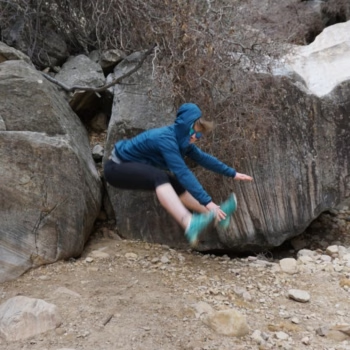 What to practice: jumps and hops to a stuck landing, starting on two feet, then one foot, then adding a rotation.
A meta-analysis of plyometric training found it improved balance about as much as dedicated balance training did. The likely reason is that every landing forces your body to set itself up before you touch down; it’s a textbook example of proactive balance.
📑 Ramachandran et al. 2021, Plyometric jump training and balance performance
What I found really interesting is that the athletes had the biggest balance gains. The non-athletes still improved, just less. The authors pointed to athletes’ training history and better body control, and most participants were under 30.
My guess is that athletes could also perform the drills more intensely. Don’t take this to mean you have to train as hard as possible to make gains!
The difference in results matches what we’ve always taught with autoregulation: don’t try to force gains. Adjust jumping (and every exercise) to where you are now and you’ll improve with less frustration and injury.
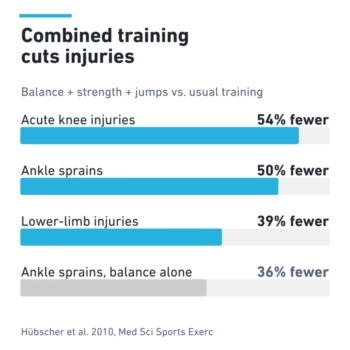 Combining jumps with balance and strength work matters too.
A systematic review of athletes in cutting and pivoting sports found that programs mixing balance, strength and jumping cut lower-limb injuries by about 40%, and acute knee injuries and ankle sprains by about half. Balance training on its own reduced ankle sprains by about a third.
📑 Hübscher et al. 2010, Neuromuscular training for sports injury prevention
Strength is a big part of balance, so don’t neglect it.
Floor Transitions and Falling
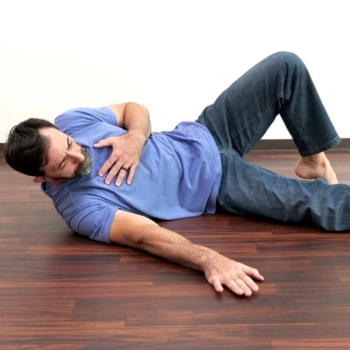 What to practice: getting down to the floor and back up in as many ways as you can: half-kneeling, kneeling, cross-legged, shin box and sit-throughs to standing, plus forward and backward shoulder rolls.
Getting down and back up fast is a performance skill. Ask anyone who grapples, plays a field sport, or spends an afternoon on the floor with their kids.
And when you do fall, knowing how best to manage it is very important. A meta-analysis of safe landing strategies found that martial arts-style rolling produced the largest reduction in impact during sideways falls.
📑 Moon & Sosnoff 2017, Safe landing strategies during a fall
Deeper Reading
👉 How to Fall Safely: the basics of landing and rolling so a fall doesn’t become an injury.
👉 How to Live Forever: why floor work and fall skills matter so much for long-term health.
Head Turns
What to practice: walking while turning your head side to side, and holding single-leg stances or scales while you turn your head.
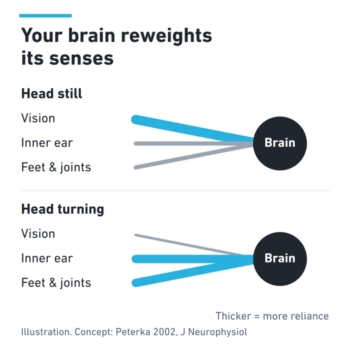 These exercises don’t have a lot of specific research behind them; I’m recommending them based on experience and biological reasoning. When you turn your head, you lose a stable visual horizon.
Your balance has to depend more on your inner ear and on what your body feels through your feet and joints. Your nervous system doesn’t rely on any single sense. It constantly reweights visual, vestibular and proprioceptive input depending on which one is most reliable at the moment.
📑 Peterka 2002, Sensorimotor integration in human postural control
The goal here is for your balance not to fall apart when your head is moving around and there isn’t a steady horizon: clocking a defender while you dribble to the basket, checking your surroundings on a bike ride, or simply looking both ways while you jog across the street.
Hand Balancing
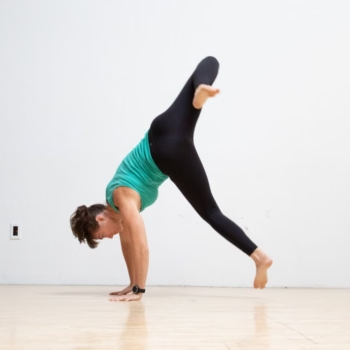 What to practice: crow, tripod and side plank variations.
Don’t forget your hands, either. Hand balancing hasn’t been studied directly for balance outcomes, but balancing on your hands is its own skill, and specificity says the only way to get it is to practice it.
It also works your upper body and core. It’s good for you and it’s fun!
Quick Reference
| Balance type | What it looks like | Try this |
|---|---|---|
| Static steady-state | Pulling on a sock while standing on one leg | Single-leg stance, scales |
| Dynamic steady-state | Running a trail over roots and rocks | Heel-to-toe and backward walks |
| Proactive | Planting and cutting on a court | Single-leg reaches, Cossack squats |
| Reactive | Getting bumped going up for a rebound | Partner nudges, lean and release |
| Turning | Pivoting to field a ball | Walk into 180° and 360° turns |
| Landing | Sticking a jump and changing direction | Hops and jumps to a stuck landing |
| Floor transitions | Getting up fast after a scramble | Shin box to standing, shoulder rolls |
Try These To See What It’s All About
https://www.youtube.com/watch?v=gPJ-DqTkd7M
In this video, Karli, a BJJ blue belt, and Jason, a strength and conditioning coach, take the eyes-closed single-leg test from the top of this article. Then Ryan walks you through three moves that each train a different kind of balance, so you can feel which one you’re missing.
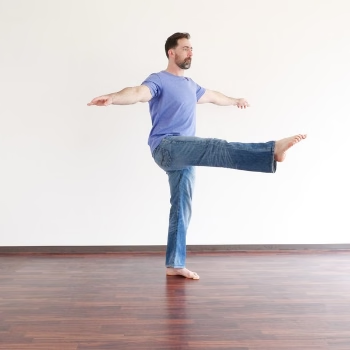
Single-leg scale
static steady-state
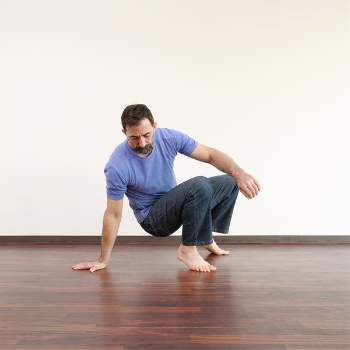
Level-change transition
floor transitions
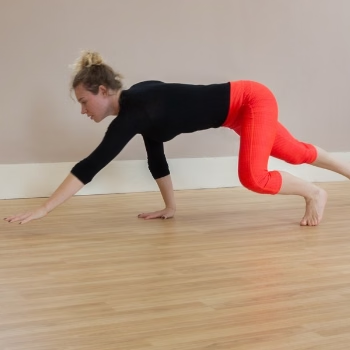
Jaguar
dynamic and proactive
Coming Soon: Equilibrium
Launching during Black Friday, Equilibrium puts every type of balance into one progressive plan, with the progressions built in so you always know what to do next. It’s designed to train on your own, at home, on your schedule.
How Much, and How to Progress
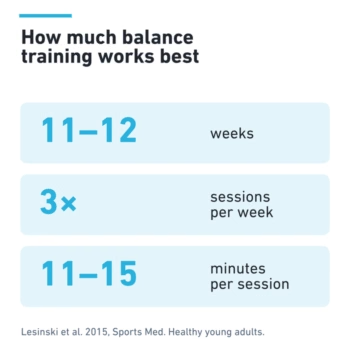 How much do you need? A meta-analysis of balance training in healthy young adults found the best results came from programs running 11 to 12 weeks, about three sessions per week.
The sessions don’t have to be long, either: the most effective ones in that analysis ran only about 11 to 15 minutes. Those sessions were likely that short because most of that training was added onto athletes’ regular workouts, which fits well with how we’ve always built balance work into our Praxis sessions.
Plan on a few months of consistent work, not a few weeks.
📑 Lesinski et al. 2015, Dose-response relationships of balance training in healthy young adults
As you go, keep raising the challenge:
- Add head turns to your walks and single-leg work.
- Add reaches to your squats.
- Grow your turns from 90° to 180° to a full 360°.
- Move from hopping on two legs, to one leg, to rotating as you land.
Each change keeps you just past comfortable and gives your nervous system a new problem to solve instead of letting it get complacent.
Every few weeks, retake the self-test from the top of this article. It’s a nice way to track progress on those specific tasks, but remember that specificity cuts both ways, and no single test can tell you everything.
Adding In Partner Work
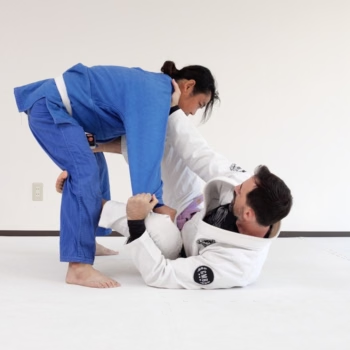 There’s one type of balance solo training can’t fully cover, and I want to discuss it so you’re aware right away. Most solo balance work is movement you start yourself. You choose when to reach, when to turn, when to jump.
That builds proactive balance incredibly well, but it doesn’t train your reaction to something you didn’t see coming, like a shove, a slip or a misstep off a curb.
One thing that you’ll need to do when you can is play some games with your friends! This is why activities like martial arts, dance, contact sports and just plain horsing around are so useful for your balance. Reactive training requires randomness and unpredictability to help you.
Being steady doesn’t get you there on its own. Two studies of older adults found that how still someone could stand didn’t predict how well they recovered from a real loss of balance.
📑 Owings et al. 2000
📑 Mackey & Robinovitch 2005
Reactive balance does respond to training, though. Programs that repeatedly and safely throw people off balance, called perturbation-based training, reduced falls in older adults and people with Parkinson’s disease. Participants were less likely to fall, and fell about half as often as controls.
Those studies focused on fall risk, but it’s the same principle that makes sparring, scrimmaging and pickup games such good reactive training for younger, active people.
📑 Mansfield et al. 2015, Does perturbation-based balance training prevent falls?
A couple of simple partner drills to start with:
- Unexpected nudges: Stand in a stable stance while a partner gives light, unannounced pushes from different directions. Start gentle and stay in a clear space.
- Lean and release: Lean forward against your partner’s hands until you’d fall without them, and have them let go without warning so you have to step to catch yourself. Researchers use a version of this, the tether-release test, to measure reactive balance in the lab.
Same principle as before: reactive balance is its own skill, so it needs its own practice.
What the Research Can’t Tell Us Yet
Balance research is useful, but there’s still a lot we don’t know. We don’t fully know the mechanism. Balance training clearly changes the nervous system, but a 2024 meta-analysis found those neural changes don’t line up well with the actual gains in skill. Something is changing; we just can’t point to exactly what yet.
As I mentioned earlier, a lot of this research is on older adults or young athletes. If you’re somewhere in between, the principles still apply, but the exact numbers might not match up. I’d argue this matters less than you may think; it’s the principles, not the specific percentages, that count.
Many balance training trials are small, which is why the meta-analyses (which pool many studies) here are helpful.
Nobody has found a shortcut to general balance, and even well-varied training hasn’t been shown to produce one all-purpose balance ability. Which is exactly why we recommend you spend good time on drills for every type.
Practice the Correction
Balance isn’t standing still. It’s constant shifting and reacting in the background of your movement, thousands of times a day. That’s dynamic equilibrium, and like any skill, you can get better at it at any age.
It’s what lets you pivot, land and react with confidence today, and it’s what will keep you moving well for decades.
The research is pretty clear: train every type of balance directly, keep the challenge just past comfortable, change the task often, and make it look like the life you actually live.
If you want a structured way to put all of this into practice, that’s what we built Equilibrium to do.
🔜 Equilibrium: Balance You Can Train
We’re just about to release our newest GMB program – which takes everything in this article and turns it into a simple, flexible balance practice you can fit around your regular training.
Sign up to get first dibs before Black Friday:
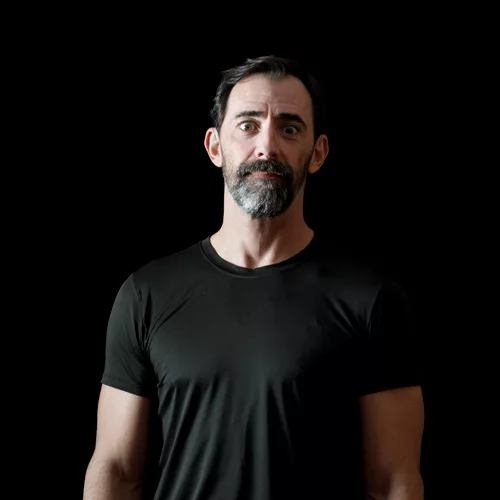
Ryan is in a dark place, prepping our new program for Black Friday 🙁

Hi, I'm Jarlo Ilano PT, DPT 👋
Jarlo Ilano, PT, DPT has been a Physical Therapist since 1998. He earned his Master of Physical Therapy from the University of Puget Sound and his Doctorate of Physical Therapy in Musculoskeletal Management from Evidence In Motion Institutes of Health Professions, was board certified as an Orthopedic Clinical Specialist with the American Board of Physical Therapy Specialties, and is a certified Therapeutic Pain Specialist through EIM/Purdue University.
In addition to cofounding GMB, Jarlo has been teaching martial arts for over 30 years, with a primary focus on Filipino Martial Arts. He designed our Train Without Pain guide and our knee and shoulder restoration programs.