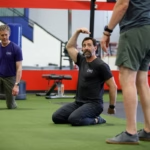
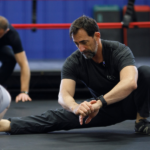
I’ve treated thousands of patients with back pain. The ones who get better have one thing in common: they started moving their whole body again — carefully, progressively, and with intention.
It might feel like it, though. Especially if you’ve been dealing with it for a long time, trying all the usual routes; medications, creams, heat, ice, braces, a few stretches and maybe even some core strength work.
Your doctors say your scans are “normal”, or that there’s “deterioration”, but whether it’s one or the other it doesn’t matter, because you’re still hurting.
So you start adjusting. Move less. Try to avoid the stuff that sets it off. Or just brace for it until you feel so stiff you can barely move even when you want to.
But here’s what we’ve seen and heard from our clients:
Back pain can change, especially when you shift your focus away from trying to fix the pain itself, and toward moving your whole body with more intention, more connection, and more control.
We’ve helped thousands of people get out of that cycle by helping them build the kind of strength, mobility, and coordination that makes their nervous system feel safe again. Strong, capable, and no longer stuck.
Eager to get started? Skip to my exercise recommendations.
Why Most Back Pain Solutions Fall Short
It may be surprising, but with all the specialized products and treatments out there, there’s nothing that has been proven to reduce or prevent back pain better than:
1. Letting time pass.
2. Moving your body.
And that movement doesn’t have to be complicated or hyper-specialized. In fact, full-body movement at an appropriate intensity and range works just as well as specific back-focused drills.
What matters most is the consistency of well-paced, progressive movement and how it retrains your nervous system. Successful exposure to movement — gradually increasing in load, variety, and challenge — teaches your body that those movements are safe.
That’s the foundation of what we teach. And it’s why we hear from so many clients who find their back pain reduced (or gone entirely) — they started moving in ways their body could trust again.
Your Nervous System Is Probably Overreacting (and That’s Normal)
 Let’s talk about why the pain might still be there even when nothing seems “wrong.”
Pain can absolutely come from trauma or damage: car accidents, falls, sudden strain. For most people, that kind of pain settles down significantly within a couple of months.
But in about 30% of cases, the pain lingers or keeps coming back even after the tissues have healed. In these cases, it’s a nervous system that’s become more sensitized. Sensations that should be harmless get amplified and interpreted as a potential threat.
Think of it like a microphone with the gain turned all the way up. Every little bit of input gets blasted through the speakers. Your nervous system is doing that with movement and sensation. It’s not broken — it’s just amped up, and it needs you to turn that dial down.
You do that by gradually introducing new input. Movement that’s varied, low-threat, and well-controlled. That’s what starts to change the system’s sensitivity.
It’s not so much that you have to avoid movements and postures forever. Think of them as areas where you slowly convince your nervous system that they’re okay to do again. Prolonged standing, sitting, lifting, carrying — these are all normal activities. But if your system is underprepared for them, they can trigger that familiar cycle:
Aggravation, Recovery, Repeat.
And if you’re doing the same things (or avoiding the same things), the nervous system has no reason to believe anything has changed.
Another important piece? Control and strength in your arms and legs. When you aren’t stable enough there, your body often compensates by overbracing the back muscles. That’s where chronic tension tends to take hold — a stiffness that is “just there all the time.”
To break that pattern, focus on improving coordination, timing, and confidence in your movements — the whole system working together. This can be the missing link in a lot of exercise programs.
Of course, strength and mobility still matter. But if you’ve been training hard and still feel stuck, don’t overlook this.
Try This Right Now: 3 Bear Walk Variations for Your Back
This is exactly what it looks like in practice. Ryan shows three bear walk variations that progressively take your spine through more range of motion — forward and back, then lateral, then rotation — while your whole body supports you through it. That’s the kind of novel, low-threat input your nervous system needs to start letting go.
Try the basic bear walk right now. Hands and feet on the floor, hips up, walk forward a few steps. Notice how your back feels after. If that went well, try the cross-step and twisting bear variations in the video.
Two times a week, one minute of each variation, three minutes total. Start at whatever level your body allows today and let it progress naturally.
When Stretches and Posture Corrections Make Things Worse
Forcing yourself to stand a certain way for the sake of “better posture” or because someone said you’re “supposed to” very rarely helps your back pain.
Especially when it’s so uncomfortable that you don’t feel any sense of ease after a couple of minutes or a few repetitions.
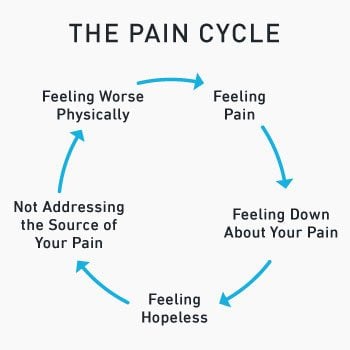 Pain is your nervous system saying, “That feels like a threat.” It doesn’t always mean damage. But it always means something’s off.
How the Pain Cycle Gets Stuck
Here’s what matters practically:
- Pain is a response to a perceived threat, and it can exist without tissue damage — and still be very real.
- Your body retains memories of past injuries and can become more sensitive to similar stresses.
- To get out of pain, you need to change what your system perceives — the input it’s getting — through gradually increasing your capacity to handle load.
Read more about how pain works
Avoiding movement entirely often makes things worse. But so does hammering away at the thing that hurts. Gradually introducing movements that are mildly challenging — but tolerable — helps recalibrate your nervous system’s response. That’s how you introduce new information. That’s what tells your body this can be okay.
Most people notice they feel worse in one direction and better in another. That’s called positional intolerance and it’s common.
- Extension intolerance means backbending, standing, or walking may aggravate symptoms.
- Flexion intolerance shows up more with sitting, driving, or bending forward.
You don’t need to avoid those movements entirely. But when you know which ones are harder for you, you can adjust how much time you spend in them and how you ease into them. That better sense of control makes a big difference. It shifts you out of the pain loop and into a more confident, capable pattern.
What to Avoid If Your Back Is Already Sensitive
Movement is essential. But passive stretching and traction-based techniques can sometimes backfire, especially if your body’s already in protection mode.
If you’ve ever come off an inversion table or a hanging bar and felt worse, that’s your nervous system stepping in to defend itself. Same with aggressive assisted stretching. When someone pushes you deeper into a position, your system may not feel in control, and that alone can spike a reaction.
When in doubt:
Move in ways where you feel supported and secure.
Full Body Movement First, Then the Details
It’s natural to think you need a hyper-specific “special exercise” for your back. But the most important thing is to get the big rocks in first.
- Get your whole system working together – integrate movement through your whole body instead of isolating parts
- Practice everyday movement patterns – crawling, shifting, squatting, and reaching
- Build confidence in motion – reduce the fear of flare-ups through gradual, successful repetition
Then you fill in with more specific movements where you can adjust the load and strain on your spine. Frankly, focusing too directly on the painful area is often too stressful, and it’s difficult to find the right amount of movement because everything hurts too much. That leads to frustration and then giving up.
Get some global full-body movement in first. When your whole body learns to coordinate better, your spine doesn’t have to do the job alone anymore. It’s easier to modify exercises and find what you can do with much less pain. Get your wins in, and then zooming in on specific areas will be less stressful.
The Full Movement Toolkit: Beyond Bear Walks
The bear walk variations above are a great starting point. But your back benefits from an even wider range of stimulus. These additional locomotions work your body through different planes and positions, each one expanding what your nervous system learns to trust.
Basic locomotions and whole-body exercises are the big rocks. Practicing and improving with these will take you most of the way — reducing your back pain and preparing your body for whatever you want to do.
Then you can add more focused locomotions and joint-specific movements to reduce the last bit of nagging symptoms and help you move better in the activities you love.
These crawling movements have helped thousands of our clients with chronic or recurring back pain.
1. Bear and Monkey
These quadrupedal exercises provide a lot of great and unique stimulus to your body. With your hands on the ground, moving together or alternating, there’s a distinct stimulation of your core and your spine.
This full-body motion gives your nervous system a different sensory and movement experience — which is exactly what helps you start to break out of a pain cycle. You have to give your body something new for it to change.
2. Twisting Bear and Spiderman
As you get more familiar and comfortable with the basic locomotions, you’ll practice variations that emphasize different actions.
The twisting bear incorporates more spinal rotation while using your arms and legs to support your whole body stability.
The spiderman locomotion adds more upper body strengthening to improve your ability to handle load in different spinal positions like sidebending and rotation.
3. Walking Frogger
The Walking Frogger works on hip strength to support your low back as it moves through different positions, such as the rounded pelvic tilt. This gives you more tolerance and adaptability for all kinds of activities.
4. Monkey 360
The rotations and hand positioning in the Monkey 360 stimulate the core and spine with different forces as you move through a circle. More tolerance and resilience in all directions.
Our Clients Beat Back Pain Without Special Back Exercises
As you can see, none of these exercises attempt to stretch or isolate the back. They coordinate the whole body together in movement — the way a healthy body moves naturally in the real world — so you can systematically build your body’s ability to function correctly in daily activities.
And it’s worked for a ton of our clients:


You can read more like these here: Elements Reviews
This is what happens when you give your nervous system enough new, well-controlled input to stop overprotecting. And it works even if you’ve been stiff or sore for years.
Can You Do This? A Quick Self-Check Before You Begin

So the real question comes down to “will this help me?” Try this quick assessment video.
If you can do that without too much discomfort, you’re likely fine to use these exercises.
Over time, you should notice easier movement, less tightness, and fewer aches. Many of our clients tell us they see results in as little as 2-3 weeks.
If Your Pain Is Acute or Getting Worse
If you have acute, very irritable and reactive pain, please see your healthcare provider.
Especially if you have:
- Pain that just keeps getting worse: read this article instead
- Pain that consistently wakes you up at night
- Weakness, numbness, or pins and needles sensations
- Trauma from falls or car accidents: read this article instead
This article is aimed at those of us dealing with less sensitive, recurring back pain issues.
Ready to Make a Real Change?
You can absolutely start with the moves above. But if you want a structured, progressive plan that builds exactly the kind of full-body coordination, strength, and motor control this article is about — that’s Elements.
Everything I’ve described here — novel movement stimulus, whole-body coordination, progressive loading that retrains your nervous system — is built into the program as a system. You’re practicing locomotions and full-body exercises in sessions designed to gradually expand what your body can handle, at a pace your nervous system can trust.
Train Your Back to Support You All Day

Hi, I'm Jarlo Ilano PT, DPT 👋
Jarlo Ilano, PT, DPT, OCS has been a Physical Therapist since 1998. He earned his Doctorate of Physical Therapy in Musculoskeletal Management from Evidence In Motion, was board certified as an Orthopedic Clinical Specialist with the American Board of Physical Therapy Specialties, and is a certified Therapeutic Pain Specialist through EIM/Purdue University.
In addition to cofounding GMB, Jarlo has been teaching martial arts for over 30 years, with a primary focus on Filipino Martial Arts. He designed our Train Without Pain guide and our knee and shoulder restoration programs.