Sit down on the floor and stand back up without using your hands, your knees, or anything else for support. That’s the sit to rise test, and it takes about three seconds.
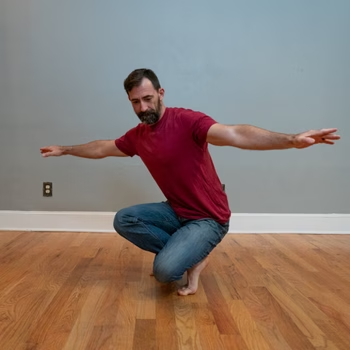 A Brazilian research group has been tracking how people score on it for over twenty-five years. In their 2025 follow-up study of 4,282 adults followed for about twelve years, 3.7% of the people who scored a perfect 10 died during the study. Among people who scored 0 to 4, it was 42.1%.
That’s a big gap for a test with no equipment and no warm-up, which is why it keeps going viral. I’ve spent a long time as a physical therapist watching people try to get up off the floor in clinics and hospitals, and the test measures something real. It also gets misread constantly.
Here’s how to do it, what the numbers mean, and what to train if it’s harder than you’d like.
How to Do the Sit to Rise Test and Score Yourself
The test is also called the Sitting-Rising Test, or SRT. Don’t confuse it with the 30-second chair sit-to-stand test, which counts how many times you can stand up from a chair. This one uses the floor.
The protocol:
- Stand barefoot on a flat surface with some open space around you.
- Lower yourself to a seated position on the floor. Cross-legged is standard, but any seated position counts.
- Stand back up.
Scoring starts at 10 and works down. Sitting is worth 5 points and rising is worth 5 points.
- Subtract 1 point every time you use a hand, forearm, knee, or the side of your leg for support, or put a hand on your knee to push.
- Subtract half a point every time you lose your balance or wobble noticeably.
So if you drop one hand on the way down and use a hand and a knee on the way up, that’s a 7. If you do it clean but wobble once standing up, that’s a 9.5.
Try it before you read on. The number you get is useful information, and the way you got it (which hand came down, where you hesitated) is even more useful.
What the Studies Found
The original 2012 study followed 2,002 adults aged 51 to 80 for about six years. People scoring 0 to 3 had five to six times the mortality risk of people scoring 8 to 10, and every one-point improvement in score was associated with a 21% reduction in mortality risk, independent of age, sex, and body mass index.
The 2025 study extended the same clinic’s data to 4,282 people and a median follow-up of over twelve years. The pattern held and got more detailed. Death rates by score group were 3.7% for a 10, 7% for 8.5 to 9.5, 11.1% for an 8, 20.4% for 4.5 to 7.5, and 42.1% for 0 to 4. The new paper also looked specifically at cardiovascular deaths, and Harvard Health’s summary notes that the lowest scorers had about six times the risk of dying from cardiovascular disease.
Two camps form around results like these.
The first camp reads the headline and concludes the test predicts your lifespan. Fail it and you’re on the clock.
The second camp points out that correlation isn’t causation, calls it clickbait, and moves on.
Both are missing what the test is for. Getting off the floor doesn’t make you live longer. The strength, mobility, and control that get you off the floor are the same qualities that keep you moving, keep you from falling, and keep you living independently, and those qualities show up in the mortality data because they show up everywhere else in your life too. The test is a fast, honest read on where those qualities are right now. That’s the useful part. Whether you live to 94 is a separate question with a lot more variables.
One caveat the researchers themselves note: the participants were patients at a private clinic in Rio de Janeiro, mostly affluent and well-educated. The numbers may not transfer exactly to every population. The direction of the finding is consistent enough that I’d take it seriously anyway.
What the Sit to Rise Test Measures
Three things, and if you scored below an 8, one of them is probably doing most of the damage.
1. Strength in Your Hips and Legs
Getting up from the floor without hands requires enough force from your legs and hips to lift your whole body from a deep position. That’s a strength demand most daily life never asks of you, which is why it fades without anyone noticing.
View this post on Instagram
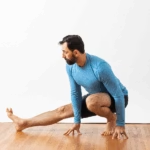
The most direct way to build it is to practice squats, lunges, and the positions in between them, from the ground and at a variety of angles. There are dozens of ways to build lower body strength, and these are the ones that transfer directly to the test, because they are the test. You’ll also pick up range of motion along the way.
2. Mobility in Your Hips, Knees, and Ankles
Reduced flexibility is linked to difficulty rising from the floor, and in clinic this is the restriction I see most in people who have the strength but still need a hand down.
View this post on Instagram
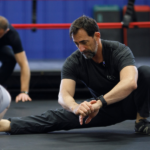
If your range is significantly limited, especially at the hips, individual stretches help and are worth doing as a supplement. Stretching alone has a ceiling, though. You can stretch for hours and still be unable to use that range under load. Working squats and lunges through your current range, at lots of angles, with more time spent on the floor, improves mobility and teaches your body to use it in the same session.
3. Balance and Coordination
Wobbling, hesitating, or dropping a hand without deciding to is usually a breakdown in how your body organizes movement. Sensory input from your joints, motor control from your brain to your muscles, and the timing that sequences it all. The test looks simple and it forces all of those systems to work together in real time.
View this post on Instagram
When a hand comes down on its own, that’s your body saying it doesn’t trust the position yet. You rebuild that trust with practice, and the practice is specific:
- Slow the movement down so you can feel where it gets unsteady.
- Repeat the transitions often. Motor learning comes from repetition with attention.
- Change the conditions. Same movement on a soft mat, with eyes closed, or holding something in one hand.
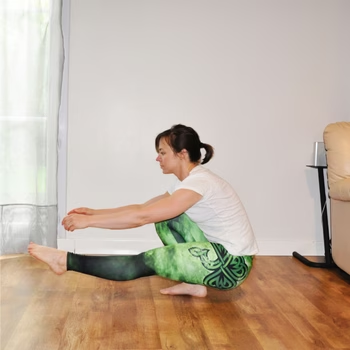 Variety builds adaptability. Locomotion patterns like the ones we teach in Elements (the Bear, Monkey, and Frogger) train exactly these coordination demands, because every rep is a transition through positions on the floor. Retrain how your body sequences movement and it responds to the world around it with more confidence.
Resource: Longevity Research Review & Recommendations
👉 How to Live Forever (or at least stay strong for a real long time)
Our full write-up on what the research says about training for a long, capable life. If longevity is your main reason for training, that’s the article, and it’s also where we cover Literal Immortality, the program we built around it.
If You Can’t Do It the “Right” Way
A lot of people look at the test and clock out immediately.
“I’ve got bad knees.”
“I can’t squat like that.”
“You can only do that if you’re already fit.”
Chronic injuries and conditions are real, and they impose real limits. Giving up on the movement the moment you see it is a bigger limit than any of them.
Here’s one alternative approach:
If you need both hands right now, work toward using one. Then work toward using that one hand less. If your knees hurt in the standard position, find an angle that’s a little less sore and practice there.
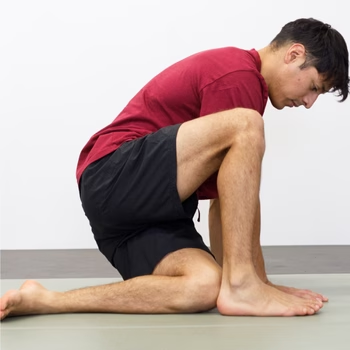 The test isn’t graded. It’s a snapshot of how your body works today and a pointer toward what to practice. Physical limitations mean your approach needs to be more specific. We’ve worked with thousands of people dealing with joint issues, pain, past injuries, or years of moving less than they’d like, and they’ve all been able to improve.
Work with your actual body instead of an idealized form. Spend a little time each week on how you move. Build strength and mobility in the actions you need every day.
Why Getting Off the Floor Matters Past the Test
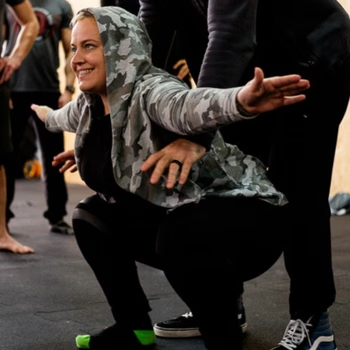 Set the mortality numbers aside for a minute. Getting off the floor without help is one of the main things that determines whether you live independently later on, and it gets harder every year you don’t practice it.
I’ve seen this in hospitals and clinics for a long time: 50-year-olds who look and move like they’re 90, and 90-year-olds who move better than most 50-year-olds. The difference is rarely luck. It’s what they kept doing.
That’s why we call what we do Physical Autonomy, and why our core philosophy fits in one line:
Train to move well, so you can do whatever you want for as long as possible.
Nobody needs to train like a pro athlete for that. You need to keep moving like someone who plans to keep living on their own terms.
Build Your Capacity for a Long, Active Life Now
Longevity and living better in that time requires more than passing a test. You have to build and keep the qualities that provide you the freedom to move, play, and live the way you want.

If you want to move better and stay capable, don’t wait until it’s a problem, start today.

Hi, I'm Jarlo Ilano PT, DPT 👋
Jarlo Ilano, PT, DPT, OCS has been a Physical Therapist since 1998. He earned his Doctorate of Physical Therapy in Musculoskeletal Management from Evidence In Motion, was board certified as an Orthopedic Clinical Specialist with the American Board of Physical Therapy Specialties, and is a certified Therapeutic Pain Specialist through EIM/Purdue University.
In addition to cofounding GMB, Jarlo has been teaching martial arts for over 30 years, with a primary focus on Filipino Martial Arts. He designed our Train Without Pain guide and our knee and shoulder restoration programs.