
A training program is like a map. It shows you a destination and some roads that might get you there.
What it can’t show you is where you’re standing right now.
Paper maps have existed for damn near forever, and people still managed to get lost. The solution wasn’t the map itself. It was GPS and that blue dot showing your current location. Once your phone knows your position, every direction it gives you is about you specifically. Turn left here, because that’s your route from where you are.
Very few training programs have a blue dot.
You get the roads and the destination and an assumption about where you’re starting from. So you follow the program for three months and you get better at the program. Your squat goes up forty pounds and you still push off your thigh to stand up from the floor.
When someone comes to see me in the clinic, I don’t decide how to help them until I’ve given them a thorough assessment. That’s unremarkable for a physical therapist but almost absent from training.
The standard advice is lift more, run more, stretch more. More of what, and why that instead of something else, gets left for you to work out on your own.
Assess, Address, Apply
Find out what’s going on.
Work on that specific thing.
Take it into something real, which shows you what to look at next.
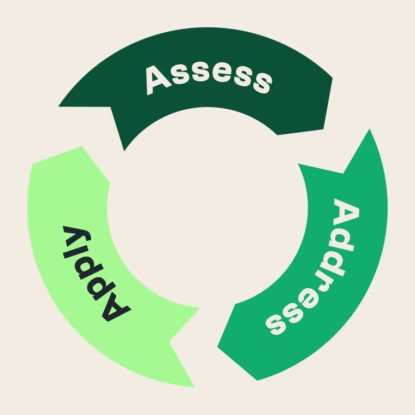 This is the loop we build our training around, and there’s no good reason for it to live only in a clinic.
Assess gives you the blue dot.
Address is the work you do about what you find.
Apply is where you use the improved capability for something you care about, and where the next limitation shows itself.
The rest of this is the first step. You can run your first assessment before you finish reading.
Start Here: Get Down and Get Back Up
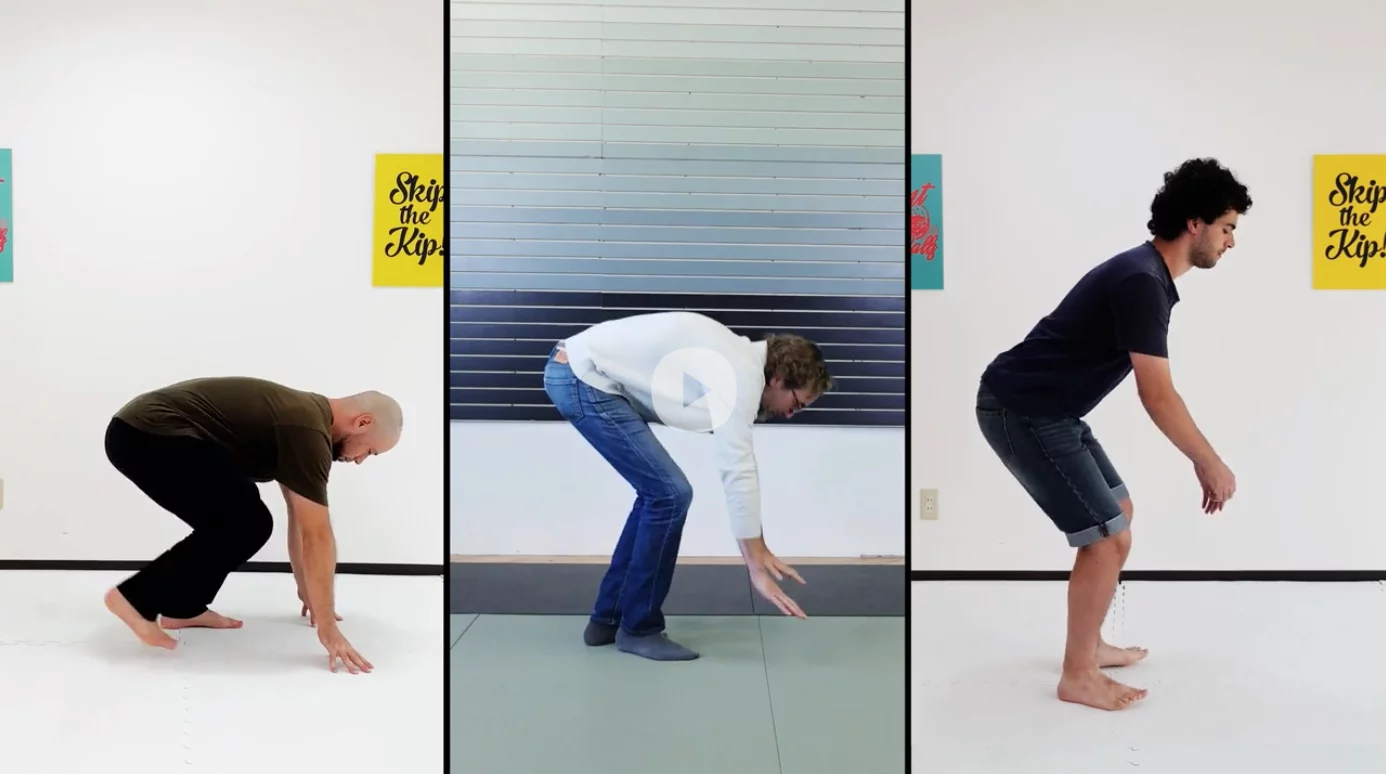
This is the low-end baseline, the minimum ability required to use our Elements program. The video runs 45 seconds. The movement is that simple. The work is what you notice while you’re in it.
Put your hands on the floor, sit down on the ground, sit back. Shift forward onto your hands and knees, stand back up. Bent knees, straight knees, hands or no hands. It doesn’t matter. Can you do it.
Then sit with it for a minute, which is the hard part:
- Do you feel tight or stiff getting up?
- Is that a flexibility limitation, or would your knees and hips just like to be stronger in that position?
That’s the whole thing. A small amount of movement and a real amount of reflection, and you know something about yourself that you didn’t know two minutes ago.
Going Deeper
If that felt fine, try this one. On hands and knees, shift your weight forward onto your hands and hold for 30 seconds. If that’s comfortable, do the same shift and lift one knee an inch off the ground. Then the other side.
- Do you feel wobbly?
- How’s the shift onto your hands? Equally strong through both? How are your shoulders, elbows, wrists?
- Is one side harder than the other when you lift a knee?
Maybe you can do all of it without much trouble, and you still noticed one or two things you’d like to be better. Less effort shifting from your legs onto your hands. Hips that feel stiffer than you’d like coming up off the floor. A right shoulder that gets a little wonky when you turn to stand.
Write those down. That’s your position.
Every Limitation Is Strength, Flexibility, or Control
Whatever you noticed lands in one of the three, and knowing which one changes what you do about it.
Push-ups are the simple version. If you can’t do a push-up, it’s usually upper body strength, or it’s flexibility through the wrists, shoulders, and back. Same movement, two different problems, two different solutions. Doing more failed push-ups addresses neither one.
Strength you probably assess already without calling it that. You know whether the hill is easier this month, whether the ball goes further. What’s easy to miss is strength in positions you’re rarely in. Can you stand up out of a full squat? How strong are your shoulders when your arms are behind you?
Flexibility is harder to notice, because you lose it gradually and you avoid the positions that would show you. Use it or lose it is an annoyingly accurate statement. Whatever you neglect gets more difficult until one day you can’t do it at all.
Control is coordination and balance, applied to the movements you do every day. Reaching and twisting up on your toes to get a box down from storage. Grabbing for a handhold on a trail. Doing those with ease rather than effort.
How to Rate Yourself Honestly
Assessment without measurement doesn’t tell you much. The specific words matter less than using the same ones every time, so you’re comparing yourself to yourself. In our programs, you rate each part of a session right after you finish it, using a short set of labels for Quality, Ease, and Density.

Each label names a different state, and every one of them is useful information. Clunky is expected when a movement is new. Chill is the right call on a recovery day. Your job is to describe what happened accurately.
For the get-down-and-up test above, Quality is the label that fits. Ease and Density describe the other parts of a training session.
Quality: How Well You Stuck to the Cues
Quality is about the movement’s key points: how consistently they showed up while you moved. It has nothing to do with how impressive the movement looked.
- Clunky: Broken, muscling through. Common with new movements.
- Smooth: Controlled and connected, with little wasted motion.
- Snappy: Everything snaps into place with full control.
- Rough: The movement is happening and needs more practice.
Ease: How Your Moves Felt
Ease is about what it cost you to coordinate the movement, separate from how hard the work was. You rate it after the exploratory part of a session, when you’re varying and combining movements instead of repeating the demo.
- Relaxed: Good flow, easy breathing, and it all feels good.
- Natural: Everything flows together, even during effort.
- Mechanical: Movements take deliberate effort and focus.
- Cautious: Holding back or bracing during unfamiliar moves.
Density: How Much You Moved
Density describes the last and hardest part of a session. It combines two things: how hard you worked, and how much rest you took between efforts.
- Chill: Relaxed effort and rest as needed. Good for recovery.
- Steady: Continuous work at a manageable pace. Builds stamina.
- Heavy: Hard effort with plenty of rest. Builds strength and power.
- Intense: Full effort with little rest. Good for conditioning.
Each of these has a place in your training. Steady builds your base. Heavy and Intense drive bigger adaptations and cost more recovery. Chill keeps your practice going on low-energy days.
Be Realistic, But Not Pessimistic
There’s a temptation to pick the label that looks best, because a good-looking log feels good. The log isn’t the point. You’re doing this to find the thing that needs work.
The opposite failure costs you the same information. Have a rough day, feel bad about it, mark yourself below what you did.
“Ideal” Doesn’t Mean Perfect
Your ideal form includes good posture and control. It doesn’t include looking like the person in the video. Ideal is different for every body, and good form is more flexible than most people assume. The only comparison that tells you anything is you against you.
Reassess on a Schedule
Run the same assessment the same way. Progress won’t be linear, so treat any single day as one data point rather than a test you passed or failed.
If the same test feels smoother and costs you less over a few weeks, what you’re doing is working. If it stalls or gets harder, that’s worth some thought. Do you need a small tweak or a real change? You only get to answer that if you’re checking in regularly.
That Was Assess. Now You Have Somewhere to Go.
You have a position now. Something felt tight, or weak, or wobbly, and you have a rough sense of which.
One assessment is a data point. It’s worth more once it becomes a habit, because the limitation you found today is going to move. You’ll resolve it, and whatever was sitting underneath becomes the thing worth working on. That loop is why the same practice keeps paying you back over years.
Which brings you to the next step, addressing the specific thing you found.
Elements has the assessment built into every session. You label your Quality, Ease, and Density as you go, and Ponder at the end of each session asks what challenged you most and where you felt progress. The picture of where you’re restricted and where you’re solid builds itself while you train. Rating yourself accurately is a skill like any other. The more you practice it, the faster and more confident you get at reading your own body, which is the whole point.
Assess and Address Your Physical Needs
With Elements, you’ll follow a clear program built around regular, directed assessment, so you can address your needs and take control of your progress.

Hi, I'm Jarlo Ilano PT, DPT 👋
Jarlo Ilano, PT, DPT, OCS has been a Physical Therapist since 1998. He earned his Doctorate of Physical Therapy in Musculoskeletal Management from Evidence In Motion, was board certified as an Orthopedic Clinical Specialist with the American Board of Physical Therapy Specialties, and is a certified Therapeutic Pain Specialist through EIM/Purdue University.
In addition to cofounding GMB, Jarlo has been teaching martial arts for over 30 years, with a primary focus on Filipino Martial Arts. He designed our Train Without Pain guide and our knee and shoulder restoration programs.