
You’ve been bitten by the bug. Ever since you started Brazilian Jiu Jitsu (BJJ), it’s all you think about.
Avid practitioners all say the same thing: BJJ is addictive. And once you’re hooked, the only thing that’s gonna keep you off the mats is an injury.
And boy, do injuries abound in BJJ!
This article gives you a complete BJJ mobility routine: five stretches and movement combinations you can use as a warm-up before class, a cool down after hard rolls, or a standalone flexibility session on your off days. It targets the five areas that take the most abuse in jiu jitsu, so you spend less time nursing injuries and more time on the mats.
Here’s what we’ll cover:
- Our backgrounds in BJJ
- The 5 most common BJJ injuries
- The BJJ mobility routine (follow-along video)
- How to keep your mobility gains
We’re a Bunch of BJJ Addicts Ourselves
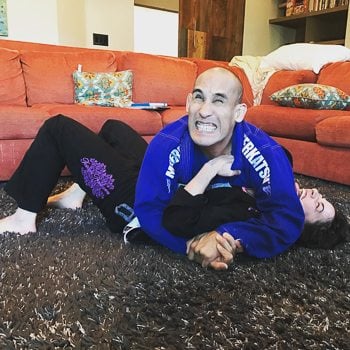
Here’s Jarlo in a fierce BJJ battle 😉
Our clients are involved in all kinds of sports and activities, but BJJ is the one we hear about most. That makes sense for a couple of reasons:
- The movements we teach map really well onto grappling.
- We train BJJ ourselves.
Jarlo, one of my co-founders, is a physical therapist who’s been practicing BJJ since 2004 and holds a brown belt under Burton Richardson. When he looks at jiu jitsu injuries, he sees them as a training partner and as a clinician who’s spent decades rehabbing the exact problems we’re about to talk about.
I came to BJJ after a lifetime in other arts. I hold black belts in Judo, Kendo, and Shorinji Kempo, spent 10 years as a competitive gymnast, and I’m now a brown belt in BJJ myself. Mostly what the brown belt gets me is being folded up by guys half my age with slightly more respect.
Beyond the two of us, thousands of grapplers among our 129,000+ clients have used our programs to stay healthy for their sport.
Why am I telling you all this?
Because we don’t just recommend the routine in this article. We use it ourselves. It works.
The 5 Most Common BJJ Injuries (and How to Address Them)
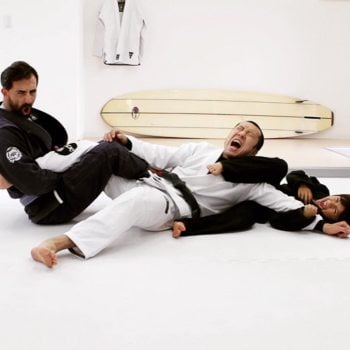
My son and I “beating up” our professor. You don’t just recover from these kinds of injuries overnight!
BJJ is a physically demanding sport that can strain most of the body in one way or another if you’re not careful or don’t have a good foundation (or, let’s face it, if you’re paired with that one white belt who seems intent on killing his sparring partners).
Here are the 5 most common injury and limitation areas that keep BJJ practitioners off the mats or stall their progress. The stretching routine below addresses all of them.
1. Wrists/Hands
This is especially problematic if you practice gi, but weak hands, fingers, and wrists can get in your way in no-gi as well. All that gripping, grabbing, and twisting adds up. And if your grip isn’t strong enough in the gi, you leave yourself open to injuries.
We’ve all seen that guy with 37 layers of tape around his fingers. Don’t be that guy.
2. Hips
Tight hips are one of the more annoying issues to have in BJJ. They get in the way of shrimping out of positions, throwing a good triangle, and even closing your guard tightly. For some people, just showing up and practicing the positions frequently is enough to work through tightness. But if your hips have been tight for years, that probably won’t cut it.
3. Shoulders
The shoulders are one of the most commonly injured areas in BJJ. Sure, that’s often from not tapping soon enough (tsk tsk), but sometimes there just isn’t time. And if you have really tight shoulders, even a little force in an americana or kimura can wreak havoc on your joints.
Start working on your shoulder mobility now, and in a couple of months you might earn bragging rights for surviving that nasty submission that always gets you.
Improve your shoulder mobility.
4. Neck
Neck injuries can be pretty awful, and they can put you out of commission for a long time, especially when they come from force, like falling improperly in a takedown. Here’s the part most people miss, though: a lot of neck problems in BJJ actually start in a stiff upper back. When your thoracic spine doesn’t move, getting stacked dumps all that pressure straight onto your neck.
Keep your neck strong and your upper back moving well so you don’t wind up in trouble down the line.
5. Ankles
If you want to hold a tight guard, the type that makes your opponent’s face turn red from frustration, you need strong ankles that can withstand pressure. And they need to be mobile enough to bend easily so you can avoid injuries from ankle and foot locks.
The last thing you want is an ankle injury that puts you on the couch for months.
The BJJ Mobility Routine: 5 Stretches You Can Use as a Warm-Up or Cool Down
The following routine builds the mobility and strength you need for your BJJ practice, and it directly addresses the five problem areas we just covered. There are a few other common BJJ injuries, like ribs and knees, but this routine focuses on the limitations above.
Jeff demonstrates the full routine here, so you can follow along:
One thing you’ll notice with this routine is a strong emphasis on motor control. We combine movements and work on improving the control you have over those movements. That’s deliberate. Jiu jitsu doesn’t ask for flexibility in isolation. It asks you to use your range of motion under pressure, in transition, with someone actively trying to take it away from you.
Let’s take a look at each exercise, including what it does for your rolling.
Forearm/Wrist Stretch
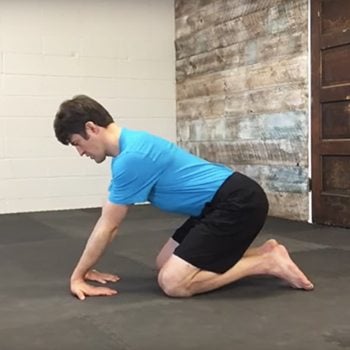
- Start on your hands and knees and rotate your wrists so that your palms are on the ground with your fingers pointing toward your knees.
- Keeping your elbows locked out, press into the ground as you move your butt back toward your heels.
- You should feel a nice stretch in your wrists and forearms as you move backward, but don’t move into any ranges that are painful for you.
- Move in and out of the stretch 10 times, then hold the last rep for 15-30 seconds.
On the mats: Your wrists and hands take a beating from gripping the gi, and even in no-gi all that grabbing and twisting works them over. Rocking in and out of this stretch dynamically lets you control exactly how much weight you load onto your wrists, which is what prepares them for grip fighting. It should feel a little better with each rep.
Lounge Chair Stretch
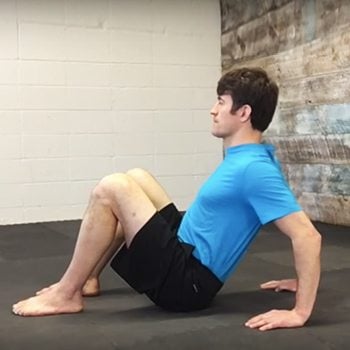
- Sit on the ground with your hands placed behind you, a little wider than shoulder width, fingers pointing forward toward your butt.
- Keep your chest up and squeeze your shoulder blades together, with your elbows pointing backward. The dynamic action is squeezing the shoulder blades down and back while pushing through your hands and breathing in deeply.
- Contract and relax this way 10-12 times, then hold the last rep for about 30 seconds.
On the mats: This opens your chest and the front of your shoulders, the exact tissue that gets attacked in americanas and kimuras. Shoulders that can move through that range with control have a much bigger safety margin when a submission comes on fast.
Sit Through to Frog Stretch
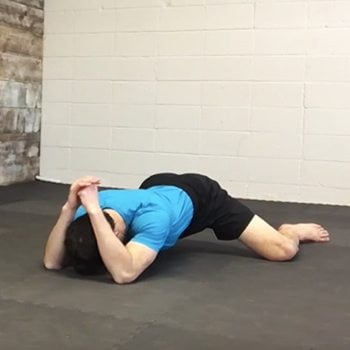
- Start on all fours, then lift your left leg up and plant the foot on the ground as you bring your right foot through to rest momentarily on your right hip.
- Continue the rotation until you are in a frog stretch position, with your knees as wide as they can comfortably go.
- Drop your elbows down to the ground and relax into the stretch for 15 seconds.
- Come up onto your hands and knees and repeat the motion on the opposite side.
- Do 5-10 reps of this sequence.
On the mats: The sit through is a classic grappling movement, so try to glide as close to the ground as you can. The frog stretch opens your adductors, which is money for side control top. And here’s the detail most people skip: when you’re on your elbows, lift your chest and scoop it forward. That works thoracic extension, which is what lets you keep your pressure driving down into your opponent instead of floating off them.
Quadruped Twist to Roll to Plow
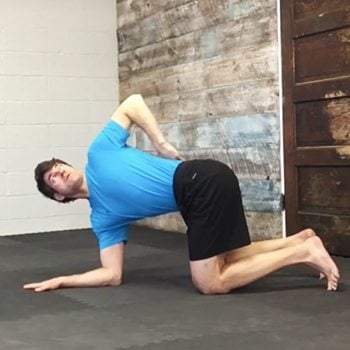
- Start on all fours, then place your left elbow down on the ground and bend your right arm behind your back. Squeeze the right shoulder blade and twist your body toward the right so that you are looking up at the ceiling.
- Do 10 reps, then guide the left arm along your body as you roll on the back of your neck into a plow position.
- Hold the plow position for 15 seconds, then roll in the opposite direction and repeat on the other side.
- Do 5 reps of this sequence.
On the mats: Remember what I said about neck problems starting in a stiff upper back? This combination works both: the twist loosens up your thoracic spine, and the plow trains neck flexion so getting stacked doesn’t feel like a car wreck. Go slow with this one. Play with leaning back onto your hips or forward onto your elbows to find where your upper back most needs the work. And in the plow, keep the weight on the upper part of your shoulders, not the base of your skull.
Kneeling Lunge to Modified Pigeon to Squat
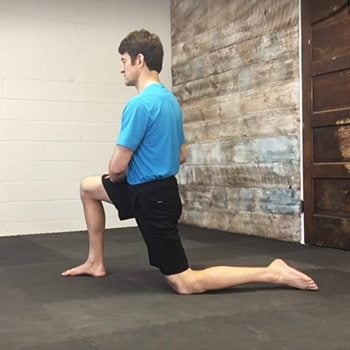
- Start in a kneeling lunge position, with one knee up and one knee down.
- Squeeze the glute of the rear leg to feel a stretch in that side hip flexor.
- Move in and out of the stretch 10 times, then hold for 15-30 seconds.
- Then, drop the front leg to the ground so that it is bent at a 90-degree angle in front of you. Let the back leg bend however is comfortable for you.
- Keep your chest up and your hips square. Hinge from the hips and pull your body forward over your leg. The dynamic action is pushing the side of your lower leg into the ground.
- Move in and out of the stretch 10 times, then hold for 15-30 seconds.
- Come up into a squat and relax there (at whatever depth is comfortable for you) for 15-30 seconds.
- Repeat the sequence on the other side.
On the mats: This sequence covers a lot of ground: hip flexors in the lunge, hip rotators in the pigeon, and full hip flexion in the squat. That’s your guard, right there. If you play rubber guard or anything that demands serious hip rotation, the modified pigeon will pay you back fast. Moving dynamically in and out of each stretch warms up the muscles and teaches you how they actually work in those positions.
How to Use This BJJ Stretching Routine
First, here’s a recap of the routine:
| Exercise | Sets/Reps |
|---|---|
| 1. Forearm/Wrist Stretch | • 10 reps, followed by 15-30 second hold |
| 2. Lounge Chair Stretch | • 10 contractions, followed by 15-30 second hold |
| 3. Sit Through to Frog Stretch | 5-10 rounds of the sequence: • 1 sit through into frog stretch • Hold frog stretch for 15 seconds on each round |
| 4. Quadruped Twist to Roll to Plow | 5 rounds of the sequence: • 10 reps of quadruped twist, then roll into plow • Hold plow for 15 seconds |
| 5. Kneeling Lunge to Modified Pigeon to Squat | • 10 contractions in kneeling lunge, followed by 15-second hold • 10 contractions in modified pigeon, followed by 15-second hold • 15-30 seconds in squat |
There are three ways to plug this into your training:
As a warm-up. Run the full routine before class to get your wrists, hips, and spine ready for live rounds. Moving dynamically in and out of each stretch is exactly what you want before training: it warms up the tissue and wakes up your control through those ranges.
As a cool down. After a hard class, slow everything down and spend more time in the holds. Your hips and upper back will thank you the next morning.
As a standalone flexibility session. On rest days, the full routine takes about 10 minutes and keeps your trouble spots moving without taxing your recovery.
If you’re low on time and dealing with a particular limitation, pick the two or three exercises that hit it. Neck feeling beat up from getting stacked? The Quadruped Twist to Roll to Plow is your priority. Tight hips holding your guard back? Don’t skip the Sit Through to Frog Stretch or the lunge sequence.
Whatever your daily practice looks like, start plugging these in where they’ll protect you from the injuries you’re most concerned about.
How to Make Your Mobility Gains Stick
A routine like this keeps your trouble spots moving. But here’s something I’ve learned over 40+ years of training: mobility you only visit for ten minutes before class doesn’t stick. If you want range of motion you can actually use in a scramble, you have to build strength and control inside those ranges. Otherwise your body gives them right back.
That’s exactly what Elements trains. You’ll work through animal-style movements that build strength, flexibility, and motor control through the same territory you fight from: deep hip positions, loaded wrists, and a spine that can rotate and flex under load. The program gives you specific progressions with clear benchmarks, so you always know exactly what to practice and when to move up.
And when you condition your body to move well through unusual positions, you become a lot harder to hurt in the unexpected ones. Which, if you’ve rolled for more than a week, you know is most of them.
Don’t take my word for it. Here’s what grapplers tell us:
“I’m a 50 year old guy, currently a brown belt in Brazilian Jiu Jitsu. After years of rugby and martial arts, my mobility and flexibility were not good. Doing Elements has not only helped improve these areas, it has helped my recovery times, and I use it as a warm up prior to training.” – Sean R.
“I train BJJ and Elements is without doubt the single best accompaniment to it. It provides a freedom on the mats that I don’t have when I’m not using Elements.” – Sean D.
“I do BJJ 4 times per week and noticed that I have been stiff and exhausted here lately after training. I added Elements 3-4 times per week, and I felt better almost immediately. I can tell my mobility has increased.” – Bryan D.
Stretch before class. Build capability between classes. That’s really all there is to it.
Move Better on the Mats (and Off)
With Elements, you’ll build the strength, mobility, and control that make every hour of mat time count. Short sessions at home, no equipment, clear progressions.

Hi, I'm Ryan Hurst 👋
After a training accident ended his competitive gymnastics career, Ryan moved to Japan, where he spent close to 30 years training and competing in judo, kendo, and other martial arts until another injury made him rethink what training is for.
As Head Coach, he leads program design and teaches every week on our YouTube channel. His book, Stay On The Mat Forever, is aimed at helping you keep training for decades. He loves handstands, dogs, and hiking.