
You can get a long way training on your own. I did, and most of the people reading this have too.
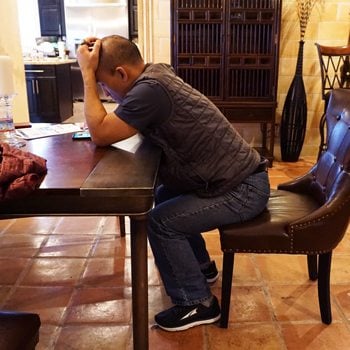 Solo training has real advantages. No schedule to coordinate, no gym politics, no waiting on equipment. You open the app, set your timer, and do the work in your living room. For a lot of what we teach, that’s exactly how it’s supposed to go.
Then you hit the part where alone stops paying off.
Nobody notices when you skip a session. Nobody catches the drift in your Bear when your hips start sagging and you’ve stopped seeing it yourself. The only person rating your quality is the same person who’d really like to call it good enough and go make breakfast.
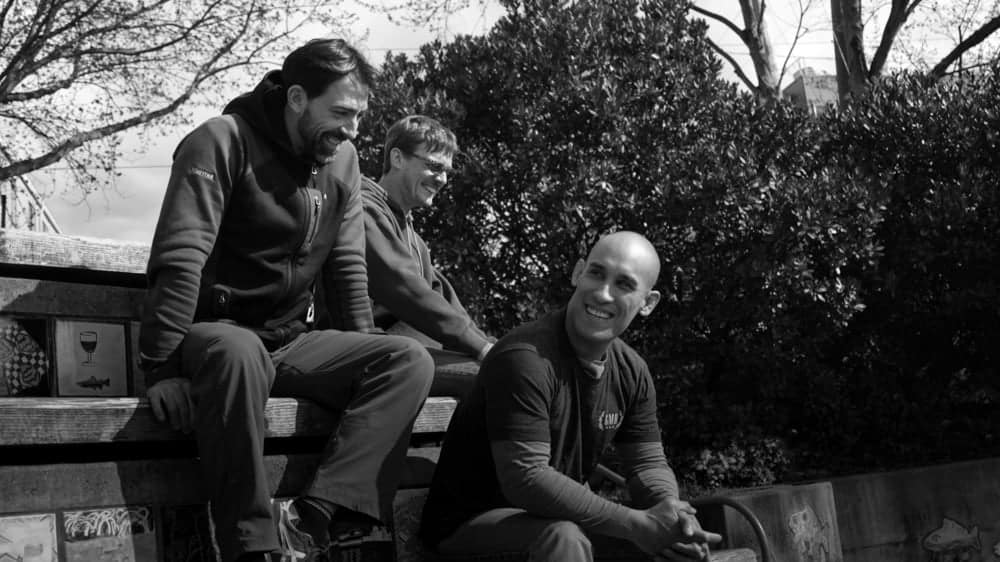
I train at a martial arts gym a few times a week, and I’ve trained on my own for almost 40 years. The moves aren’t any different. What’s different is that on the mat, someone is watching, someone is pushing, and someone notices when I’m coasting. My solo work keeps me ticking over. My mat time is where I actually get better.
After watching a few thousand people start and stop, here’s what I’ve landed on: the people still training hard years later are the ones who got connected. The discipline everyone credits is mostly a story we tell about something that’s actually social.
“Loneliness Kills”
This isn’t only a training observation. It shows up in the health data, and the size of the effect is bigger than most people guess.
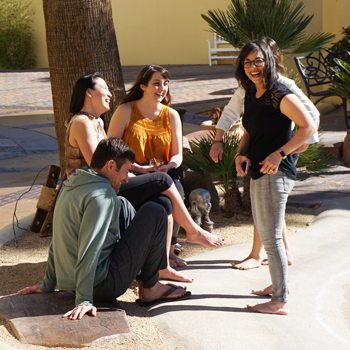 A few years back a writer for the Boston Globe set out to report on the idea that middle-aged men have no friends, and partway in he realized he was describing himself. Social isolation tracks with higher rates of cardiovascular disease and dementia and a shorter life. The Surgeon General has called it an epidemic.
The longest-running study we have on this backs it up. Harvard followed a group of men for more than seven decades, and the director summed up the whole pile of data in two sentences:
“Loneliness kills. It’s as powerful as smoking or alcoholism.”
That’s a physical therapist’s favorite kind of finding, frankly. The thing that moves your lab numbers and your lifespan turns out to be other people.
If connection does that much for your heart, it does the same for your training. The mechanism is identical. The people around you set the baseline for what counts as normal, and you drift toward it without ever deciding to.
Three Ways to Put People Back Into Your Training
Train Toward the Same Thing as the People Around You
 The strongest bonds I’ve seen in training come from people chasing the same kind of capability. At my gym, the word people reach for without being prompted is “family.” Nobody planned that. It comes from showing up, struggling at the same things, and watching each other slowly get good.
Real progress takes motivation, decent instruction, and consistent, honest work over a long stretch of time. Doing all of that next to other people doing the same thing builds a closeness that’s hard to manufacture any other way.
So look at what you’re actually training for, and find people aiming at the same place. The work gets more enjoyable, and you build the kind of bond that keeps you showing up on the days you’d rather not.
Be Choosy About Who Gets in Your Ear
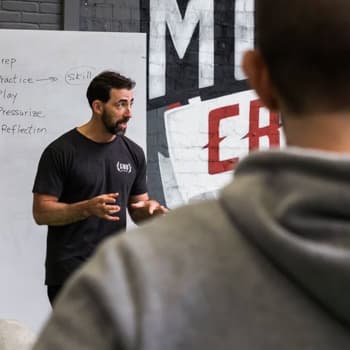 A low room pulls you down to its level just as reliably as a good one lifts you.
For most people training at home, the real drain is noise. The guy at the gym who tells you bodyweight is a waste of time. The comment section that turns every honest question into a fight. The endless scroll of people half your age doing things that have nothing to do with your goals, which quietly convinces you you’re behind.
You don’t have to cut anyone out of your life over this. You do get to decide whose opinion about your training actually counts. Spend your attention on rooms where the baseline is people doing the work, not people performing it.
Make the First Move
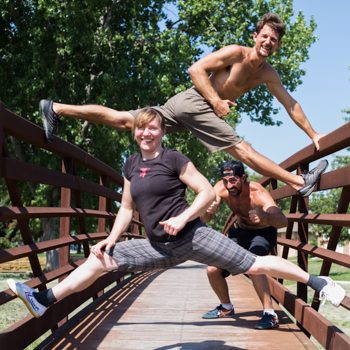 Good training company rarely lands in your lap, especially as an adult, and especially online. It looks like luck from the outside. Up close it’s almost always someone deciding to reach out first.
We’ve run our own company this way from the start. We work with people whose approach to training and life lines up with ours, not whoever offers the best affiliate cut. It’s simpler, and it holds up over years.
If you look around right now and your training has gone quiet and solitary, that’s the signal. You’ll have to do the reaching. The people worth training with are out there doing the same work, waiting for someone to go first.
You’ve Already Done the Hard Part Alone
You’ve proven you’ll do the work when no one is watching. That’s the rare trait, and you already have it.
What moves your training now is people in the room. Someone who’ll tell you when your Frogger is falling apart, who’s chasing the same capability you are, and who notices when you go missing. You’ve got the programs. This is the piece they can’t replace.
The Part Solo Training Can’t Give You
Alpha Posse is our coaching group. You post a clip of your actual training, Ryan, Leah, or I tell you exactly what to adjust, and you work alongside people training at your level instead of guessing on your own.
Hi, I'm Jarlo Ilano PT, DPT 👋
Jarlo Ilano, PT, DPT, OCS has been a Physical Therapist since 1998. He earned his Doctorate of Physical Therapy in Musculoskeletal Management from Evidence In Motion, was board certified as an Orthopedic Clinical Specialist with the American Board of Physical Therapy Specialties, and is a certified Therapeutic Pain Specialist through EIM/Purdue University.
In addition to cofounding GMB, Jarlo has been teaching martial arts for over 30 years, with a primary focus on Filipino Martial Arts. He designed our Train Without Pain guide and our knee and shoulder restoration programs.