When something’s working in your training, the natural impulse is to add more. And when something’s not working, the impulse is also to add more. Both instincts point the same direction, and both can be wrong.
 I see this constantly — in the clinic, in myself, in the emails we get from clients. People who are doing good work, making reasonable decisions, and still ending up hurt or burned out. The problem is rarely stupidity. It’s a misunderstanding of where the line is.
Your Adaptive Threshold
Here’s a concept I explain to patients all the time: the adaptive threshold.
Think of two lines. One represents how much you’re doing — training, sport, daily physical demands, all of it. The other represents how much your body can tolerate before it can’t adapt fast enough to keep up. The space between those lines is where progress lives.
Overuse injuries happen when your activity crosses above that threshold. But here’s the part people miss: the threshold itself moves. It drops with stress, poor sleep, a heavier work schedule, illness. And yes, it drops with age — gradually, but it drops. So activities that were well within your capacity six months ago might be sitting right on the edge now, and you wouldn’t necessarily notice until something starts hurting.
This is also where the paradox shows up. Better conditioning, better mobility, better strength — these all raise your threshold. Good things. But in the effort to build that threshold, you can push right up against it and tip over. The thing you’re doing to protect yourself becomes the thing that gets you.
A Few “Nothing Too Crazy” Decisions
A patient came in recently. Middle-aged, desk job, but genuinely active outside of it. Consistent gym routine alongside regular golf — not a vacation golfer who plays twice a year and wrecks himself. This guy plays weekly. He knows what he’s doing.
He showed up with a few weeks of elbow pain. No specific incident he could point to, and that’s what confused him. If he’d swung wrong or overdone a single session, he’d have had something to blame. There was nothing like that.
But when I started asking questions, the picture filled in. He’d had some free time and played four rounds back to back — more than usual, but nothing outrageous. Around the same period, he’d been pushing a little harder at the gym. Again, nothing dramatic on its own.
Neither thing would have registered as a problem in isolation. Together, on top of his baseline training and life load, they were enough. A few “nothing too crazy” decisions added up to a problem.
What made it click for him was understanding that the threshold isn’t fixed. It moves with everything else going on in your life. Things that used to be well within his capacity now sit closer to the edge simply because the margin has gotten thinner over the years.
And here’s the thing most people get backwards: his instinct was to look for something to add. Another exercise, a brace, a new protocol. He felt better after initial treatment, but the main thing he needed to do was pull back on gym volume and gradually rebuild the balance with his golf schedule. Subtraction, not addition.
When Training Starts Consuming You
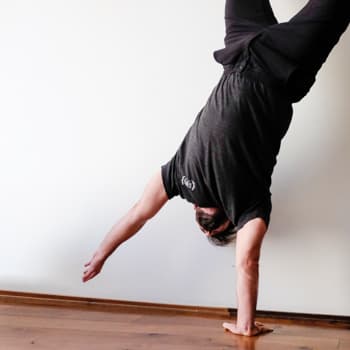 Ryan has shared his one-arm handstand story publicly, and there’s something in it that applies beyond the physical training.
He had the discipline and the schedule. Twice daily, no exceptions. Prep work, mobility, line drills, supplementary work — morning and evening. He’d planned it out carefully and committed fully. That’s what it takes for a skill like that, and he was willing to do it.
A couple months in, he realized he was yelling at his kids to get out of the room so he could finish his practice. They’d run in wanting to play, doing what kids do, and he was pushing them away to hit his reps.
 That was the moment he saw it clearly: the training had crossed a line. His body could handle the volume. His life couldn’t.
The adaptive threshold applies here too — not just physically, but across your whole life. Training that crowds out your relationships, your energy for work, your ability to be present when it matters has exceeded a threshold, even if your joints feel fine.
Ryan also landed on something I think is massive: when he started asking “what did I learn today?” instead of judging whether a session was good or bad, he never had a bad session again. That shift — from a physical outcome you can’t always control to a mental outcome you can — is a real game changer. And frankly, it’s one of those things I’d told other people before I ever applied it myself.
The Swing
Here’s the pattern I see more than actual overtraining: someone figures out they’ve been doing too much. They pull back hard. Feel guilty about pulling back. End up doing nothing for a stretch. Then the guilt builds, tips the other way, and they go hard again. Lather rinse repeat, as it says on the bottle.
The overcorrection is just as unproductive as the original problem. You don’t develop anything sitting on the couch feeling bad about sitting on the couch.
The middle is where the work happens. And I know “the middle” sounds like a compromise — like settling. It’s the opposite. The middle is the most productive position to train from, because it’s the only one you can sustain across years.
What Intelligent Calibration Looks Like
 Ryan’s friend Levi is a good example of how to do this practically. Packed schedule — firefighter, BJJ at least four days a week, lifting five days, kids’ activities, plus other commitments. Something had to give.
The move wasn’t complicated. He cut lifting from five days to three. BJJ is his current priority — getting his purple belt — so that stayed protected. The freed-up time went to mobility work and extra recovery. And since he never knows if he’s going to get adequate sleep at the fire station, that recovery time pays off directly on the mats.
The other key: autoregulation at the gym. Just because Tuesday is scheduled as a heavy day doesn’t mean it should be a heavy day if Wednesday’s BJJ session matters more. Keep the goal the goal.
Simple subtraction. No elaborate new system. Just an honest look at what matters most right now and a willingness to let the other stuff take a step back.
Finding My Own Balance
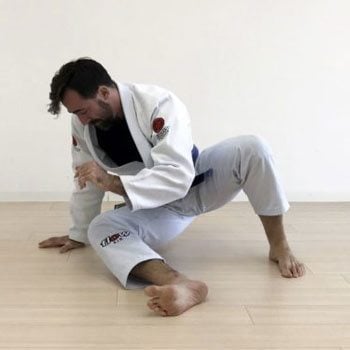 I’ve had to apply the same thinking myself. For a stretch, I’d developed the capacity to train four hours a day, several days a week. I had the time and my body could handle it because everything else in my life was fairly stable and predictable.
Then I went back to triple the patient care hours. That changed things dramatically.
The most significant cut was BJJ. I still love it, but it’s demanding in ways that don’t allow for much self-regulation. You show up and match what’s in the room, or you don’t really show up at all. When you’re rolling with younger, more aggressive training partners, the pace isn’t yours to set. With everything else pulling on my recovery, that cost had become too high.
What I kept was my solo martial arts work — Baguazhang and Kali. Both can be strenuous when you push them, but they’re low-impact and, more importantly, self-paced. If I have thirty minutes and moderate energy, I can get something real out of a session.
The other piece was letting go of developing everything at once. I had to drop the “perfect” plan. I put my strengths on maintenance and picked one or two areas to actually develop. That’s it.
But it works. I’m still training regularly and I’m still feeling strong and capable. The constraint forced a better strategy than the one I had when time was unlimited.
Find the Window
 Enough stimulus to respond. Enough margin to recover. That’s the window.
Your threshold is specific to you and it changes over time. Watch for signs it’s shifting — nagging aches that don’t have a clear cause, energy that doesn’t bounce back, sessions that feel harder than they should. Those are signals, not failures. Adjust before you’re forced to.
Adaptation can’t happen unless you keep training.
Too many people push right to the edge of that threshold and end up having to stop altogether. And too many people, once they stop, stay stopped longer than they need to because guilt and frustration take over where good judgment should be.
Self-regulation is harder than letting a spreadsheet or a wearable tell you what to do each morning. But it’s the skill that keeps you training for decades, and it’s well worth learning.
Train at Your Own Pace Without Burning Out
Elements is built around autoregulation — you rate your own performance each session and the program adjusts with you. Thirty to forty-five minutes, three to four days a week, scaled to your energy and your schedule.

Hi, I'm Jarlo Ilano PT, MPT 👋
Jarlo Ilano has been a Physical Therapist (MPT) since 1998 and was board certified Orthopedic Clinical Specialist (OCS) with the American Board of Physical Therapy Specialties. He’s undergone extensive postgraduate training in neck and back rehabilitation with an emphasis in manual therapy along with being certified as a Therapeutic Pain Specialist by EIM/Purdue University.
In addition to cofounding GMB, Jarlo has been teaching martial arts for over 30 years, with a primary focus on Filipino Martial Arts.