
The people who get stuck on a skill are usually the ones trying hardest to do it perfectly.
 I’ve watched it for almost three decades, in the clinic and on the mats. Someone drills the same movement the same careful way, again and again, waiting for it to click. The reps pile up. The progress doesn’t. They’re practicing exactly the way they were told to, and that turns out to be the problem.
You’ve probably heard the line: “Practice doesn’t make perfect. Perfect practice makes perfect.” It’s a fine saying for a few narrow situations. For learning complex physical skills, it’s mostly backwards.
We get conditioned to believe mastery comes from the “right” routine and the “optimal” rep every single time. But as we’ve covered in our piece on ideal form, good form is a set of principles and safety boundaries, not a rigid standard you either hit or fail. Lock yourself into one narrow way of moving and you starve your body of the information it needs to learn.
So here’s what I want to hand you: five motor learning strategies, drawn from a few decades of research and a lot of clinical practice, that make skill building faster, stickier, and a lot more fun.
How Proper Motor Learning Strategies Encourage Skill Development
 It seems obvious that getting good at a skill means practicing that exact skill, as well as you can, over and over until it sticks. The reality is more interesting than that.
Back in the 1970s, the motor learning researcher Richard Schmidt put forward his Schema Theory: the idea that your movements are run by what he called Generalized Motor Programs, built from all the inputs your body takes in as you move (the sensations, the muscle actions, the results of those actions, and so on). The specifics of his model have been argued over and refined in the decades since, which is exactly how this work is supposed to go. The core insight has held up.
Every rep you do, your body gathers feedback so it can run that movement a little better next time.
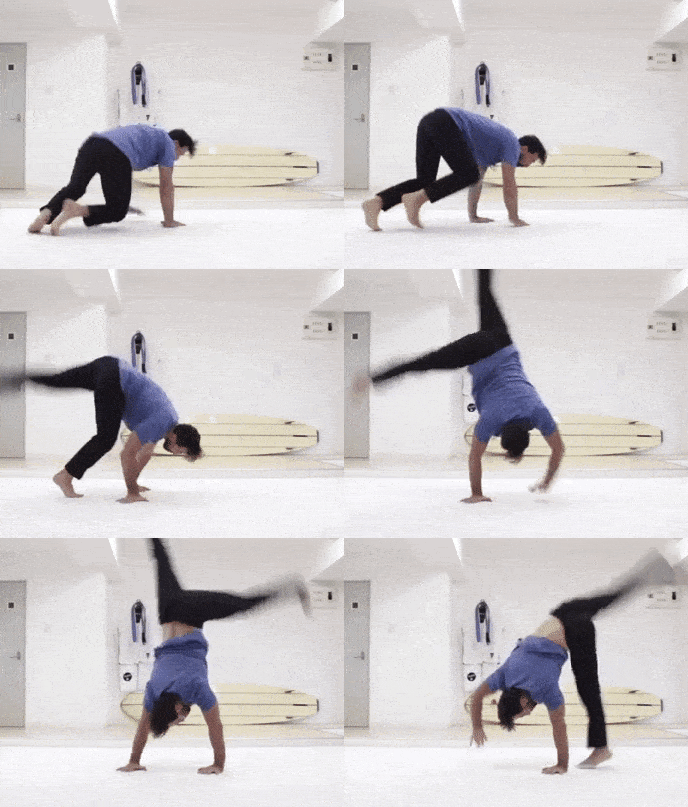
Practice a cartwheel, for instance, and your brain registers:
- the feeling of bending down to place your hands on the ground
- the force with which you kick up your legs
- how you balance while inverted
- how hard you land at the end of the movement
You take all of that in and refine the movement, session after session.
The trouble starts when you clamp down on yourself chasing “perfect.” Feed your body the same input in the same pattern every time and you stall out on the skill you’re working. Give it room to make errors, to do the movement a little differently, even “wrong,” and you hand it richer information to learn from.
Motor control is one of the building blocks of Physical Autonomy, which is why these strategies sit at the heart of how we build training in the GMB Method. The aim of practicing this way is retention. Skills that still work weeks and months later, and that keep compounding as you layer new ones on top. That’s the line between a session that felt good and capability you actually keep.
Five Strategies to Build a Better Motor Learning Environment
The hard part is the middle ground. Too rigid and you stop learning. Too loose and you either practice garbage or get hurt. The useful zone gives you room to make productive mistakes while keeping enough structure to stay safe and keep improving. These five strategies are how you find it.
Strategy #1: Delay Technical Feedback
When you train, there’s a strong pull toward immediate feedback. If you’re working with a coach, it feels natural to want them correcting your form as you go. That’s what they’re there for, right? On your own, you reach for a mirror to do the same job.
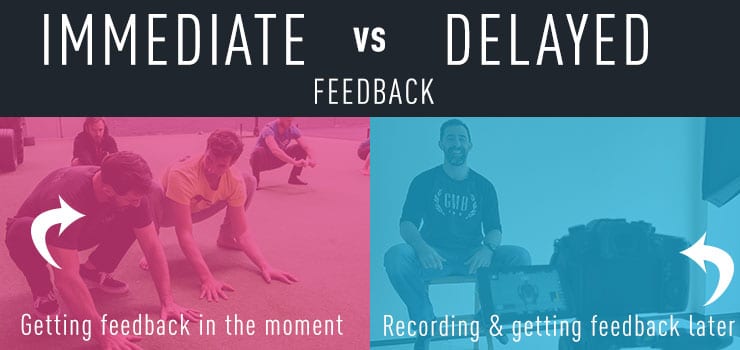
On the surface, getting that feedback right away (the technical term is Knowledge of Results) looks like it should beat getting it later. Of course you’ll do better when you can fix errors the moment you make them.
Except that’s only true in the short term. Immediate Knowledge of Results improves performance during the session, while delayed feedback leads to better long-term retention of the skill.
Why would that be?
The theory is that immediate feedback interferes with how your brain processes all the sensory and motor information during and after the movement. The learning you’d have gotten from messing up and sorting it out yourself gets short-circuited by the correction.
Immediate feedback becomes a crutch you lean on without noticing.
Strategy #2: Give Yourself a Wide Bandwidth
Bandwidth is the cousin of the feedback idea we just covered. It’s how much room for error you allow yourself in a session.
A narrow bandwidth means a low tolerance for error before you step in to correct it. Like immediate feedback, that produces fewer mistakes in the session and better-looking performance right after. And like delayed feedback, a wider bandwidth produces better retention down the line.
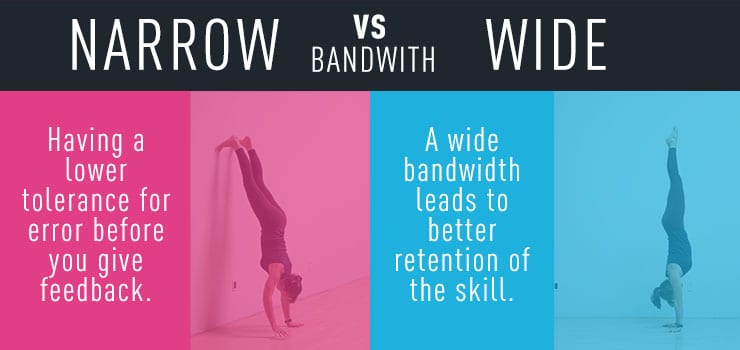
With a balancing skill like the handstand, coming off the wall even a little gives you a wider bandwidth than relying on it completely.
Teaching a kid to ride a bike is the clearest version of this. You can hold them to a narrow bandwidth or a wide one.
- Narrow Bandwidth: Training wheels on the bike, or a parent hovering the whole time, making sure the kid never drifts off course.
- Wide Bandwidth: The far end is the parent who drops the kid on the bike, says “good luck,” and offers nothing else. The useful spot sits in between: pull one training wheel so there’s room for error but not enough to get hurt, or start them on a balance bike with no pedals so they scoot along and adjust their own balance as they go. That last one is self-regulation in its purest form, and it’s exactly the kind of productive error we’re after.
So there’s a balance to strike between too narrow and too wide.
Lock the session down too tight and you cut off the learning. Let it run wild and you lose the safety rails. Give yourself room for healthy error and you’ll improve, and hold onto the improvement, far more reliably.
Strategy #3: Try an Unpredictable Practice Arrangement
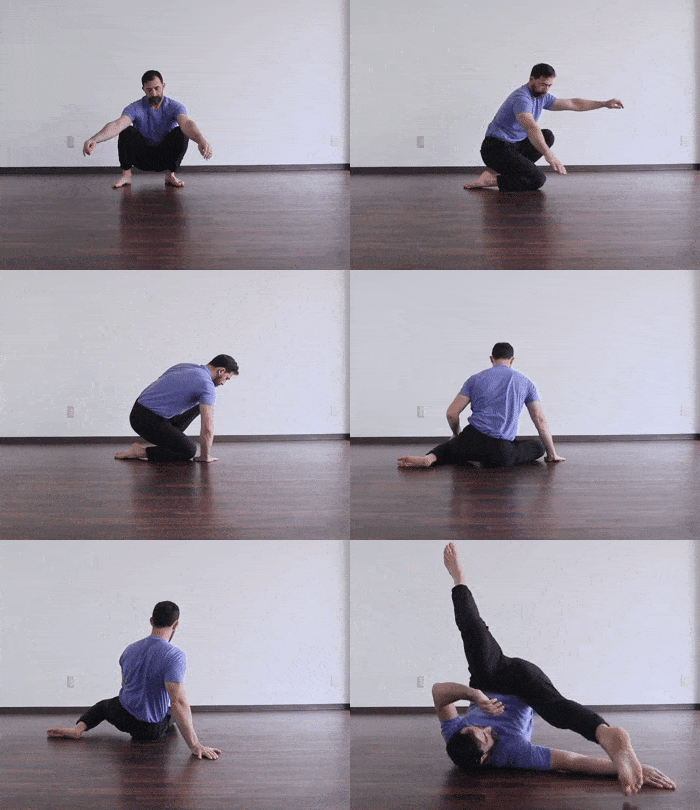 There’s more than one way to arrange a skills session. The most common is blocked practice: you repeat the same drill for a set block of time.
You’d think that’s the fast track to mastery, and just like immediate feedback and narrow bandwidth, blocked practice does show an early bump in performance. But it’s temporary. Measured over the long term, random practice beats it.
Random practice means that instead of one drill repeated endlessly, you mix several tasks and vary the sequencing within the session.
- Rather than chasing one skill through hundreds of identical reps, we teach a range of related skills, with variations inside each one, across the program.
- The course has you doing a different movement most days. That looks like it should hurt retention. Because the skills are related, though, coming back to them at different points means you return with better understanding and better performance.
Random practice likely works because of the novelty it feeds the nervous system. Run the same drill on repeat and, let’s be honest, it gets boring. Your body keeps moving while your brain checks out of the learning.
This isn’t a fringe idea. A 2024 meta-analysis in Scientific Reports pulled together decades of work and found that mixed, varied practice improves how well you retain a skill, with some of the largest effects in adults and older adults. Worth being straight about the limits: the effect is strong and consistent in tightly controlled lab tasks and smaller in messy real-world skills. So treat variety as a reliable lever, not a magic switch.
Strategy #4: Pay Attention to External Cues
Attentional focus is what you’re concentrating on while you practice.
With an internal focus, your attention is on the inner experience of the movement. With an external focus, it’s on the effect the movement produces out in the world.
Back to the bike:
- Internal Cueing: If you feel yourself tipping right, you might think about firing your left obliques and driving your right foot down through your quads. No parent would ever say this to a child, but adults love to overanalyze.
- External Cueing: Just get from here to there. Start at this bench, ride to that side of the park.
You’d guess an internal focus would teach you faster. The research says the opposite, and it says it with unusual consistency. A 2021 review in Psychological Bulletin pooled more than 140 studies and found an external focus produced better performance, better long-term learning, and even more efficient muscle activity than an internal one.
An internal focus tends to interfere because it floods you with information too early, before your body has had a chance to sort things out on its own. One line of research even found that giving someone detailed instructions on the “correct” movement before they tried it produced worse results than telling them nothing at all.
Strategy #5: Break Your Practice into Whole-Part-Whole
The usual way to teach a complex skill is to break it into simpler pieces and drill those. Trouble is, chopping a skill into components, however sensibly you do it, tends to reduce overall performance compared with practicing the whole skill.
But breaking things down is genuinely useful for cutting frustration and building consistency, so you don’t want to throw it out. Research should guide the work, not get in the way of actually doing it. So we take the best of both with the Whole-Part-Whole method.
You run the full movement, break it into parts, then put it back together and run the whole thing again.
Say you’re working on front rolls:
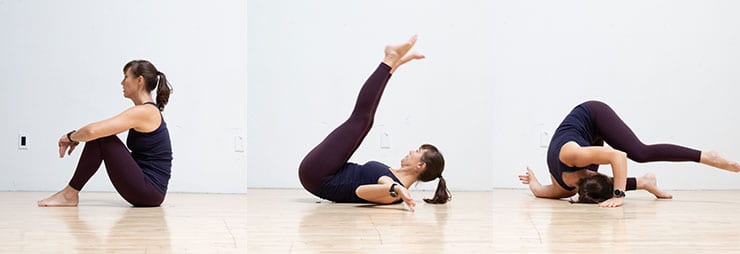
- Start by practicing the front roll as best you can.
- Then work the components: squatting down low, tucking your chin, coming up onto your toes.
- Finish by going back to the full front roll, putting the pieces together.
This structure helps you pull the most learning out of the skill.
Applying Motor Learning Strategies to Your Skill Practice: The Cartwheel
Let’s run the cartwheel through all of it.
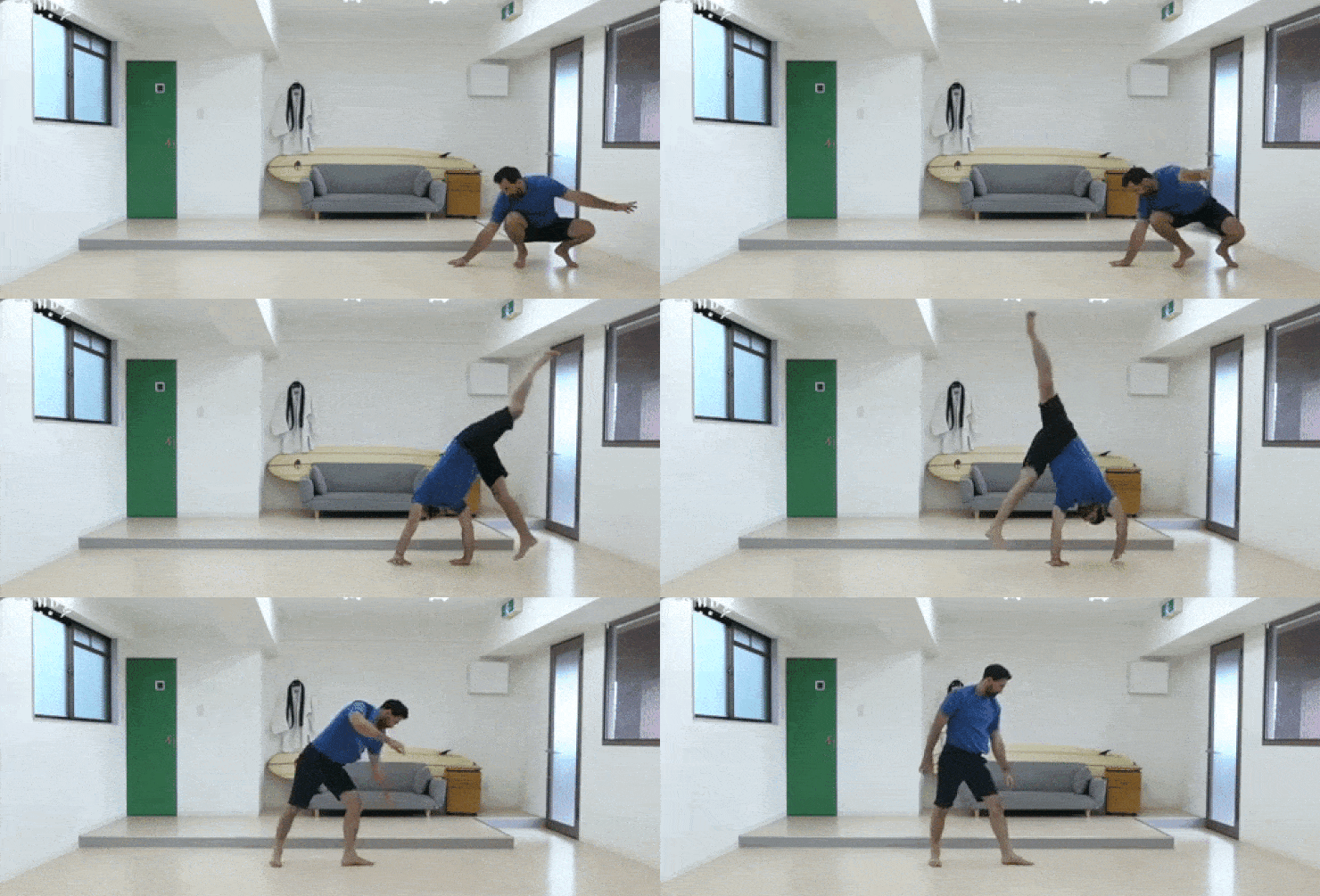
First you need a way in, either an in-person coach or a good tutorial (luckily we have a great one). The tutorial covers the strength and flexibility you’ll want, plus progressions for the skill itself.
You can’t fully separate a skill from its attributes like strength and flexibility, but for a cleaner illustration we’ll focus on the skill itself and set those aside. You’ll find our approach to the attributes a cartwheel needs in the tutorial.
Delayed Feedback
A mirror or a friend checking your form can help in the first session or two, for safety and to keep frustration down. Just don’t fall into needing that immediate feedback to feel okay.
Drop the crutch as soon as you can and you’ll improve faster.
Instead, film your practice and watch it back after the session. Use what you see to shape the next one.
Wider Bandwidth
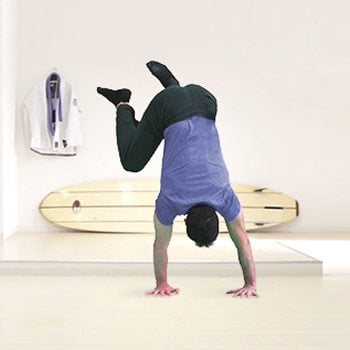 A “correct” cartwheel has your hands and feet starting and finishing on the same line of travel.
Demanding that on every rep, and counting anything else as a fail, is a narrow bandwidth. Give yourself room for more error, especially early, and you’ll learn the thing faster.
That wider bandwidth feeds your body more useful information to adjust and refine as the reps add up.
Unpredictable Practice
Here it gets a little trickier.
The cartwheel is a relatively simple skill. You face one direction, move in that direction, and the whole trick is staying on that line while you do it smoothly. There are three variations in the tutorial above, but past a certain point you’re better off just doing the straight-line cartwheel. To an observer it can look like the same thing over and over.
The random part lives in your intent and your focus from rep to rep. The external cues below are how you build it in.
External Cues
External cues sit outside your body. Internal cues sit inside it.
Throwing a baseball, for example: thinking about where your elbow is and how much your hip rotates is internal. Thinking about the target you’re throwing to is external.
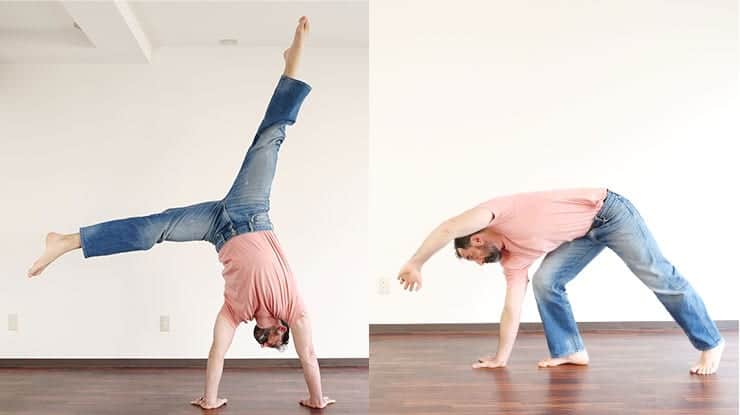
For the cartwheel you’ve got a few external cues to choose from:
- Where are your fingers pointing when you plant your hands?
- Where do your feet land at the end?
- Where is your gaze through the movement?
To make the session random, rotate through the different cues instead of holding one the whole time.
Whole-Part-Whole
This is the most intuitive of the bunch. Run the full movement for a few reps, practice the components, then finish with the full movement again.
The cartwheel breaks down simply:
- The start: standing, then placing your hands on the ground. Don’t worry about the rest. Do that, then reset.
- The middle: both hands on the ground, bringing your legs up. Plop down however you land, just don’t hurt yourself.
- The end: from that middle position with both hands down, focus on how your feet come back to the floor.
Build an Environment Where Skills Actually Stick
For building raw attributes like strength or flexibility, a focused, repeat-the-good-rep approach makes sense. Skill is a different animal. It lives in your nervous system’s ability to adapt, and it grows when you feed it varied, slightly messy, self-corrected practice.
Which is why retention matters more than any single clean session. A skill you can still do months later, and build on, is the one that pays you back. The rep that looked perfect on Tuesday and was gone by Friday cost you the same time and left you nothing. Stack a few skills that hold, and your capability starts to compound. That compounding is the whole game.
And it keeps working as you age. A 2008 brain-imaging study (Boyke and colleagues) found that adults who learned a demanding new coordination skill physically grew gray matter in the brain regions that run it. Your nervous system stays ready to learn far longer than most people assume.
Use these five strategies and you’ll spend less time chasing perfect reps and more time owning your movement.
Build Skills That Compound, One Movement at a Time
Elements is built on exactly these strategies. You’ll develop real body control through a set of foundational movements that carry over to almost anything physical you take on next.

Hi, I'm Jarlo Ilano PT, DPT 👋
Jarlo Ilano, PT, DPT, OCS has been a Physical Therapist since 1998. He earned his Doctorate of Physical Therapy in Musculoskeletal Management from Evidence In Motion, was board certified as an Orthopedic Clinical Specialist with the American Board of Physical Therapy Specialties, and is a certified Therapeutic Pain Specialist through EIM/Purdue University.
In addition to cofounding GMB, Jarlo has been teaching martial arts for over 30 years, with a primary focus on Filipino Martial Arts. He designed our Train Without Pain guide and our knee and shoulder restoration programs.