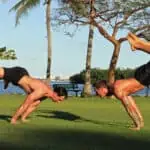
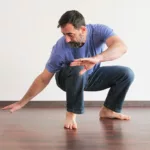
MovNat (short for “mouvement naturel” or “natural movement”) is a system built around the idea that human beings evolved to move in specific ways, and that training those movement patterns makes you better at being a human.
Founded by Erwan Le Corre, it organizes training around fundamental movement categories: walking, running, crawling, climbing, jumping, balancing, lifting, carrying, throwing, catching, swimming, and fighting.
The method emphasizes efficiency.
Every movement has a technically sound way to perform it that minimizes energy waste and injury risk, and MovNat coaches are trained to teach those specific techniques. This separates it from the “just go play outside” advice you’ll get from people who watched one YouTube video about natural movement. MovNat has a real curriculum, real progressions, and real coaching standards.
What makes it click for people is the “combo,” which is how MovNat strings individual skills together. Crawl to a line, jump, roll, sprint to a rock, jog back. The combo structure is where MovNat stops being a collection of techniques and starts feeling like an actual physical practice.
Why MovNat Stands Out from “Movement Culture”
The natural movement space has a lot of brands in it now, and most of them emphasize similar ideas: move in varied ways, don’t just isolate muscles, train for real life. After a while, they start sounding interchangeable.
MovNat separates itself in two ways that matter.
The first is the application course. At the end of a MovNat workshop or certification, you go outside into an actual uncontrolled environment and apply everything you’ve practiced. Ryan described this after his retreat: you’re in the jungle, and whatever’s there, you deal with it. A tree shows up, you climb it. A river appears, you jump over it. A dead log lies across the trail, you balance on it. There’s no scaling. There’s no adjusting the obstacle. You use the skills you’ve built, or you find out where you’re lacking.
This isn’t a workout. It’s a field test for physical capability, and it creates a feedback loop that no gym session can replicate. You find out very quickly whether your controlled-environment technique actually holds up when the ground is uneven and the branch is wet.
The second differentiator is coaching rigor. Jenn Pilotti, who holds certifications in multiple movement systems (and is also a GMB trainer), made an observation that MovNat was the only certification where she was asked to actually teach a movement and prove she could coach. Most certifications test whether you can perform. MovNat tests whether you can get someone else to perform. That’s a different standard entirely, and it produces coaches who are better at their job.
Where GMB and MovNat Overlap
When I talked with MovNat about what our organizations share, the conversation kept landing on the same themes. Both of us build training around skill acquisition rather than workout metrics. Both of us treat the body as something you practice with, not something you punish into shape. And both of us have watched our most dedicated clients go through the same arc: they start in structured fitness, hit a ceiling, go searching for something that actually makes their body more capable, and end up discovering that practice-based training was the answer the whole time.
MovNat’s people describe this as coming “full circle.” You start out as a kid who runs and climbs and plays without thinking about it. Then you enter the world of sets, reps, and programs. You get stronger by certain measures but start feeling like your body has blind spots. You go looking for what’s missing. And you land back where you started: training that looks like play but requires real skill.
We see this with every GMB client who’s been lifting for fifteen years and can deadlift twice their bodyweight but can’t get up off the floor smoothly. The solution in both systems is the same: go back to fundamental movement patterns and build real competence there.
The philosophical overlap is deep enough that we’ve formalized it. GMB and MovNat have established an education partnership where completing GMB programs, like Elements, earns continuing education credits toward MovNat certification. We did this because we both believe that good coaches should train across multiple systems. Nobody owns the one true gospel of how to move well. Your job as a practitioner is to collect tools that work and know when to apply each one.
Where We Diverge (And Why That’s OK)
MovNat goes wide. It covers the full spectrum of human locomotive capacity, including skills that require trees, rocks, water, and open terrain. The best expression of MovNat training happens outdoors, in unpredictable environments, ideally with an experienced coach spotting your technique in real time. Their workshops and retreats are, by all accounts, some of the best experiences in the fitness industry. People describe them the way martial artists describe their most formative training camps.
GMB goes deep on a narrower set of bodyweight movement patterns that you can train in your living room. Elements uses four locomotor movements (Bear, Monkey, Frogger, Crab) and builds strength, mobility, and motor control simultaneously through structured daily sessions. You don’t need a park. You don’t need equipment. You need a few square feet of floor space and about 20 minutes.
These aren’t competing approaches. They’re different zoom levels on the same picture.
The strength, mobility, and body control you build through a program like Elements is the same physical foundation that makes MovNat’s climbing, jumping, and balancing accessible and safe. The environmental adaptability that MovNat develops is where those indoor skills prove their worth in the real world.
I live in Tokyo. I’m not climbing trees on my lunch break. My daily practice happens on a mat in my apartment, and it directly feeds everything else I do when I actually get outdoors. The two approaches aren’t in tension. They’re sequential.
Where to Start
If you have access to a MovNat workshop, certified trainer, or retreat, go. It’s an experience worth having, and the coaching quality is among the best you’ll find anywhere in fitness education. Check movnat.com for upcoming events and their online training options.
If you want to start building the movement foundation that applies to everything MovNat teaches (and everything else you do with your body), Elements is the simplest way to begin. Four movements, 20 minutes a day, no equipment, structured progressions that meet you where you are. You can start tonight.
Build the Movement Foundation That Transfers Everywhere
Elements develops the strength, mobility, and body control that make every physical pursuit more accessible. Four animal locomotion patterns, structured daily practice, zero equipment required.
Hi, I'm Andy Fossett 👋
A lifelong martial artist and former schoolteacher, Andy's deeply concerned with autonomy and fitness education. As CEO, he's dedicated to providing an open, accessible culture for both clients and staff to enjoy exploring more of what they're truly capable of.
These days he mostly coaches teachers, from GMB Trainers to martial arts instructors around the world. The rest of his time goes to burgers, bourbon, and his wildly off-topic rants on the GMB Podcast.