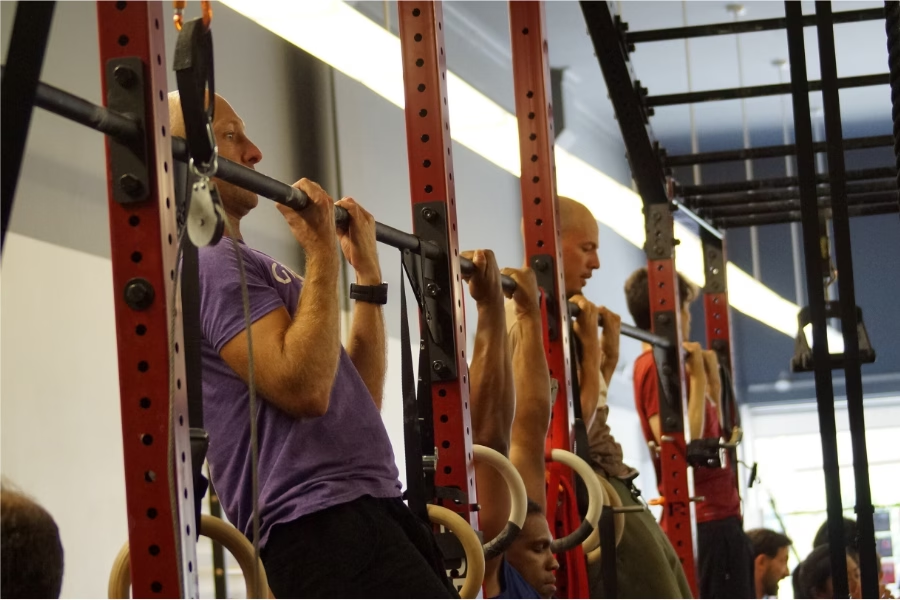

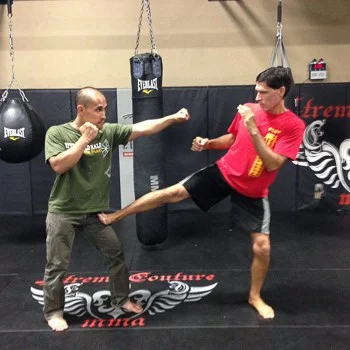
 In martial arts, we don’t choose the winner based on who kicked the most times.
The winner is the one who kicks with the right amount of power, at the right time, to the right target, while the other guy is trying to hit him instead.
It’s not the volume that matters.
It’s the capability under pressure.
That’s the logic behind how we use timed sets in GMB programs.
We remove the rep count because counting makes you chase “more” instead of “better.” And more isn’t better.
Better is better.
When we say “practice this movement for three minutes,” some clients get confused. Where’s the target? How do I know if I did enough? How do I know I’m making progress?
Here’s the short answer: timed sets give room for engaged work without pretending all reps are equal. Progress shows up as increasing quality and more work done in the same time.
Yes, it’s subjective. This is a feature, not a bug.
And since many GMB movements (like locomotor exercises) don’t have clean, countable units, the times sets just make sense.
Here’s how timed sets work and what progression looks like when you stop chasing numbers.
🎙️ Podcast: Why We Use Timed Sets
If you prefer to listen, Ryan and I recorded a pod episode covering much of this article’s content, along with practical examples and a few really terrible jokes.
Stick that in your earhole, or check out more of our sporadic pods here.
When Counting Sets & Reps Doesn’t Fit
Rep counting works well when certain conditions are met.
You need a clear start and finish. Each repetition should be mechanically similar. Quality and tempo need to be stable or controlled.
That describes barbell lifts and some calisthenics movements. It doesn’t fit skill-based training.
Take a standard push-up. A strict push-up with controlled tempo and full range of motion is not equivalent to a rushed push-up with compromised form. But if you’re just counting reps, they both get tallied the same way.
The number hides the quality and value of the work.
This gets worse as movement complexity increases. A Bear Walk doesn’t have an obvious “rep.” Is it one step? Four steps? A full lap around the room? The movement is continuous, your orientation changes, and your attention shifts between balance, positioning, and forward progress.
Trying to count discrete units doesn’t map to what your body is actually doing.
Timed sets sidestep this problem entirely. Instead of pretending there’s a clean unit where none exists, they make space for engaged work over a fixed window. The question shifts from “how many?” to “how much quality work can I sustain?”
That’s a more honest question. And it’s the one your body is actually answering.
Measuring Quality Practice with Time Under Attention
In strength training, you’ll sometimes hear of Time Under Tension.
That’s the total time a muscle is working during a set. So if you’re doing a bicep curl, it includes all the time you’re curing and excluded the time you’re lowering the weight or pausing between reps.
 We wanted a simple way to measure quality practice, so we adapted this concept and coined the term Time Under Attention.
Just as it sounds, TUA is the total time you spend focused on performing quality movement.
That includes:
- Setup and positioning
- Focused execution of the movement
- Exiting and resetting between efforts
Rest and unfocused movement doesn’t count.
And here’s a key point: timed sets are not about moving continuously to reach an arbitrary time. They’re just a container for your practice.
What you do inside that container – how you manage quality, when you rest, how you sustain attention – is what determines your progress.
In skill-based and integrated movement, attention itself is a load. You’re not just asking your muscles to produce force. Your nervous system also has to coordinate balance, manage transitions, maintain body awareness, and make constant micro-adjustments.
That’s real work. And it’s work that degrades before your muscles actually fail.
With a handstand, your balance fails before your shoulders give out. With a Bear Walk, your attention to moving smoothly will wane before your legs get tired. With complex transitions, coordination breaks down before strength does.
Trying to count reps would just sweep this under the rug.
When you work within a timed set, the question becomes: how much quality work can I sustain while staying engaged? Not “did I hit my number?” but “can I maintain standards for the duration?”
Again, there’s no point to counting punches in a boxing match.
Managing Work Within a Timed Set Duration
This is where a lot of confusion happens, especially in programs like Elements where you might see a 5- or 7-minute practice block.
The instinct is to think: “I have to do Bear Walk for 7 straight minutes? That’s impossible.”
That’s not what’s happening.
You’re not “doing Bear for 7 minutes.” You’re practicing Bear for 7 minutes.
Here’s what that actually looks like:
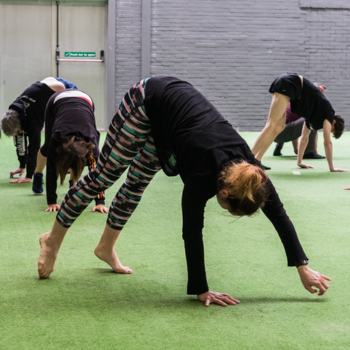
- Set up carefully into the A-frame position
- Move for a few steps or a brief segment
- Return to A-frame and exit to kneeling
- Rest as needed
- Set up again
- Repeat
The entire block is practice time, and you let the timer run, regardless of which phase of the cycle you’re in.
Movement starts and stops and ability and capacity allow.
Rest whenever you need it to maintain quality.
This is important to understand: setup and exit are part of the learning process.
Positioning yourself correctly, finding comfort in the shape, managing tension as you enter and leave the movement—all of that is skill development. Rushing through it to maximize “movement time” defeats the purpose.
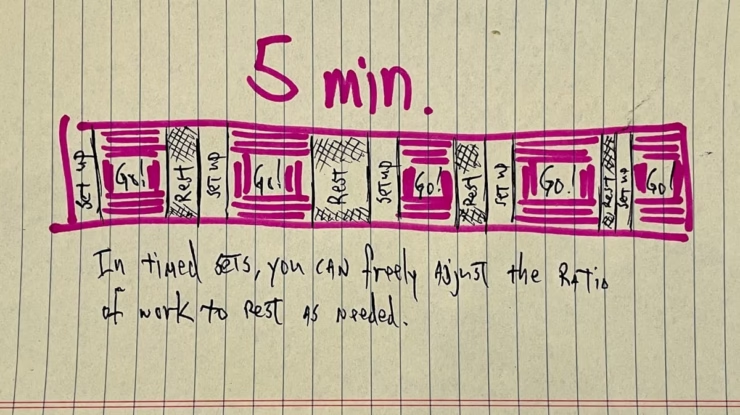
Early in your practice, the ratio might look like 10 seconds of setup, 8 seconds of movement, and 30 seconds of rest, repeated several times.
That’s absolutely enough. Especially with a new movement you’re learning.
Over time, that ratio changes.
You need less time to set up because positioning becomes familiar. You can sustain movement for longer segments because your coordination improves. Your rest periods shorten because you’re not working as close to your edge.
The time stays the same. Density increases.
Density is the proportion of the timed set spent actively working versus resting. More work fits into the same window as your capacity grows. You’re not forcing this – it happens naturally.
There is no expectation that you start anywhere near continuous movement.
The whole point is that you probably can’t at first anyway. The timer creates space for the messy, intermittent reality of learning something new. As you get better, that space fills in on its own.
This is why timed sets work so well for skill development.
They allow you to practice honestly at whatever level you’re actually at—not the level you wish you were at, or the level some arbitrary rep target assumes you should be at.
Progressive Overload & Skill Development with Timed Sets
So how do you know you’re actually getting stronger without a rep target to chase?
Easy: more quality work in the same time.
That’s it.
Let’s look at what this actually looks like across three different types of movement.
Strength Example: Push-Ups
- Early stages: You do 5 push-ups, rest for 15 seconds, do 4 more, rest again, manage 3 more before the timer ends. Total: 12 push-ups in 60 seconds, with significant rest between clusters.
- Later stages: You do 12 push-ups continuously, rest for 8 seconds, do another 9, brief pause, finish with 5 more. Total: 26 push-ups in 60 seconds, with shorter rest periods.
Same 60-second window, but your strength increased without anyone prescribing a rep target.
The density of your work reveals your progress.
Integrated Movement Example: Bear Walk
- Early stages: You set up, take 3-4 careful steps forward, exit to kneeling, rest, set up again, take a few more steps. You might complete 4-5 short segments in 60 seconds.
- Later stages: You set up once, move continuously for 15-20 seconds with direction changes, brief standing rest, then another sustained segment. The movement has flow. Transitions happen inside the pattern instead of requiring complete exits.
Same time, but your coordination improved. Your ability to sustain attention and maintain quality while moving increased.
That’s not something a rep count would capture.
Skill Example: Handstand
- Early stages: You kick up, hold for 1-2 seconds, come down, rest for 10 seconds while you recover your focus. You might get 4-6 attempts in 60 seconds.
- Later stages: You kick up, hold for 10-15 seconds with micro-adjustments, come down with control, rest for 10 seconds, get back up for another sustained hold.
Same 60-second practice window, but your balance capacity increased dramatically.
See how this works?
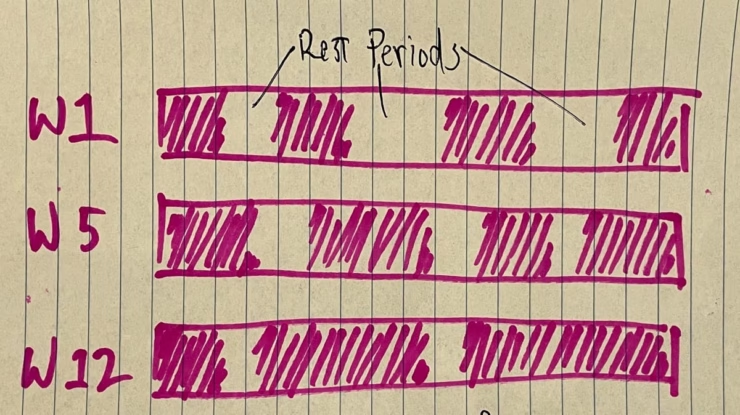
This is what “getting better” looks like when you’re not optimizing for “more.”
Instead of chasing an arbitrary number, you’re achieving increased capacity through sustained quality work.
That’s progressive overload measured by density instead of volume.
Applying Timed Sets in Your Practice
There’s just need to overcomplicate this:
- Set your timer for the prescribed duration (typically 30-120 seconds depending on the program and movement)
- Move with quality until you need to rest. Not until you collapse. Not until the timer ends. Until maintaining your standards requires a break.
- Rest as long as needed to restore quality. This might be 5 seconds. It might be 30 seconds. The goal is to be ready for another quality segment, not to minimize rest time.
- Continue until the timer ends. Set up, move, exit, rest, repeat. The entire duration is practice time.
- Rate your quality and effort after the set. Don’t skip this. It’s the only way you’ll see patterns over time.
Of course, make it even easier in our programs:
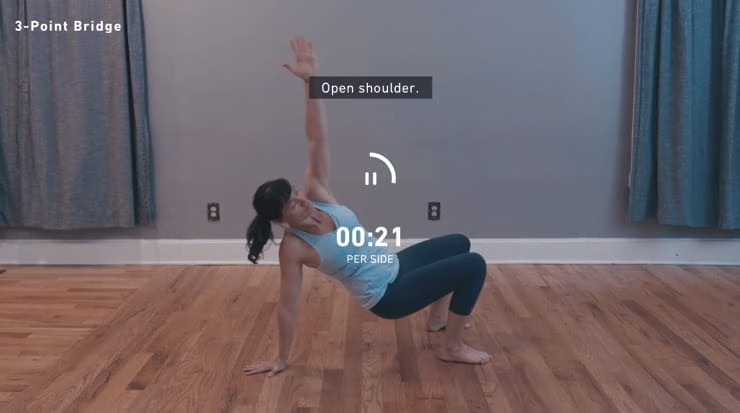
All you have to do is hit START and follow the instructions and integrated timers build into the session flow.
(Here’s how GMB programs work, with a complete session walk-through example.)
What You’ll Notice Over Time
You won’t notice big changes from session to session. Maybe not even week to week at first. But over 3-4 weeks, patterns emerge:
- Fewer stops needed to maintain quality
- Better movement control throughout the set
- Higher quality maintained deeper into the timer
- More total work completed in the same window
That’s the trend you’re building toward.
Some sessions will feel better than others. That’s normal and expected. But we’re looking at the trend rather than not individual data points.
Common Mistakes with Timed Sets
- Trying to fill every second with movement. You’ll sacrifice quality to do it. Rest is part of the work, not a failure to work hard enough.
- Not resting long enough between segments. Form breaks down, you ingrain sloppy patterns, and you’re no longer practicing what you think you’re practicing.
- Not tracking anything. Without notes, you can’t see patterns. You’ll question whether the program is working when it absolutely is. (Again, this is built into our programs.)
- Comparing day to day. Tuesday felt great, Thursday felt terrible—so what? Look at weekly trends. Daily variance is noise, not signal.
- Pushing density before you’re ready. You don’t force more work into the time. You give your body the time and space to figure out how much it can do well.

Some sessions you’ll do less work than the week before.
Your quality for one session might decrease.
Maybe you’ll need more rest some days.
That’s fine. You’re tired, recovering from something, or dealing with life stress. The timed set show that without “failing” your rep target.
This is autoregulation in action.
The timer gives you permission to meet your actual capacity on any given day, not the capacity you wish you had.
Why Timed Sets Work Long-Term
Timed sets support the kind of training you can sustain for years, not months.
First, autoregulation is built in.
You don’t need to calculate percentages or adjust prescribed reps based on how you feel. The timer stays the same. Your work inside that timer adjusts automatically to your current capacity.
High-energy day? You do more. Low-energy day? You do less. It’s automatic.
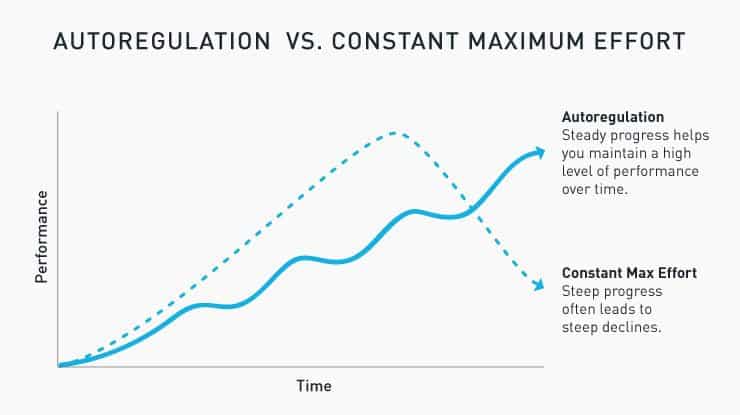
Injury risk stays low, because you’re not grinding through prescribed volume when your form is deteriorating.
Quality paces the work. When it drops, you rest. When you can, you continue. This keeps you training consistently instead of cycling between overreach and forced recovery.
Over time, you learn to read your own signals. You know when to push, when to back off, when “just a few more” is productive versus destructive.
This skill transfers everywhere so you’re not dependent on a coach telling you what’s appropriate.
Making Timed Sets Work in Your Training
Timed sets aren’t vague or tricky.
They’re more precise where precision actually matters.
Relying on a rep target gives you false precision, with exact numbers that hide what’s really happening with quality, attention, and sustainable effort.
You’ll know you’re making progress when:
- You complete more quality work in the same time
- You maintain standards longer before needing rest
- You need less recovery between segments to restore form
That’s not just a nice theory. You can see it in your performance over weeks. You can feel it in how movement changes from effortful to owned.
More isn’t better. Better is better.
And timed sets reveal “better” in ways rep counting often can’t.
Simplify Your Training with Integrated Tools
GMB programs leverage timed sets, self-assessment, and integrated tracking to keep you making progress without guesswork.
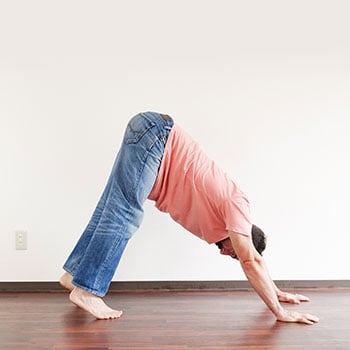
Want to see how all our programs fit together?
Check out the full curriculum overview to understand how our programs work across different training phases and goals.

Hi, I'm Andy Fossett 👋
A lifelong martial artist and former schoolteacher, Andy's deeply concerned with autonomy and fitness education. As CEO, he's dedicated to providing an open, accessible culture for both clients and staff to enjoy exploring more of what they're truly capable of.
These days he mostly coaches teachers, from GMB Trainers to martial arts instructors around the world. The rest of his time goes to burgers, bourbon, and his wildly off-topic rants on the GMB Podcast.