Forty years of training, and Stephen Stern had never figured out how to stop fighting his own body.

Stephen went through dramatic swings in his weight over the decades. At 65 (right), he’s in the best shape of his life.
The pattern was always the same. Dive into something hard. Go all-in for months. Get results. Burn out. Stop completely. Gain weight. Feel awful. Look in the mirror. Start the whole cycle over again.
On his 59th birthday, he saw it happening one more time. And this time, as a chiropractor who’d spent decades watching patients his age lose capabilities they never got back, he knew what was at stake.
“When I turned 59 I decided, by the time I’m 60 I want to be fit again,” Stephen said. “And this time he needed to break the cycle.”
Here’s how he did it — and what his body can do now at 66 that it couldn’t do at 30.
The Feast-or-Famine Pattern

Stephen after running the Boston Marathon in 1987.
The same cycle played out across every decade. Yoga in his 20s, then weightlifting — always intense, always all-or-nothing. Distance running in his 30s, which “really fed the compulsive, addictive side of me.” He recalls years where he maybe missed five days the whole year. But that intensity ground him down.
“Looking back now, I can see how I really abused my body,” he said.
Chronically tired and sore, with a damaged knee in near-constant pain. “I’d have to walk down steps sideways because my left knee couldn’t handle the angle of going straight down.”
He kept running in his usual all-or-nothing style into his 50s, then lost interest and stopped. Weight came back. The familiar discomfort returned. Same mirror, same pattern, four decades running.
If this sounds familiar — maybe your version involves CrossFit phases or marathon training blocks or gym memberships that last exactly until the motivation runs out — keep reading.
The Walk That Changed Everything
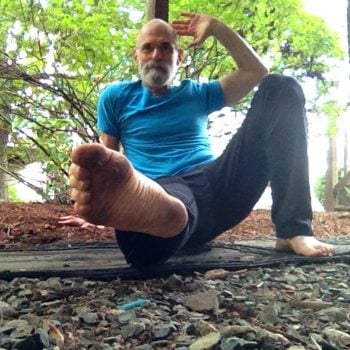 One cold November day, right after his 59th birthday, Stephen looked outside at the heavy snow and decided to go for a walk instead of a run.
Simple as that. And something clicked: gentle exercise didn’t hurt his body the way intense running always had.
That realization started a process of actually listening to what his body could handle — though it took some detours. He spent several months grinding through P90X and Insanity. “I never could finish a 3-month program without getting injured. It also got very repetitive and boring.” Kettlebells and calisthenics followed, and eventually he found GMB and started working through our movement curriculum.
“I was looking for more creativity, safety, variety, and something that really engaged me in a conscious way, not just counting reps. I saw a promo that talked about play and exploration. That sounded appealing — that there was something new every day that I could work with. And it wasn’t like I had to do a full workout around it. I could just do it as a warm-up or as a cool down. There was a lot of freedom with it.”
For the first time in over 40 years of training, Stephen started treating his body as a partner in the process rather than something he had to overpower.
“It allowed me to look at my body in a way that connected me with what’s going on in the moment, so that I could honor it and respect it, and not make it do something it’s not ready for.”
As the training progressed, he tried every movement variation. And unlike his years of pushing through pain on long runs, he started paying attention to what his body was telling him about his actual abilities and boundaries — not what his ego said he should be doing.
“My ego would get in the way at first and I’d want to see if I could do the more advanced variation, and then I’d have to back off. Eventually, I let go of what I had to accomplish and just got into the moment. I started just feeling where my body was in that moment, on that day, at that time. GMB really encouraged that, and helped me move from ‘here’s what my body is supposed to do’ to ‘here’s what my body is feeling right now, and what does it want to do right now to accommodate that movement.’ That’s what it nurtured over time in me.”
And for the first time since injuring his knee more than 40 years earlier, Stephen started regaining the ability to squat and walk down stairs without pain.
What Stephen Can Do at 66
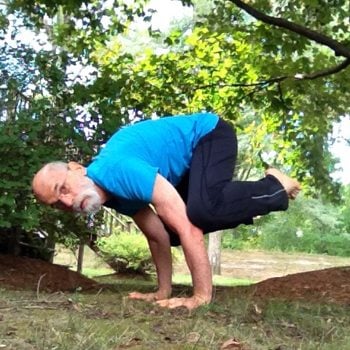 “I don’t like saying I move like a younger man,” Stephen said. “I’m an older man and I move the way an older man can move.”
Since training with GMB, Stephen has built capabilities most 30-year-olds can’t touch. Smooth, controlled muscle-ups and skin-the-cats on rings after progressing through our Integral Strength curriculum. Clean bent arm stands on parallettes. And after several years of working through our programs, he became a GMB Trainer so he could bring this approach into his chiropractic practice.
His body composition is the best it’s ever been — and that includes the marathon years. “I wasn’t as fit as I am now. I wasn’t as lean as I am now. I was probably carrying 20 extra pounds compared to now, even though I was running all those miles.”
Stephen at 66 is more confident in his body than Stephen at 18 ever was.
The Capability That Actually Matters
 The muscle-ups are impressive. They’re also beside the point.
Stephen first started exercising to change how he looked. The skills and the strength came later. But the thing that actually changed his life is a kind of physical competence that doesn’t make for flashy Instagram clips.
“The other day I was doing something and I missed a step, and I caught myself really simply. I was thinking, ‘Gee, a lot of people my age would have really hurt themselves doing that.’ But to me, it was no big deal. There’s a certain competency I have in my body and a certain amount of confidence that knows I can take care of myself and be self-sufficient, which is very satisfying for a person who’s aging.”
Catching yourself on a missed step. Squatting down without thinking about it. Walking downstairs facing forward. This is what physical capability looks like in daily life — and it’s built the same way Stephen built his muscle-ups: through progressive skill practice with focused attention, over time.
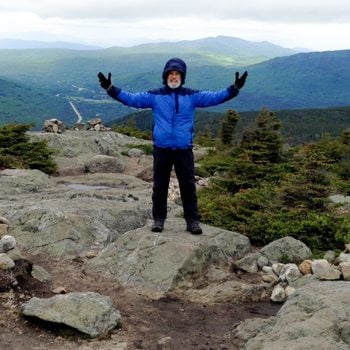
That confidence in his body also opened up something he couldn’t have predicted. He and his 30-year-old daughter Rachel hike mountain summits together.
“She and I hike mountain summits together. We did this one hike. It was like a magical weekend. We just spent all weekend hiking, just the two of us. To see her put that much effort into climbing to the top of the summit, for a father to see her work through a struggle like that, it gave me a lot of joy. I want to continue those kinds of experiences with her.”
That’s what’s on the other side of building real physical capability. Saying yes to the experiences that matter to you and knowing your body can handle them.
Where Stephen Is Now
Stephen has been a GMB Trainer for years now, integrating movement training into his chiropractic practice and coaching others through the same approach that broke his own 40-year boom-and-bust cycle. He’s an active presence in our training community — proof that the method works across decades, not just across a 12-week program.
The guy who couldn’t finish a 3-month DVD program without getting injured now trains consistently, year-round, because the approach is built to sustain.
“It tickles my joy itch to move this way,” he said. “There’s a certain contentment and satisfaction, an inner smile, that comes from exploring the body and connecting with it in a healthy, creative fashion.”
Build the Movement Capability You Actually Need
Elements builds strength, mobility, and body control together through progressive locomotor training — wherever you’re starting from.
Hi, I'm Andy Fossett 👋
A lifelong martial artist and former schoolteacher, Andy’s deeply concerned with autonomy and fitness education. As CEO of GMB Fitness, he’s dedicated to providing an open, accessible culture for both clients and staff to enjoy exploring more of what they’re truly capable of.
He's best known for his wildly off-topic rants on the GMB Podcast and spends the majority of his time eating burgers, sipping bourbon, and reading books.