
I squat every day, and I do it on a knee that surgeons rebuilt after I tore it apart at eighteen.
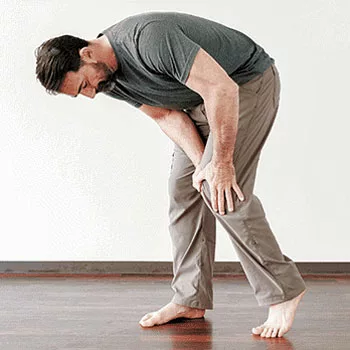 That injury ended my gymnastics career. I tore the ligaments in my right knee, had reconstructive surgery, and walked away from the sport I’d built my life around.
Decades later I train martial arts, drop into a deep squat without thinking about it, and load and twist that same knee in ways that would make a lot of people wince.
I earned that back the slow way, building strength and mobility around the joint a little at a time, year after year.
So when someone tells you that you have “bad knees” and squatting is off the table for good, I don’t buy it.
Maybe you had a surgery and haven’t felt the same since. Maybe it’s arthritis, or you’ve been told you have zero cartilage. Maybe it’s just that nagging pang every time you go to sit down, and you cringe a little watching someone else drop into a squat.
You might figure squatting is bad for your knees and you’ll never go near it again.
I don’t believe that has to happen.
If you’re reading this, you’re probably open to reframing how you think about your knees and what you can do about your symptoms.
Good.
There are ways to gently reintroduce squatting and adapt your training around your history, whatever your x-rays or MRIs show and whatever you’ve been told. Work at it and you’ll likely find these same strategies make other things easier too: lunging, jumping, or hauling yourself up a hill on the ski slopes.
Quick word before we start. None of this is me telling you to skip your doctor. If you have chronic pain or weakness in your knees, get evaluated by a medical professional first. A few rare and serious conditions hide behind knee trouble, and those need a skilled physician, not an article.
That being said, let’s talk about…
- Form and loading adjustments to make the squat more comfortable for your knees
- Stretching techniques to reduce the overall strain on your knees
How to Squat, Even if You Have “Bad Knees”
More than anything, you have to understand that giving up on squatting is not an option. This is a fundamental movement pattern, so it’s worth the effort.
What you’ll find below:
- 5 Ways to Modify Your Squat Technique
- 6 Hip Mobility Exercises for Squats
- 2 Ankle Mobility Exercise for Squats
- 4 Additional Resources for Pain-Free Squats
You can either skip to what you think will help most, or keep scrolling for the full context.
Don’t Get Discouraged by Comparison
Your squat doesn’t have to look like the ones you see exercise models perform.
In fact, it probably won’t look the same unless you have identical proportions i.e. the length of your legs and torso are the same, your hips, ankles and knees have the range of motion, you have similar lower body strength capacities, and so on and so forth….
And, if you have knee sensitivities (and the model doesn’t), your approach to squatting will be different.
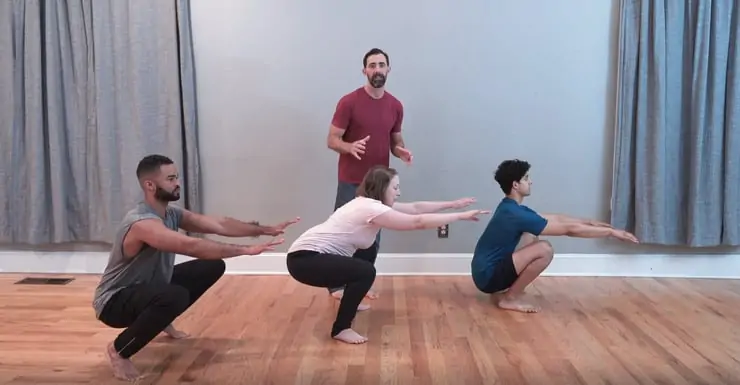
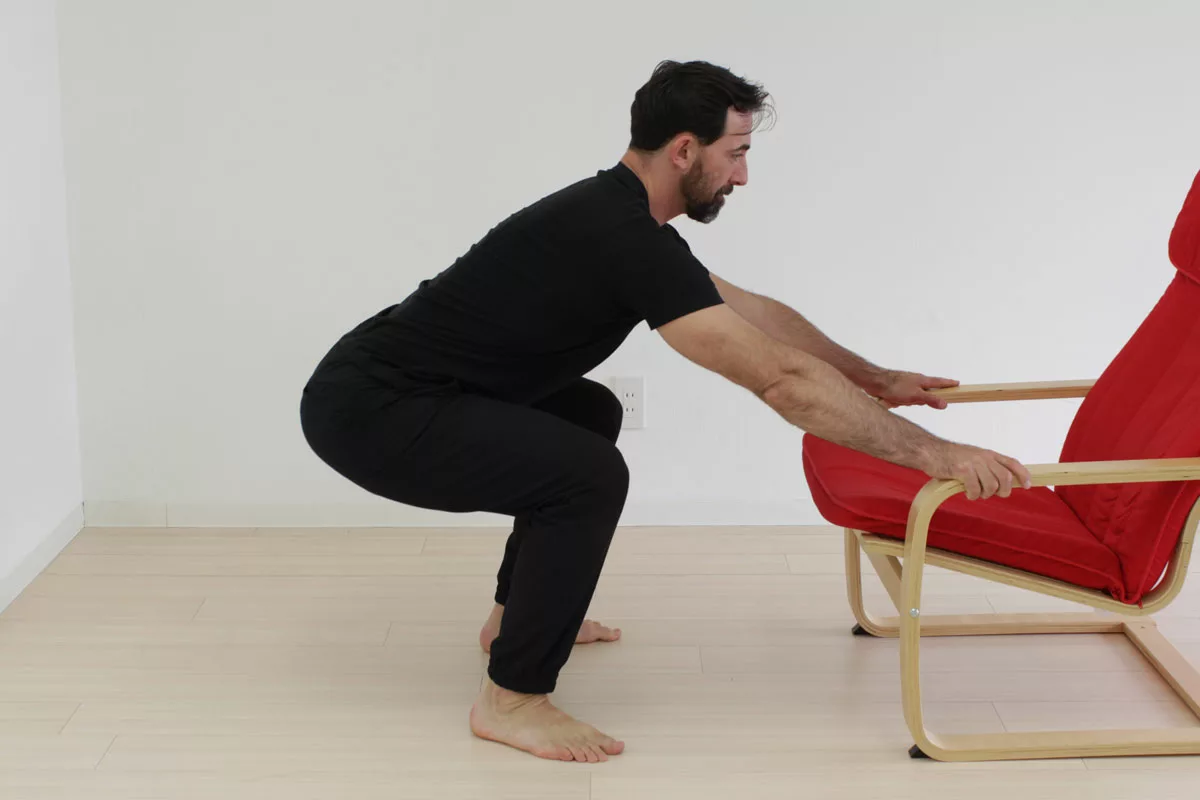
An example of various squat forms for differing body types in our training programs.
Sure, you could just completely avoid squatting — and this may actually be a good idea temporarily if the pain is very acute. But this isn’t the best long term solution. You don’t want to remove such a fundamental movement from your life if you can help it.
So what can you do?
5 Ways to Adjust Your Squat Technique
Here’s some ways to adjust or modify your squat technique to put less pressure on your knees.
Adjust Your Foot Angle
Depending upon what is specifically more irritable for your knees, you may find squats more doable with your toes angled either in or out. Experiment with this and with a bit of trial and error you’ll find the best angle for you. If someone gives you crap about keeping your feet at a specific angle all of the time, don’t listen.
Try a Wider Stance
A narrower stance may be better for medial (on the inside) knee issues, as this is less of a strain on adductor (groin) muscles. A wider stance, on the other hand, may help the knees by transferring some of the stress to the hips.
Change Your Torso Angle
See if keeping your torso more forward rather than upright helps. Doing this may shift more of the load towards your hips rather than your knees.
Experiment with Weight Distribution
The general advice out there is to keep an even weight distribution throughout your foot, but you may find that squatting feels more accessible when your weight is shifted more in one direction than the other. Like you might feel more comfortable with your weight more on your toes or heels. Just make sure you feel stable in the orientation you choose.
Reduce Your Squat Depth
Finding the best squat for you could be as simple as not sitting as low as you can. Find the depth where it begins to irritate your knees. Remember that point and practice squatting through your range, stopping just before you hit that irritating place. Over time, and with patience, you’ll likely see your range of motion improve. Don’t force it. Let it all happen naturally.
Mobility Exercises to Relieve Knee Pain During Squats
When it comes to overall knee health, you want to look at the range of motion you have available at the joints right above and below your knees. Meaning: your hips and ankles.
When these get tight or restricted, more stress is placed upon your knees as you move, which can cause pain and instability.
If that doesn’t quite make sense, think about the hip, knee, and ankle being links on a bike chain. If the hip and/or ankle links become stiff they can’t bend around the chainrings properly as you pedal. Instead they’ll skip and click over the chainring, making the knees (those poor links in the middle) do more of the work and giving you a rather unpleasant biking experience.
So, if you were to become your own mechanic and loosen those stiff links, the load across the chain would become more evenly distributed.
The result: a smoother ride and happier knees.
6 Hip Mobility Exercises for Better Knees
If you feel like your hips are the main source of your problems, here are some of the best stretches to improve hip rotation as well as hip extension:
For each stretch (unless stated otherwise), start with moving in and out of your end range for five to 10 repetitions. Then on your last rep, hold the stretch for 20-30 seconds.
Seated Hip Rotations
 This is a great exercise to improve hip external rotation.
- Start in a comfortable seated position and cross one ankle over the opposite knee.
- With your hand, press down gently on the knee that’s elevated to externally rotate the hip.
- You can keep the bottom leg bent, or if you prefer, you can straighten the leg and prop it up on something like a chair or a step stool. However, the higher the prop surface, the more challenging this stretch gets.
Piriformis Stretch
 This stretch targets a thin muscle in your glutes called the piriformis, which helps to externally rotate the hip and lift your thigh out to the side when your hip is flexed (like in a deep squat). If you sit most of the day, this muscle can get really tight.
- Sit on a chair, lift the leg you’d like to stretch and cross the foot over the opposite thigh. Bend that knee as much or as little as needed for your comfort.
- Initiate the stretch by hugging the outside of the knee as you rotate your chest towards the knee. If it helps: think about pulling the knee towards the opposite shoulder.
Butterfly Stretch
 The butterfly stretch is great for loosening up the groin and improving hip rotation to the side.
- Sit comfortably in a chair with both of your feet propped up. Keeping your knees bent so that the soles of your feet are facing (if not touching) one another.
- Draw your knees downward and keep your chest up as you lean forward into the stretch. Use your hands for assistance to pull your groin closer to your heels.
- You’ll want to be mindful of your back on this one, so keep it straight and upright as you move through the stretch.
- By the way: This stretch can be done one leg elevated at a time if you want, too!
Lunge Stretch
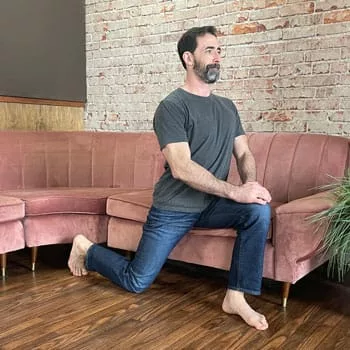 Now, this one might take a bit of trial and error to figure out the right foot positioning. But once you find it, it can work wonders for hip extension.
- Begin in a lunge position with one knee on the ground and the other at 90 degrees — the legs are about hip-width distance apart. Make sure that the front foot is positioned as such so that when you shift forward the shin remains more or less upright (rather than angled down or back).
- Keep the chest tall and hips square as you shift your hips forward into the stretch.
Pigeon Stretch
 This classic stretch not only helps you with hip mobility but also your spine and hamstring flexibility.
- Begin sitting on the floor with your front knee bent at a 90 degree angle. The back leg can be bent or lengthened, but whichever you choose, you’ll want to make sure your starting position feels comfortable.
- Using your hands for support at either side, fold forward from the hips towards the floor, keeping your chest tall. Only bear as much weight as you can comfortably tolerate. Then press back up to sit upright. Another way to think about this motion: shift the back hip forward towards the front heel and then back to the rear foot.
- If sitting on the floor feels uncomfortable, this stretch can be performed while sitting in a chair. To do so: Place the front leg on another chair with the knee bent at 90 degrees. Allow your rear leg to fall to the side. Keep the chest tall then lean forward towards that front leg, then press back up to an upright position.
Squatting Internal Rotation
 This dynamic movement helps to encourage blood flow after you stretch. Don’t hold the end position for long though! Just keep moving and explore the positions.
- Sit in as deep of a squat that feels accessible to you. If needed, hold on to a table or chair out front for support.
- While keeping the foot connected to the ground, rotate one knee towards and away from your center.
Ankle Mobility for Better Knees
To address tight ankles in general, we’ve got an in-depth ankle mobility routine (see below). But below are some of my favorite mobility exercises specifically for squats…
The Modified Lunge
 Now in the usual lunge stretch, the focus is on opening the hip flexor. But this one is really working on ankle compression a.k.a dorsiflexion.
- Begin in a half-kneeling position. Make sure to have any cushions nearby if you need more comfort for your knees.
- Try to keep your heel on the floor as you shift your knee forward. Keep your chest up.
- Pulse in and out of your end range 5-10 times before holding the stretch for 20-30 seconds.
Frogger
 While this move is typically known to improve hip mobility you can alter it to focus more on your ankle mobility as well.
- Start in a deep squat that’s comfortable for you.
- Slowly (and we mean slowly) slide the hands forward as you drop your knees towards the floor to get to a floating tabletop position.
- This is the important part: Drive your heels backward to the ground as much as possible as you slide into that table top in order to stretch the ankles.
- Once you’re in the floating table top, hop the legs forward to return to the squat position.
- Practice this for 1-2 minutes.
More Resources for Squats & Knee Health
First thing, first: try the adjustments and exercises above – gently at first! – and see how they help you identify precisely what you can and can’t easily do.
Do it now! Honestly, you know what happens when you plan to do things later…
After you’ve done that, these might also be helpful:
- Ankle Mobility Exercises – Stiff ankles make squatting a major challenge and can put extra pressure on your knees. These exercises can help.
- Heels Come Up When You Squat? – If your heels lift the second you go deep, that’s usually an ankle and hip issue feeding straight into your knees. Here’s how to fix it.
- Beginner Hip Mobility Routine – Likewise, if your hips are tight, it can force your knees into unsafe positions.
- Knee Health Exercises – Learn the most common causes of knee pain and some movements can can help undo the damage.
- Bodyweight Squat Technique – Our classic guide to learning to squat correctly for your body type.
Remember though: knowledge is not power. You have to act on it, and having a proven plan can help.
Build Knees That Hold Up for the Things You Actually Do
The adjustments and stretches above earn you a more comfortable squat today. That’s worth a lot on its own, and you should feel some of it within a few sessions.
Comfort that lasts comes from somewhere a little deeper: building the capacity underneath the squat so your hips and ankles carry their share and your knees get a break from doing everyone else’s work. That’s what our Elements program is built around.
It’s a gradual on-ramp. Shorter sessions, gentle loading, designed for the person who’s been told their body won’t cooperate. You earn the position first, then you load it. Do that, and the squat goes back to being something you just do instead of something you brace for.
Start Where Your Knees Are Today
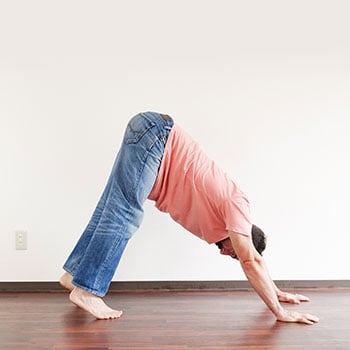


Hi, I'm Ryan Hurst 👋
After a training accident ended his competitive gymnastics career, Ryan moved to Japan, where he spent close to 30 years training and competing in judo, kendo, and other martial arts until another injury made him rethink what training is for.
As Head Coach, he leads program design and teaches every week on our YouTube channel. His book, Stay On The Mat Forever, is aimed at helping you keep training for decades. He loves handstands, dogs, and hiking.