If you’re generally strong and capable, but feel stiff when you squat, kneel, or get up off the floor, you probably need to open your hips.
Hours of sitting, old injuries, and years of training that built strength while skipping mobility — it adds up.
This guide is for active adults who want their hips to move well again so everyday life feels easy, not so they can hit a deeper yoga pose.
These exercises will help if you:
- cannot squat below parallel with comfort
- have daily lower-back stiffness after sitting
- have trouble kneeling down without bracing
- feel a hip pinch when sitting cross-legged
What Tight Hips Cost You
 Tight hips slowly drain everyday capability. You don’t notice how much you bend, kneel, twist, and squat in normal life until those things start feeling hard.
Getting up and down off the floor is the one most people notice first. They realize they can’t get down without a lot of effort, or worse, can’t get back up without bracing on something.
Playing with kids on the ground turns into a logistics problem. Cleaning behind furniture becomes a project.
The “I’ve fallen and I can’t get up” commercial seems funny until it stops being funny.
For more on what’s happening at the hip joint and how to think about it from a clinical perspective, see Jarlo’s Understanding Your Hips.
How to Open Your Hips
There are plenty of ways to open your hips. We’ve shown most of them at one point or another — isolated stretches, unique combinations, every kind of variation.
The approach that consistently works fastest is to combine stretching with active movement from day one. Static stretching alone gives you temporary tolerance to a position. Adding movement builds usable range you can keep.
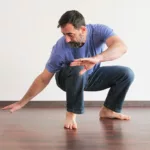
Ryan demonstrates a few examples from our Elements program:
Each of these movements covers angles you’d otherwise need a dozen separate stretches to hit — flexion, extension, rotation, abduction — woven together with the rest of the body engaged.
That last part matters. Real-world hip motion never happens in isolation. You twist while you stand, hinge while you carry, rotate while you reach. Putting away groceries asks your hips to do five different things in sequence. Static stretching one direction at a time doesn’t prepare you for that.
If you want a daily routine that pulls all of this together, our hip mobility routine packages it as a 5-10 minute daily practice.
How to Know Your Hip Openers Are Working
The exercises that work for you are the ones that target the angles and motions you actually struggle with. Plenty of stretches come from the world of physical therapy and personal training. They isolate a tight muscle, you do them, you feel them. That’s fine.
The harder question is when to add them, when to drop them, and how to tell if they’re actually moving the needle.
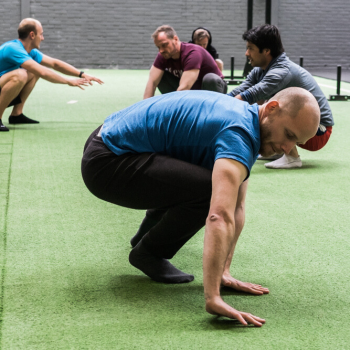 The most reliable way to track progress is to use everyday “benchmark” activities — the things you actually do in normal life.
Can you kneel, squat, or stoop without your joints locking up? Can you maneuver in tight spaces — cleaning behind the toilet, reaching for the Christmas lights at the back of the closet, picking something up off the floor without bracing?
“Hip external rotation improved 15 degrees” doesn’t mean much in your daily life. “I just dropped down to grab a pen and got back up without thinking about it” means everything.
Pick the activities you’ve been struggling with. Watch them. When they feel easier, the work is doing its job.
Beginner Hip Openers You Can Do Right Away
You don’t need Cirque du Soleil flexibility to start. You can begin on day one with movements that meet you where you are.
The clients in this video are demonstrating exercises we use in the early stages of our programs. They’re specific enough to give you targeted hip work and gentle enough to do without warm-up.
The traveling butterfly is the one most people recognize first. It’s the same butterfly stretch you remember from junior high gym class, but with movement added. You sit on the floor, fold your legs in front of you, then rock from straight legs to the butterfly position and back. The straight-to-butterfly transition is essentially a seated version of standing to squatting.
What makes it more useful than the static version: as you move through the angles, you find out where you’re actually tight. Some people get stuck on the way down. Others lock up coming back up. That’s information you can use.
We pair preparation movements like this with full-body locomotion exercises (Crab, Bear, Monkey) so hip opening happens inside real movement, not just in a position you hold on a treatment table.
Stretch and Strengthen at the Same Time
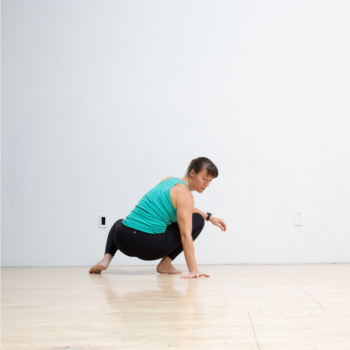
The Sumo Frogger is an exercise our clients dread the first time they see it and swear by within a few weeks. It’s a clear example of what we mean by combining stretch and strength in one movement.
You’re stretching the inside of your thighs — the adductors — and the deep hip rotators while simultaneously demanding strength to control the movement. That combination, stretch with active strength at end range, is what builds usable mobility instead of temporary flexibility.
Open hips need strong hips. The Sumo Frogger gives you both at once. Most gyms don’t program this kind of exercise. They should. Try it once and you’ll feel why.
What Open Hips Actually Get You
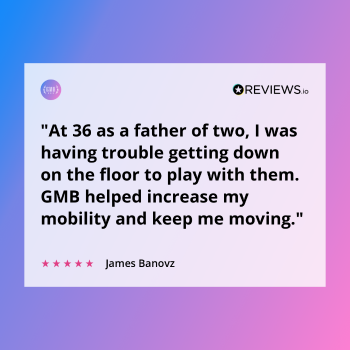 Open hips show up in the small things first. You bend down to tie your shoes without bracing on something. You squat to pick up a kid without your back fighting you. You move around tight spaces without rearranging your whole body to get there.
Watching how kids move makes the potential obvious. They bend, twist, drop, and pop back up without thinking about it. You’re not going to get back the loose joints and ligaments of a six-year-old. You can absolutely get your adult hips moving better than they are now.
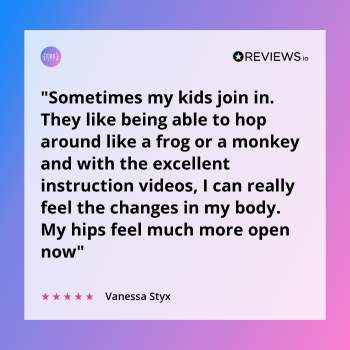 The trick is consistency, not complexity. You don’t need a complicated routine. You need a few movements you’ll actually do, on most days, for as long as you’ve got hips.
Pick two movements from this article. Do them every day for a week. Notice one real capability difference — sitting deeper, standing easier, getting off the floor without thinking about it.
Then build from there.
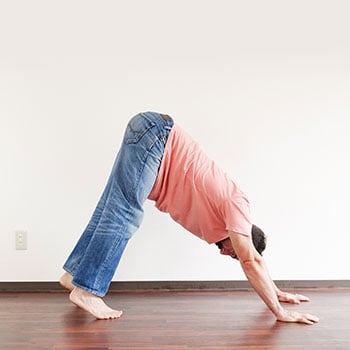
Already training and just need the focused mobility component? GMB Mobility is purpose-built for that.

Hi, I'm Jarlo Ilano PT, DPT 👋
Jarlo Ilano, PT, DPT, OCS has been a Physical Therapist since 1998. He earned his Doctorate of Physical Therapy in Musculoskeletal Management from Evidence In Motion, was board certified as an Orthopedic Clinical Specialist with the American Board of Physical Therapy Specialties, and is a certified Therapeutic Pain Specialist through EIM/Purdue University.
In addition to cofounding GMB, Jarlo has been teaching martial arts for over 30 years, with a primary focus on Filipino Martial Arts. He designed our Train Without Pain guide and our knee and shoulder restoration programs.