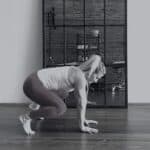
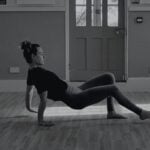
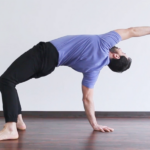
Walking around on all fours like a bear looks a little goofy, and it’s also one of the most useful movements you can train.
The Bear builds real strength through your back, shoulders, and arms, and it does it while putting your spine in a position it almost never gets to be in.
The Bear is a locomotion movement, which just means moving your whole body through space. It’s one of the “animal” movements, right alongside the Frogger, Monkey, and Crab, and they’ve been used in gymnastics and martial arts training for a long time. Once you get the hang of it, the Bear is the one I reach for most.
A few weeks back I’d shot and edited close to 200 videos, which meant a lot of hours hunched over a computer. When my upper back finally had enough, the Bear is what I used to undo it. Hands on the ground, hips up, head down, and the whole upper spine gets to decompress while you build strength at the same time. That two-for-one is why I keep coming back to it.
How To Do The Basic Bear
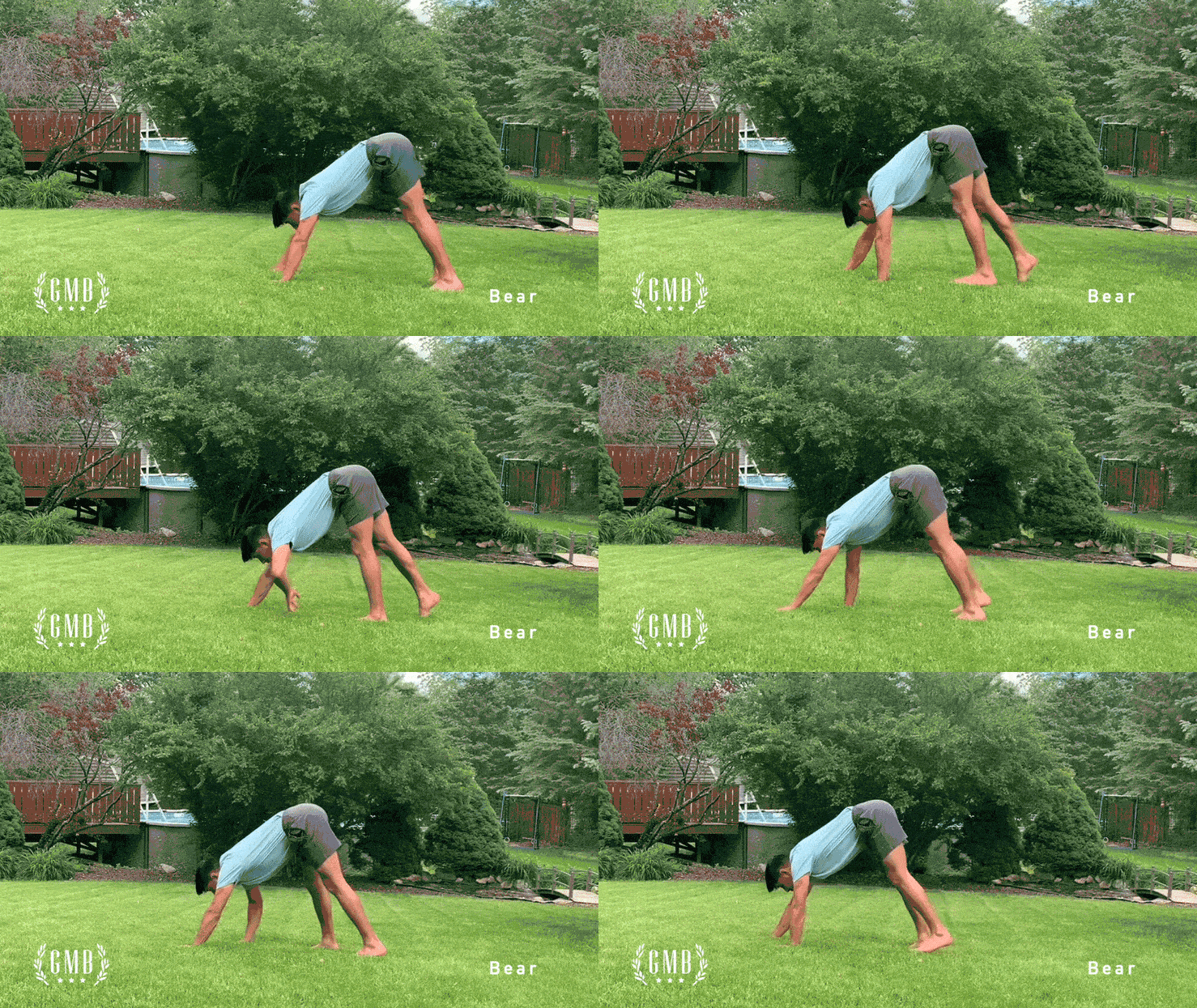
- Step 1: Start on all fours with straight arms and a slight bend in your knees. Get your hips up a little and your weight into your hands.
- Step 2: Move your right hand and left foot forward together.
- Step 3: Move your left hand and right foot forward together, and keep alternating to travel forward or backward.
Bear Walk Variations for Strong Shoulders and a Healthy Back
Below you’ll see 5 variations of the Bear that we use in our programs.
In the video above you can see 5 main variations on the Bear:
- Standard Bear – straight arms and straight legs
- Bent Arm Bear – bent arm, straight legs
- Bent Limbs Bear – bent arm, bent legs
- Bent Leg Bear – straight arm, bent legs (AKA “Sexy Bear”)
- Bent Elbow Bear – starts with straight arm, straight legs, but the elbow bends to touch the ground after each step
📝 Note that these are variations rather than typical “progressions” you see in most workout programs.
Which variation you work on comes down to what you need. If you want more shoulder strength, spend your time on the bent arm Bear. If you’re after core stability and balance, the Sexy Bear (yes, that’s what we call it) will keep you honest.
Get comfortable with the standard Bear first, then play with the others and see what your body asks for.
Cross-Step Bear Crawl Variation for Greater Coordination and Stability Challenge
Once the standard Bear feels solid, try crossing your center line as you move. It’s a small change that challenges your balance and coordination in a hurry.
Shifting your weight side to side gets your hips and shoulders moving through different ranges, and your core has to stabilize across your body as your torso rotates.
Simple tweak, big difference once you start doing it.
What If I Can’t Do the Bear Walk Like the Videos? 🤔
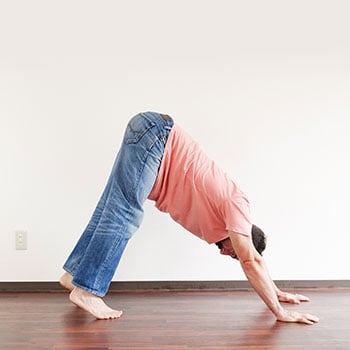
You don’t have to nail the full Bear right away. If it feels rough, start with the A-Frame instead. Get into the table top position, then push your hips up and back into the A-Frame.
Here’s one of our Lead Trainers, Eduardo, showing how to get into this position:
A cue I like: push your hips up as high as you can and let your knees bend a little. That opens your shoulders and lengthens your spine, which is most of what you’re after here.
Some people notice their wrists get sore from supporting their weight on their hands. If that’s you, run through our wrist routine and give them time to adapt.
Even More Bear Crawl Variations and Their Benefits
| Variation | Benefits |
|---|---|
| Standard Bear | • Scapular strength through concentric and isometric protraction, eccentric and isometric retraction, and eccentric control of elevation • Rotator cuff strength to control eccentric internal rotation and concentric, isometric external rotation • Spinal strength for isometric extension, rotation, and flexion • Hamstring and calf flexibility |
| Bent Arm Bear | • Elbow strength • Spinal strength and controlled mobility • Hamstring and calf flexibility |
| Bent Limbs Bear | • Elbow stability • Knee stability • Spinal strength for isometric rotation, extension, and flexion |
| Bent Leg Bear | • Rotator cuff strength • Knee strength • Spinal strength and controlled mobility |
| Bent Elbow Bear | • Elbow strength • Rotator cuff strength • Spinal strength |
The Bear takes real full-body strength and coordination, since you’re moving on all fours and matching each hand to the opposite foot. Pick up your right hand, move your left foot. It feels awkward for about a week, then it clicks.
It’s great for strengthening your spine, upper back, and shoulders, and it’ll open up your hamstrings and hips over time. Because you’re inverted with your head below your hips, it also decompresses your spine while you work, which is the part my desk-bound upper back appreciates most.
As the Bear gets comfortable, it carries over to the other animal movements like the Monkey and Frogger.
Here’s Eduardo running some of the Bear variations we use to build shoulder strength:
How To Train The Bear
The Bear builds strong shoulders, strong arms, and the ability to hold your own bodyweight up on your hands. That’s the groundwork for push-ups, inverted presses, and down the road, handstands.
A stronger core and steadier shoulders show up everywhere else too. Martial arts, swinging a racket, tossing your kid into the pool without tweaking your back. The coordination you build crawling carries into all of it.
Four or five minutes of Bear variations also makes a great warm-up. It gets your whole body online and ready to work, with your shoulders, hips, spine, and core all firing before you start your session.
The Bear is one of four animal movements that, practiced together, build a base of strength, flexibility, and control that makes everything else you do feel easier. You learn it once, and you keep it.
That’s what Elements is for.
Build a Foundation You Can Rely On at Any Age
With Elements, you’ll get strong, flexible, and capable using the Bear, Monkey, Frogger, and Crab, so you can move well without restriction.

Hi, I'm Ryan Hurst 👋
After a training accident ended his competitive gymnastics career, Ryan moved to Japan, where he spent close to 30 years training and competing in judo, kendo, and other martial arts until another injury made him rethink what training is for.
As Head Coach, he leads program design and teaches every week on our YouTube channel. His book, Stay On The Mat Forever, is aimed at helping you keep training for decades. He loves handstands, dogs, and hiking.