
You’ve been training for years. You’re consistent. You’re not lazy. You’re doing the work.
And yet, something that should be well within your capability… isn’t.
Maybe you’re stiff in places that don’t make sense for how much you train. Maybe you tried something new and your body just wouldn’t cooperate. Maybe you’re doing more and more work and making less and less progress.
It doesn’t mean you’re broken. It’s not just age. Nope. It’s basic physics.
You have a bottleneck.
Your Bottleneck Limits Your Capability
You know the tropes.
The super-flexy yoga girl who can put her foot behind her head but can’t carry two bags of groceries up the stairs. The roided-out gym bro who benches 315 but needs to hold onto the wall to sit down on the toilet.
These are silly caricatures. But they persist because we all intuitively understand something important: well-rounded physical ability matters, and being really good at one thing doesn’t cover for being bad at another.
What we don’t always appreciate is just how many “things” make up physical capability.
Strength, mobility, endurance, balance, coordination, agility, motor control, range of motion under load. These aren’t nice-to-haves on top of fitness.
They are fitness.
And if any one of them is lagging significantly behind the rest, it limits what you can do with all the others.
That’s your bottleneck.
Think about a highway. Four lanes in each direction, well maintained, moving fast.
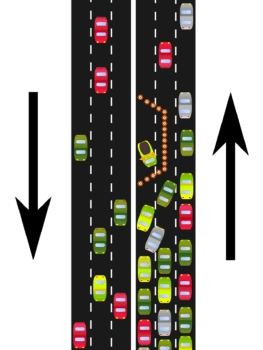 Then at mile 47, it narrows to a single lane for a half-mile construction zone. Traffic backs up for miles.
And when you reach the end?
The road is clear, and traffic flows easily, like magic.
Doesn’t matter how wide the rest of the highway is. The construction zone dictates how much traffic gets through.
Your body is the same kind of system.
The person with strong legs who can’t get up off the floor smoothly has a bottleneck. The runner with great endurance who keeps tweaking their ankle has a bottleneck. The lifter who’s stiff and achy despite stretching every day has a bottleneck.
In each case, the constraint isn’t where they think it is, because they’ve been looking at the four-lane stretch of highway and wondering why traffic isn’t moving.
Once you see this, a lot of training frustration starts to make sense.
And the first thing you realize is that adding more of what you’re already doing is exactly the wrong response.
The Noise Problem (Don’t Make Oatmeal Raisin Lasagna)
If you’ve spent any time on fitness YouTube, you know what the advice looks like.
Add mobility work. Do prehab. Get your zone 2 cardio in. Do HIIT twice a week. Train plyometrics for power. Hit your max strength work. Don’t forget single-leg stability. And wrist strengthening. And thoracic rotation. And hip CARs. And breathing drills.
Every channel has a “top 5 exercises for X” video. Hell, us too!
Strong wrists. Healthy elbows. Bulletproof shoulders. Healthy back. Mobile hips. Strong knees. Flexible ankles.
Each one presented as the critical piece you’ve been neglecting. And it might be! All of that advice is actually solid in isolation.
The problem is when you try to do all of it at once.
I want you to try something.
Go into your kitchen. Get the biggest bowl you have and put it on the stove.
Then open your refrigerator and take out every item. Every single one.
Put a little bit of each into the bowl. An egg. Some ketchup. A little butter. Tomatoes. Mushrooms. A little beef. A little chicken. That leftover stroganoff from last week. Yesterday’s lunch.
All of it is food. All of it is sustenance. All of it is good for you.
You should be eating all of it.
Now heat it up. Let the flavors really mingle.
Tell me if you want to put that in your mouth.
A training program is a recipe. A lasagna recipe is great. An oatmeal raisin cookie recipe is great.
But oatmeal raisin lasagna is an abomination, and that’s exactly what you’re making when you try to bolt together every piece of advice from every expert into one mega-routine.
The bottleneck concept is the antidote.
You don’t need to address everything. You need to find the one constraint that’s limiting your system right now and direct your attention there. Everything else either waits or gets handled by a solid general program that covers the bases.
Two Things You Actually Need
A good training setup for someone past the beginner stage has two components.
First: a broad training plan that develops strength, mobility, and coordination together.
This handles most of what your body needs. One good recipe, followed as written.
The specific program matters less than covering the bases: pushing, pulling, squatting, hip hinging, rotating, moving on the ground, and using your body in varied directions.
Most popular workout templates skip at least half of that list.
If all you’re doing is push-ups, squats, planks, and burpees, you’re training in two directions with zero rotation, no shoulder range of motion, no lateral movement, and no coordination work. That’s a recipe for getting strong in a narrow band while developing bottlenecks everywhere else.
Ryan breaks this down:
Rotation, lateral movement, full shoulder range, independent leg work, and full-body coordination. These are the patterns that standard programs leave out, and they’re often exactly where bottlenecks develop.
Second: specific, targeted work on your current bottleneck.
This is the piece that makes your general training actually pay off.
Without it, you’ll improve in the areas where you’re already capable and stay stuck where you’re restricted.
With it, you release the constraint and the whole system opens up.
Finding Your Constraint to Clear the Bottleneck
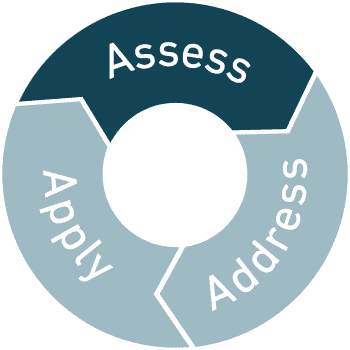
So how do you find the bottleneck? You test yourself honestly.
We call this Assess, and it’s the first step in a framework we use across all our programs.
The assessment isn’t a fitness test in the conventional sense. You’re not measuring how fit you are. You’re searching for the specific constraint that’s limiting what you can do.
A test tells you your score. An assessment tells you where to direct your effort.
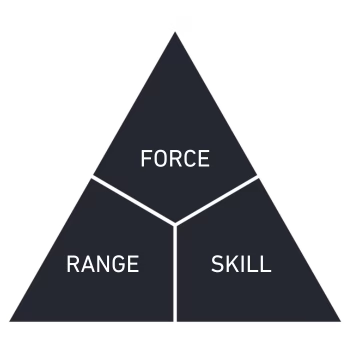
Your physical capability comes down to three attributes: strength, mobility, and control. These let you express force, range, and skill.
Most experienced trainees have invested heavily in strength. Fewer have systematically developed their mobility or motor control to the same degree.
That imbalance is where the bottleneck usually lives.
For experienced trainees hitting ceilings in their 30s, 40s, and 50s, the most common bottlenecks fall into a few patterns:
Hip mobility restricting ground movement.
You can squat with a barbell, but getting down to the floor and back up with ease is a different story.
The restriction shows up in deep squats without load, in transitions between positions, and in anything that requires your hips to work in multiple directions.
Shoulder range limiting overhead and rotational capacity.
Years of bench pressing and front-dominant training have built strong shoulders in one plane.
Reaching overhead, rotating under load, or supporting bodyweight on your hands reveals the gap.
Motor control under varied conditions.
You can generate force in a straight line. Absorbing force, redirecting it, or controlling momentum through a change of direction is where things break down.
This is the bottleneck behind a lot of “random” tweaks that seem to come from nothing.
Poor ground-to-standing transitions.
Getting up and down from the floor should be easy and fluid.
If it requires momentum, a hand on the couch, or a specific sequence you can’t vary, there’s a constraint in there.
A good self-assessment makes these visible.
Move through a set of fundamental patterns and notice where things feel restricted, shaky, or harder than they should be given your training history.
That’s your construction zone. That’s where the work goes.
Addressing the Bottleneck
Once you know the constraint, the question is how to train it.
And this is where progressive skill-based training works differently from the “just add a corrective exercise” approach.
A corrective exercise isolates the problem.
Tight hips? Stretch them. Weak core? Plank more. Limited shoulder range? Band pull-aparts.
These can help, but they train the attribute in isolation, disconnected from how you actually use your body.
They’re ingredients without a recipe.
We call the next step Address, and the approach is to load the bottleneck through movement, progressively.
You train the restricted pattern in context, at a level you can manage well, and build from there.
If your bottleneck is hip mobility in ground transitions, you don’t just stretch your hips and hope the improvement transfers.
You practice ground movements that require hip mobility while simultaneously demanding coordination and control. The stretch is built into the movement. The strength is built into the movement. The motor pattern that ties them together is built into the movement.
This is the logic behind skill-based training.
You develop the attribute and the ability to use it at the same time. A hip stretch gives you range. A movement practice that loads that range while you coordinate your whole body gives you capability.
The Constraint Shifts
Once you resolve a bottleneck, a new one appears.
The system is no longer limited by your hip mobility, so now the limiting factor might be upper body coordination, or core rotation under load, or single-leg balance.
The constraint shifts because the system has changed.
This is the third step: Apply.
Take your improved capability into more complex or demanding movement, and the new context reveals the next bottleneck.
Then assess again. Address again. Apply again.
The loop runs continuously.
Training as an ongoing practice of finding and resolving constraints is a fundamentally different orientation than “follow this 12-week program and you’ll be fit.”
A solid program builds general capacity. The constraint-finding cycle is how you direct that capacity toward what actually matters for your body, right now.
And “right now” keeps changing.
Your body changes. Your activities change. Your recovery capacity shifts with your schedule and your stress.
The bottleneck that mattered six months ago might be fully resolved while a new one has quietly developed. A framework that adapts with you is worth more than a hundred static programs.
Where to Focus if You’re Unsure
If all this makes sense and you’re wondering what to do first, the answer is simple: build the broad foundation and let it show you where the bottleneck is.
Elements was designed to do both.
The program develops strength, mobility, and motor control through fundamental movement patterns (Bear, Monkey, Frogger, Crab) that cover pushing, squatting, rotating, and moving on the ground in multiple directions.
That’s your broad base, and it fills the mobility and control gaps that most strength-focused trainees are carrying.
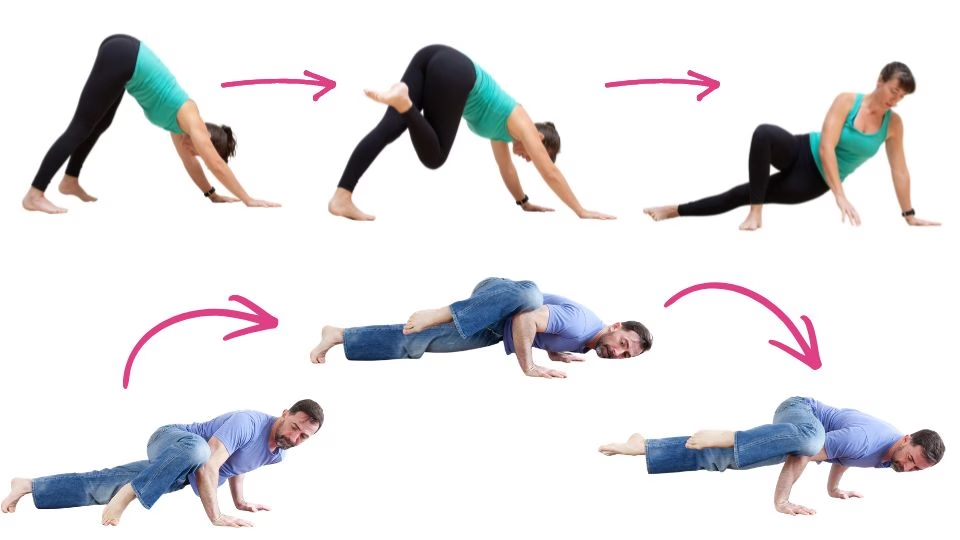
Elements also functions as a rolling assessment.
Every session, you rate your movement quality and ease, which means you’re generating data about where you’re restricted and where you’re strong. After a cycle, you have a clear picture of your specific bottleneck and you know exactly what to address next.
From there, Level 2 programs let you target your specific constraint: Integral Strength if the bottleneck is strength, Mobility if it’s range, or a combination.
Assessing tells you which one. You don’t have to guess, and you don’t have to do all of them at once.
Find the bottleneck. Address it. Move on to the next one.
Find Your Bottleneck and Start Making Real Progress

Hi, I'm Andy Fossett 👋
A lifelong martial artist and former schoolteacher, Andy’s deeply concerned with autonomy and fitness education. As CEO of GMB Fitness, he’s dedicated to providing an open, accessible culture for both clients and staff to enjoy exploring more of what they’re truly capable of.
He's best known for his wildly off-topic rants on the GMB Podcast and spends the majority of his time eating burgers, sipping bourbon, and reading books.