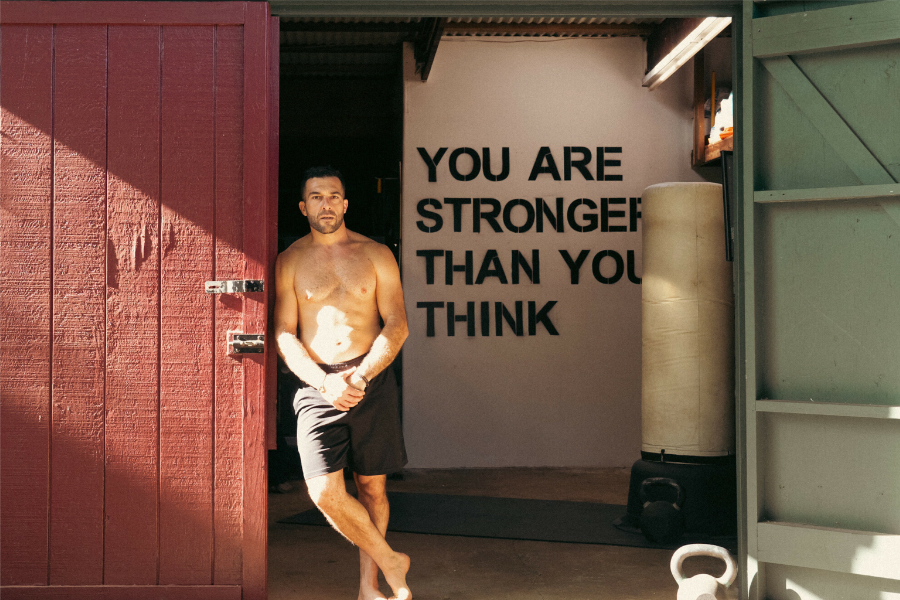

John Patrick Morgan walked away from seven years of CrossFit without losing the strength it gave him. He just stopped getting injured.
He’s 45, hyper-competitive, came up through martial arts and endurance sports before spending the better part of a decade chasing leaderboard numbers in CrossFit. The training worked until it didn’t, and by the time he found us, the injuries were stacking up faster than the PRs.
Three months in, his metric for strength had shifted. He stopped measuring by what he could put on a barbell and started measuring by how his body felt and what it could actually do.
Here’s how that shift happened, and what you can pull from his experience if you’re in a similar spot.
Where CrossFit Stopped Working for Him
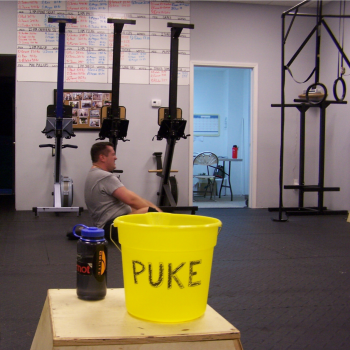 CrossFit gave John what a lot of competitive guys want from training. A leaderboard to chase, real metabolic conditioning, measurable strength gains. He went hard for seven years.
The same competitive wiring that made him good at it also made him bad at pacing.
“As I got older, I realized that CrossFit was taking me beyond what was safe.”
The injuries kept stacking up. Nothing catastrophic, just the slow accumulating kind that has you modifying your workout, then modifying it again, then quietly wondering if you’re going to be one of those guys who walks away from the sport because the body stops keeping up with the identity.
I’ve seen this pattern in a lot of patients and clients over the years. The frustration isn’t really the injury. It’s the loss of the thing that made you feel powerful. Slowing down feels like surrender. Doing less feels like losing.
How One Coaching Cue Changed His Whole Approach
 A client of John’s, also a post-CrossFit GMB user, recommended us. She framed it as “scrubbing his brain,” which turned out to be about right.
He came in skeptical the program would challenge him. First couple of weeks of Integral Strength, he wasn’t breaking a sweat. The movements felt too easy and the volume felt low.
Then he had a session with Rose, one of our coaches. She told him to do fewer reps. He asked how many. She said one. For thirty seconds.
That’s when it got hard.
“It’s almost like I needed it to be too easy to find out that it was me that was making it too easy. To learn this new dimension to how to be in relationship to strength in my body. And then it became one of the hardest things I’ve ever done.”
The principle Rose handed him became the organizing question for the rest of the program. How do you make a movement harder without changing what the movement is? You slow it down, you increase the precision, you stop letting momentum carry you through positions, you start owning every inch of range you move through.
That’s training quality. And when you do it seriously, you’ll notice you don’t need as much volume or as much weight to get a real training effect. By the end of three months, John was getting CrossFit-level metabolic demand from movements he’d initially dismissed as warmups.
He ran Integral Strength alongside Elements, two sessions of each per week, thirty to forty-five minutes a session. Four sessions a week total. He went hard during them.
The everyday capability gains showed up faster than he expected.
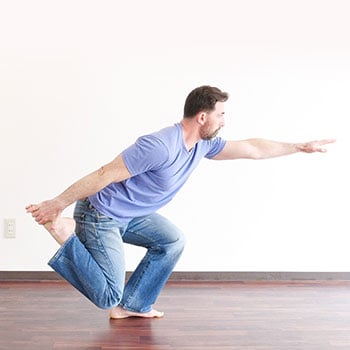
“We live on a farm and we have to pull weeds. Since GMB it’s been easier to just sit in a squat and pull weeds, instead of having to pull for thirty seconds, get up, move around, and sit back down again. Even though I’d been doing barbell squats, that’s different than hanging out down low without weight.”
That’s the test that matters. Whether your body can do what your actual life asks of it. Whether you can hang out in a squat to pull weeds, get back up off the floor without thinking about it, or pick up your kid without bracing for it.
John’s own framing of what he gained is worth letting him say in full.
“I really get the word autonomy that GMB uses. I just feel amazing in my body after these four months. What I can do with my legs now, in this body that I live in every day, is so much greater. I have so much more of a sense of control and mastery over my body, and that gives me a greater sense of power than a number on a barbell ever did. So I didn’t actually lose anything. Even if I’ve quote-unquote lost a little bit of my barbell lift, I’ve gained power and freedom.”
Here’s the full conversation we had about it.
What to Take From John’s Approach
A few specific moves John made that I’d want you to notice if you’re in a similar spot.
Movement Quality Will Get You Further Than Movement Quantity
 This was the lever that worked for John. He kept training hard. What changed was the attention. He stopped letting momentum carry him through positions and started feeling each part of every movement.
Slowing down enough to control the full range of a movement, then holding the positions you’d normally bounce through, exposes weaknesses you can’t see at speed. You find out where you actually have control and where you’re getting away with compensation.
Once you fix the gaps, the strength has somewhere to live. The reps you do build into something durable.
Build Strength Your Body Can Actually Use
 What John gained was a body that could squat down and stay there long enough to do real work, then stand back up and do something else. His barbell numbers might have dropped slightly. He didn’t care.
That’s the kind of strength most people actually want from their training, even when they think they want the number. If you can pick up your kid, sit on the floor with your family, lift heavy stuff when you need to, and keep doing all of that into your fifties and sixties, you have the strength that matters.
The way you build it: prioritize how a movement feels and what you can control inside it. Let intensity rise on the days you’re moving well. Pull back on the days you’re not. That’s what we mean by autoregulation, and it’s how John kept making progress without setting himself back.
What Opened Up Once He Stopped Getting Hurt
 When you remove the constant low-level injury cycle from a competitive person’s training, you find out what they actually want to do with their body.
For John, that turned out to be more than just continuing to CrossFit safely. Once he was a few months in and his body felt reliable again, his sense of what was possible started expanding.
He’s working toward a freestanding handstand. He’s considering whether he could build up to a backflip at 45. He’s thinking about getting back into martial arts. The competitive wiring that used to get him hurt now has somewhere productive to go.
“I see a new world opening up. I don’t know what my future holds, but it’s definitely more exciting than it was when I was just trying to keep lifting weights so I lived longer and stayed strong by some metric.”
 There’s a family piece to this too. Locomotion work doesn’t stay in the training session. He, his wife, and his three-year-old and eight-year-old all do Spider-Man crawls and other floor work around the house together. Training gets folded into life instead of competing with it.
That’s the part that’s hard to see going in. When your training stops costing you injuries and starts giving you capability you can use, the goal expands on its own. You stop training just to hold on to what you’ve got, and start training because it keeps opening up new things to play with.
The Long Game
The simplest version of the lesson here, and the one I’d want you to take from John’s story: make sure whatever you do today means you can still practice tomorrow.
That’s the metric that matters once you’ve been training long enough to know what your body costs. Numbers on a bar don’t carry forward if your shoulder is shot. Speed doesn’t compound if your knee gives out. What compounds is the practice itself, the daily small effort to move well and stay capable, year over year.
John’s competitive instinct didn’t go anywhere. He just pointed it at a different target: greater capacity to feel his body, higher quality of movement, the long practice itself. Those are things that can keep getting better for decades.
If you’ve been doing the hard work for a long time and you’re starting to feel the cost, this is a good place to redirect what you’ve built.
Build The Strength That Matters
Integral Strength is the program John used to build the kind of capability that carries you through the rest of your life. Skills you can actually use, strength that doesn’t depend on a barbell, and a practice you can keep going as long as you want to.
Hi, I'm Jarlo Ilano PT, DPT 👋
Jarlo Ilano, PT, DPT, OCS has been a Physical Therapist since 1998. He earned his Doctorate of Physical Therapy in Musculoskeletal Management from Evidence In Motion, was board certified as an Orthopedic Clinical Specialist with the American Board of Physical Therapy Specialties, and is a certified Therapeutic Pain Specialist through EIM/Purdue University.
In addition to cofounding GMB, Jarlo has been teaching martial arts for over 30 years, with a primary focus on Filipino Martial Arts. He designed our Train Without Pain guide and our knee and shoulder restoration programs.