
Imagine you started working on the handstand about a year ago and it went great.
Belly-to-wall, check. Back-to-wall, done. Kick-ups came a little slower, and then you got to rebalancing and stopped.
Four months go by.
The instinct is to go looking for a better progression. Maybe you skipped a step somewhere. Maybe there’s a regression you’re supposed to be doing first. Maybe the person whose progression you’re following left something out.
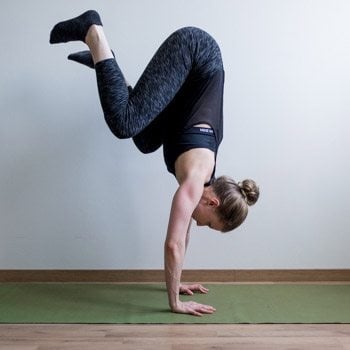 I’ve been teaching movement skills for decades years, and I can tell you what’s usually happening, because it’s the same thing almost every time.
It’s not that you’re missing a step. It’s that the step you’re standing on is narrower than it needs to be.
The Skill-Progression Staircase
There’s a belief sitting underneath all of this that I think you’ll recognize.
The belief is that every skill has one correct sequence of steps, that the sequence is the same for everybody, and that your only job is to find the right one and climb it in order. Call it the Staircase.
It’s an appealing idea. It turns something messy into something orderly.
It also means that when you get stuck, the problem is the staircase you picked, so you can go find a better one instead of doing harder work. And there’s an enormous amount of content out there feeding this, most of it made by people with a lot of camera time and not a lot of teaching time. Ten steps to the planche. The only pull-up progression you need. Fix your handstand with this one drill.
It’s also just plain wrong.
Skill development is genuinely progressive. You go from not being able to do something to being able to do it, and you pass through stages on the way. With some skills those stages are pretty discrete. That part is correct, and I’m not saying otherwise.
What isn’t real is the idea that those stages line up into a single objective path that works the same way for every body.
What you actually have is a foundational movement and a bunch of variations of it.
Some of those variations are harder than others for most people, which is why we can put them in a sensible order and why programs are useful.
But one variation might feel brutal for you and easy for the person next to you, based on your joint structure, your movement history, what sports you played, and where you’re carrying old injuries.
My ankle has seven screws in it and it’s never going to bend the way yours does. I navigate that by building strength and skill around it.
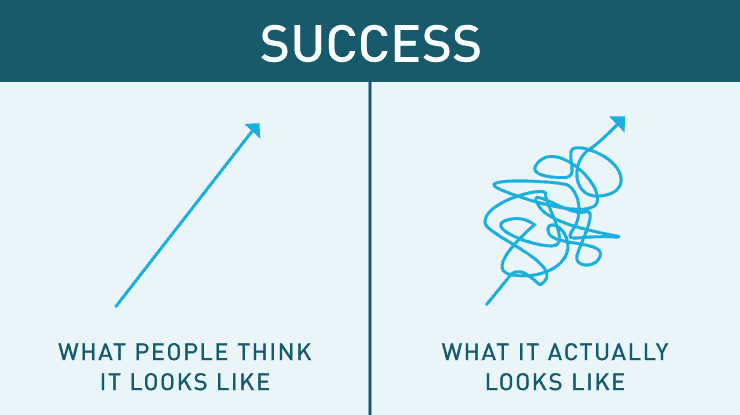
You’ve seen this image a hundred times. It’s fine as far as it goes, and it’s what progress looks like from the outside. But it doesn’t tell you what’s happening on the inside during all those curves, or what you should be doing while you’re in one.
That’s the part I want to give you.
Two Directions in Progression: Up and Out
I think about skill work as moving in two directions:
Vertical is up. It’s the next harder variation of the thing you’re chasing. Tuck to advanced tuck to straddle. Wall handstand to float to freestanding. This is what everybody means when they say “progressions,” and it’s the direction that feels like progress because you can point at it.
Horizontal is out. It’s everything at roughly your current level that isn’t the next step up. Same movement with a different depth, a different direction, a different range, a different tempo. Different hand positions. Different surfaces. It also includes movements that aren’t the goal movement at all but build the strength, range, and control the goal movement is going to demand from you.
You experience both when ou learned to drive.
You passed your test and you could drive. Then you drove in rain. Then you drove on the highway. Then you towed a trailer, and drove in a city where you didn’t know the roads, and parallel parked a stick shift on a hill.
None of that moved you up a ladder. There’s no advanced driver’s license waiting at the end of it.
But it all contributes to making you someone who can actually drive.
Or take singing. There’s singing it at karaoke, and then there’s singing it while you play guitar, singing it while you play piano, singing it with a band that’s a little too loud, doing a reggae version of it, doing a punk version of it.
The gap between “I can sing this song” and “I can sing the hell out of this song in any situation” is entirely horizontal.
Horizontal work doesn’t feel like a direct path, so we want to skip it.
It’s often harder than the vertical attempt you were making, and it feels like exactly what it is, which is practice and work. The thing that’s missing is the visible line connecting it to your goal. Nobody puts “played with my hand position for six weeks” on the list of steps to the handstand, so it doesn’t feel like it counts.
It counts. And it counts for a LOT!
If you want to go deeper on how to build variation into movements you already own, we wrote about that in two kinds of complexity.
Why the Next Step Feels Impossible
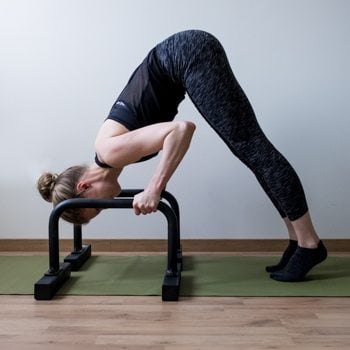 First thing to know: the first time you try any new variation, it’s going to feel too hard. That’s normal. That’s not a verdict on you, and it’s not a sign you picked the wrong staircase. It’s information about where you are today.
The question is what to do with that information, and there are only two real answers.
Either you haven’t done enough of the current stage, or you haven’t done it well enough.
The second one is more common than people want to hear.
Here’s the example I see constantly: the frogger stall.
The Frogger Stall is a movement that many people struggle with at first, because it’s genuinely hard. People tell us they can’t get it, that they’re stuck, that they need something in between.
Almost every time, it’s the same cause: they’ve been doing the regular Frogger by pushing off with their legs to hop forward, instead of using their arms and torso to pull the knees forward.

Both versions get you across the floor. They look close enough on video that you’d never know. But only one of them builds the upper body and core strength that the Stall runs on.
Which is why we very specifically teach it a certain way in Elements.
But if you ignore the instructions, your progress suffers.
You can do hundreds of Froggers, feel completely comfortable with them, and still get stuck trying to stall. Then you go looking for a missing progression, and there isn’t one.
How to Work Both Directions
In case this all sounds vague or theoretical, here’s how the process works:
Test up more often than you think you should
Don’t wait until you feel ready for the next variation. You won’t feel ready, and waiting turns into months. Test it regularly and let the attempt tell you where you are.
A session that does this well looks like:
- Warm up with the variation you already own. Three reps or holds, building from short to your full working duration.
- Test the next variation up. Short attempts, up to 8 sets, full rest between, and stop each one before your form goes.
- Drop back to your current variation and bank the volume there. You’ll be more tired now, so scale it down and keep the quality high.
- If you’re still fresh, finish with assisted work or an easier variation. If you’re cooked, you’re done.
Our programs basically do this for you 🙂
Figure out what’s actually missing
When the test doesn’t go, don’t just log it as “too hard.” Figure out which of three things came up short: strength to produce the force, range to get into the position, or control to coordinate it.
You might guess wrong on this the first time. It’s fine.
With handstands, everybody says balance and it’s almost never balance. It’s usually control, specifically rushing the entry so they never actually set the position up. We wrote a whole piece on finding your real bottleneck, and it’s worth your time.
But don’t stress over it. “Extra” work isn’t necessarily waste.
Building a broader base over a longer time eventually leads to better performance.
Train “out” from the center
Once you know what’s missing, go sideways along that attribute.
If it’s range, work the same movement at depths and angles you normally avoid, and spend time in the end positions instead of passing through them.
If it’s strength, load the pattern in a shape you can control, which often means a shorter lever, a smaller range, or an easier surface with more of it.
If it’s control, slow the whole thing down, change the tempo, change the direction, and take away the stability you’ve been borrowing.
And then there’s everything adjacent. Movements that aren’t your goal at all but demand the same thing from your body. For a handstand, that’s Frogger work, Crow, Crane, Bear, wrist prep, hollow body holds, and half the transitional movement stuff we teach.
None of those are steps on the handstand staircase, but all of them build the handstand.
Play is part of the work, not the reward
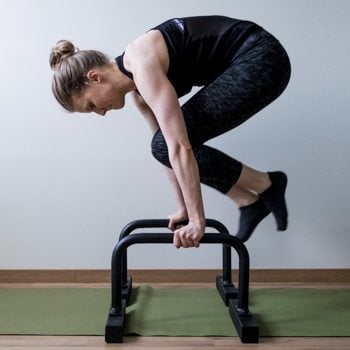 This is where Play earns its place in a training session, and it’s more useful than most people realize.
Practice happens at the edge of your ability. Play happens at the core of your competence. Take something you already own, relax exactly one variable, and pay attention to what changes.
If you can hold a solid handstand with your legs straight and toes pointed, open your legs a little and see what happens to the structure. Then relax your feet entirely and see what that does.
If you’re doing a Bear, turn your hands out to the side. Drop your hips a couple of inches. Slow the whole thing down until you find the spot where you’re balanced between hand placements, and then put your hand somewhere you never put it.
One variable at a time, on a movement you’re comfortable with, in a setting where you’re safe.
You’re testing where your control ends, which is the only way to extend it.
Every one of those is horizontal work, and you’ll notice it makes the version you were practicing feel easier when you come back to it.
How to tell it’s working
This is the part that trips people up, because horizontal progress doesn’t show up on a rep count. You can’t put “explored 40 hand positions” in a spreadsheet and watch the number go up.
What you can track is quality and ease at your current level, which is exactly why we build those ratings into our programs instead of chasing numbers. Is the movement holding its key points more consistently than it did three weeks ago? Does it cost you less to do it? More on why we organize training this way in our piece on why rep counts hide more than they show.
And then there’s the test itself. You go back up, and the step that was impossible in March is merely hard in May. That’s your answer.
Why the Broad Base Wins Later
I came to all of this through coaching, but the research points the same direction, so it’s worth a minute.
A 2022 meta-analysis pooled 51 studies covering 6,096 athletes, 772 of them world-class. The athletes who ended up world-class as adults had done more practice in other sports as kids, started their main sport later, and progressed more slowly early on than the athletes who topped out at national level. The kids who specialized early and climbed fast were a different group of people from the adults who ended up at the top.
It matches what I’ve watched happen with thousands of students. Broad and varied looks slower for a while. Then it doesn’t.
Applying Horizontal Progression in Practice
Here’s two skill examples to drive this home for you…
The L-Sit
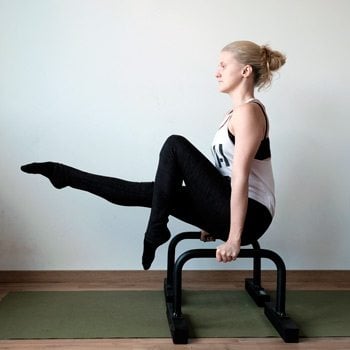 The vertical path is the one everybody knows. Tuck hold, one leg out, both legs out, and eventually you’re holding a clean L.
Say you’re stuck at one leg. Vertically, there’s nothing to do but keep failing at two legs.
Horizontally, there’s a lot. Hold the tuck longer than you need to. Hold it with your knees a little lower than feels comfortable. Do it on the floor instead of parallettes, which takes away shoulder range and makes you earn the depression. Do it on parallettes with your hands turned. Work compression from a seated position with your legs on the ground.
That’s what we do in Integral Strength. The L-Sit progressions are in there, and so is everything running alongside them.
The Handstand
Our handstand tutorial has a step-by-step progression in it, and people are sometimes surprised by how much of the training isn’t handstands.
Wall walk-ups. Kick-up practice where you barely touch the wall. Floats. Bails and cartwheel exits, which are pure safety work and also completely change how willing you are to commit. Frogger and Crow for the compression and the hand strength. Wrist prep, because wrists are where handstand practice usually goes to die.
None of that is a step on the way up. All of it is width. And the people who do it get their handstand sooner than the people who spend a year kicking at a wall.
The Goal Move Is a Tool
 Here’s the thing I’ve come around to after a few decades of this.
Training for the split is worth more than being able to do the split. Training your body to run for an hour without stopping is worth more than the hour of running.
The handstand, the muscle-up, the planche, the bridge: these are excellent ideas to organize your training around. They give your practice a direction and a reason to show up. They’re specific enough that you can build a plan around them.
But the true result is the base you build while you were working toward them.
That’s the part you take into your sport, your job, your hikes, and your sixties.
I do a short hip routine every morning. It takes a few minutes and it’s not building toward anything. If I skip it, everything else in my day works a little worse. In terms of any specific goal, it might look like a waste. But it might be the most valuable thing I do.
Go out, not just up. The goal will get closer while you’re not looking at it.
Build the Base Everything Else Stands On

Hi, I'm Ryan Hurst 👋
After a training accident ended his competitive gymnastics career, Ryan moved to Japan, where he spent close to 30 years training and competing in judo, kendo, and other martial arts until another injury made him rethink what training is for.
As Head Coach, he leads program design and teaches every week on our YouTube channel. His book, Stay On The Mat Forever, is aimed at helping you keep training for decades. He loves handstands, dogs, and hiking.