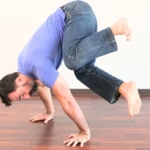
People see our videos and try to file them under something they already know.
My favorite: “Isn’t that just Yoga?”
 I wish I had a nickel for every one of those comments. I’d be exorbitantly rich in nickels.
And honestly, fair enough.
When something doesn’t fit your expectations, you mash it into a category you already have.
Put a heavy weight in front of someone and everybody knows the plan: pick it up, put it down. Give them a circuit to spike their heart rate: push on through.
Our approach doesn’t look like either of those, so people reach for the nearest label.
So in this article, I want to answer “what do you teach?” the way our clients would answer it. What discipline it resembles matters a lot less than what you get out of it: what changes in your body, and when you’ll notice.
I’ll cover:
- Our backgrounds, so you can see where this came from (and what we deliberately don’t teach)
- What we teach: the three attributes every program builds
- What clients notice improving, in the order they tend to notice it
- Why the method works that way
Why We Started This Whole “GMB” Thing
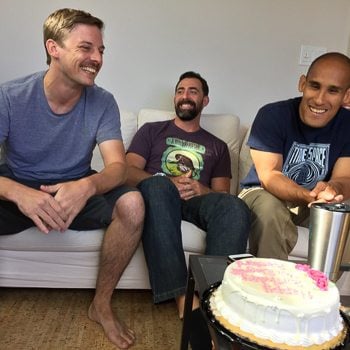 Andy, Jarlo, and I started GMB in 2010. GMB stands for Gold Medal Bodies, and over time that name stopped fitting what we do, so we shortened it.
We come from different corners. I was a competitive gymnast through my childhood and teenage years, then spent 28 years in Japan studying martial arts: Kendo, Iaido, Judo, Shorinji Kempo. Jarlo is a Doctor of Physical Therapy who’s been treating patients for over 25 years. Andy is a lifelong martial artist and teacher who’s spent his career figuring out how people learn.
Training and coaching across that many disciplines showed us the common thread running through all of them: the principles of good training that work everywhere. And each of us had noticed the same thing in our own practice. Good training made us better at our sports, and it also made us move better, with less pain, in every other part of our lives.
That connection, between training and everything outside of training, is the piece most systems skip. We built GMB to teach it.
One thing we’re clear about: we don’t teach gymnastics, martial arts, yoga, or physical therapy. I competed in gymnastics for years, and it would be disrespectful to that sport to claim that what we do is gymnastics. It’s a specific sport with specific rules, and that’s a different thing. Same goes for the other disciplines. They shaped how we teach. They’re not what we teach.
What We Do Teach
We teach you to get stronger, move better, and build confidence in your body. Plain and simple.
Whether you’re into martial arts, climbing, lifting, or you’re getting back into shape and working through some aches and pains, the training makes your body more capable and harder to injure for everything you do.
We structure our programs around three attributes:
Strength: The Force for Movement
 Being strong makes everything easier, and having some strength in the bank helps on the days you’re not at your best.
But strength is a means to an end, and the end is up to you. Some people are happy chasing another plate on the barbell forever. Plenty of people aren’t, so we design full-body strength training in service of a question: what do you want to be strong for? Answer that, and your training gets a direction.
Flexibility: The Freedom of Movement
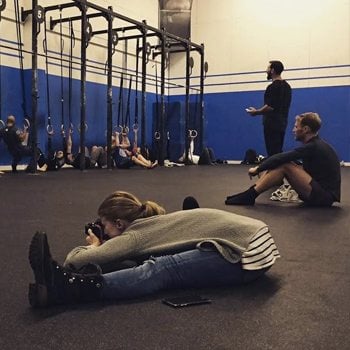 Flexibility doesn’t require the splits (though it can include them if that’s what you want). It means moving the way you want without feeling restricted.
Some people distinguish between flexibility and mobility, and in our experience they’re two sides of the same coin, developed through the same work. One of my favorite client comments came from a plumber who told us stretching helped him squeeze into the tight spaces on his job. That’s the standard: flexible enough for what your life asks of you.
Body Control: The Autonomy of Movement
 This is my favorite part of our curriculum: learning to move your body in a wide variety of ways, some functional, some seemingly impractical.
You can tell a lot by watching someone move. When you see a dancer or a gymnast moving with grace, you’re seeing years of work on control. Body control gets far less attention in fitness programs than strength and flexibility do, and without it, those other two attributes can only take you so far.
If you can control your body in your training, you’ll control it in your life too.
Those three attributes are the curriculum. But a curriculum is just a list until you see what it produces. So the honest way to finish answering “what do you teach?” is to show you what our clients report back.
What Clients Notice, and When
We have over 2,000 client reviews at this point, collected through Reviews.io, a third-party platform where we can’t edit a word. Reading through them, a clear pattern shows up in what people notice first, next, and years down the line.
The First Few Weeks: Ordinary Movement Gets Easier
The earliest changes show up in movement quality. Stiffness backs off, positions that were uncomfortable become available, and everyday movements start feeling smoother. Clients report these within the first handful of sessions:
“At 53 I am really impressed how I am progressing. Having struggled to get a heels down squat for some time I did it after just a few weeks of Elements.”
“Two things that happened quite soon a few sessions into Elements: noticing that my posture felt more upright and that my movements had an easy flow to them… For example getting down to pick something from the lower tray of the dish washer and getting up and turning 90 degrees to place it into a tall cupboard.”
“I’m only 12 sessions in and I already feel a major difference. I look forward to every session knowing that even a little bit of time focused on the RIGHT thigns is making a huge difference.”
The dishwasher one is my favorite kind of result.
Nobody buys a training program dreaming about unloading dishes. But bending, turning, and reaching without thinking about it is exactly what the training builds, and it’s usually the first place clients feel it.
A Few Months In: Capability Shows Up Uninvited
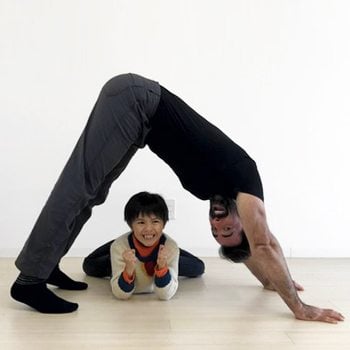 The next stage is when capability starts appearing outside your training, in situations you never practiced for:
“I went to a music show where standing for hours is the norm and I remember going wow my lower back isn’t hurting and it’s hour 2.”
“The first real thing that made a big difference was when I went skiing, and could easily sit down in the snow with skis on and then get back up again without taking them off. Before, I was quite clumsy and could not even imagine being able to do that.”
“I’m 54, and I have a 10-year-old boy and a 15-year-old girl; both are very active. I have done various martial arts for over 20 years and have ‘earned’ bad shoulders and knees. As long as I do a GMB program 2-3 times a week I don’t have any pain and can ski, mountain bike, and play sports with my kids.”
See what’s happening here?
Nobody trained “standing at a concert” or “getting up in the snow with skis on.” They trained a small set of movements with attention, and the capability transferred to situations we could never have programmed for. That transfer is the product.
Years Later: The Foundation Keeps Paying
The reviews I’m proudest of come from people who’ve been with us the longest:
“5 out of 5 stars because GMB is the main reason why I have more mobility and move better at 46 then in my twenties. Over the years i have done almost all of their programmes with Elements, Integral Strength and Mobility multiple times. It laid a foundation to explore movement and dance as a hobby and most importantly helps me play more freely with my 6 year olds.”
“I wound up on the road without gym access reliably, and picked up a GMB program to try and fill in the gaps. I found myself feeling and moving better, and almost a decade later it’s one of the cornerstones of my training still.”
“Since discovering GMB several years ago it has been an integral part of my lifestyle and daily routine. It has helped me correct a long term shoulder problem, which is now 100% and just generally helped me feel the best I have in the last 25 years (at 53).”
So here’s the pattern across two thousand reviews: the first results arrive in weeks, and the reason people stay for a decade is that the capability keeps compounding.
Moving better at 46 than at 26 isn’t a fluke result. It’s what consistent practice does when the practice is designed well.
I can vouch for the long end of that curve personally. I’ve got a rebuilt ankle and knee, plus a couple of shoulder surgeries behind me, and after four decades of training I still practice daily and move better than I did in my competitive years.
The method in our programs is the same one I every damn day.
Why It Works That Way
 Andy is fond of saying we’re an education company that teaches fitness.
That’s the honest truth, because the results above come from how we teach more than from any particular exercise.
Three things do the heavy lifting.
The programs are deliberately simple.
Elements, our foundational program, is built on four movement patterns. That simplicity throws some people at first, and it’s the result of filtering decades of training and clinical practice down to what’s universally useful, then building a system to teach it deeply. We wrote about the deceptive simplicity behind effective training if you want the full argument.
Every session is structured like a coached practice.
A session prepares your body, gives you focused skill work while you’re fresh, makes room to explore and play, applies physical effort once the precise work is done, and closes with a check-in on how it went. We call that structure the 5P Praxis Protocol: Prep, Practice, Play, Push, Ponder. It’s the reason clients tell us the sessions feel like play instead of punishment, and enjoying your training turns out to be the single strongest predictor of whether you’ll keep doing it.
You learn to coach yourself.
Rating your own movement quality and effort each session teaches you to read your body and adjust: when to push, when to refine, when to back off. That skill compounds into what we call physical autonomy: the confidence that your body can handle what you want and need it to do, anytime.
And that last one is kind of the whole point for us.
We’re lifelong students who became teachers on purpose. We’re not trying to make you dependent on us forever. Our job is to teach you until you don’t need us.
One more thing you may have noticed: nothing on this page is about how you’ll look.
There’s nothing wrong with visible abs if you’ve got them, but physique has very little to do with how your body works in your daily life, so we don’t program for it. Mine come and go, even as I get stronger, mostly depending on how often my wife makes tamales.
We build the attributes, and the results our clients report are the ones you just read.
See for Yourself
Since 2010, we’ve taught over 129,000 clients. You can read their reviews, all verified and outside our control.
And if the results in this article sound like what you’re after, the place to start is the same place most of those reviewers started.
Build Strength, Flexibility, and Control You’ll Use Everywhere
It’s where the “few weeks in” results come from.
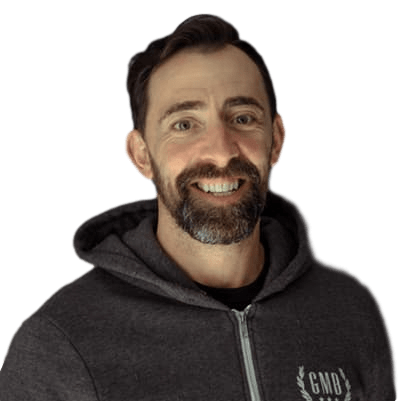
Hi, I'm Ryan Hurst 👋
After a training accident ended his competitive gymnastics career, Ryan moved to Japan, where he spent close to 30 years training and competing in judo, kendo, and other martial arts until another injury made him rethink what training is for.
As Head Coach, he leads program design and teaches every week on our YouTube channel. His book, Stay On The Mat Forever, is aimed at helping you keep training for decades. He loves handstands, dogs, and hiking.