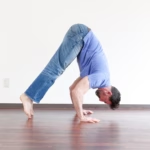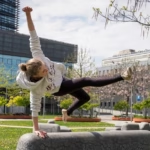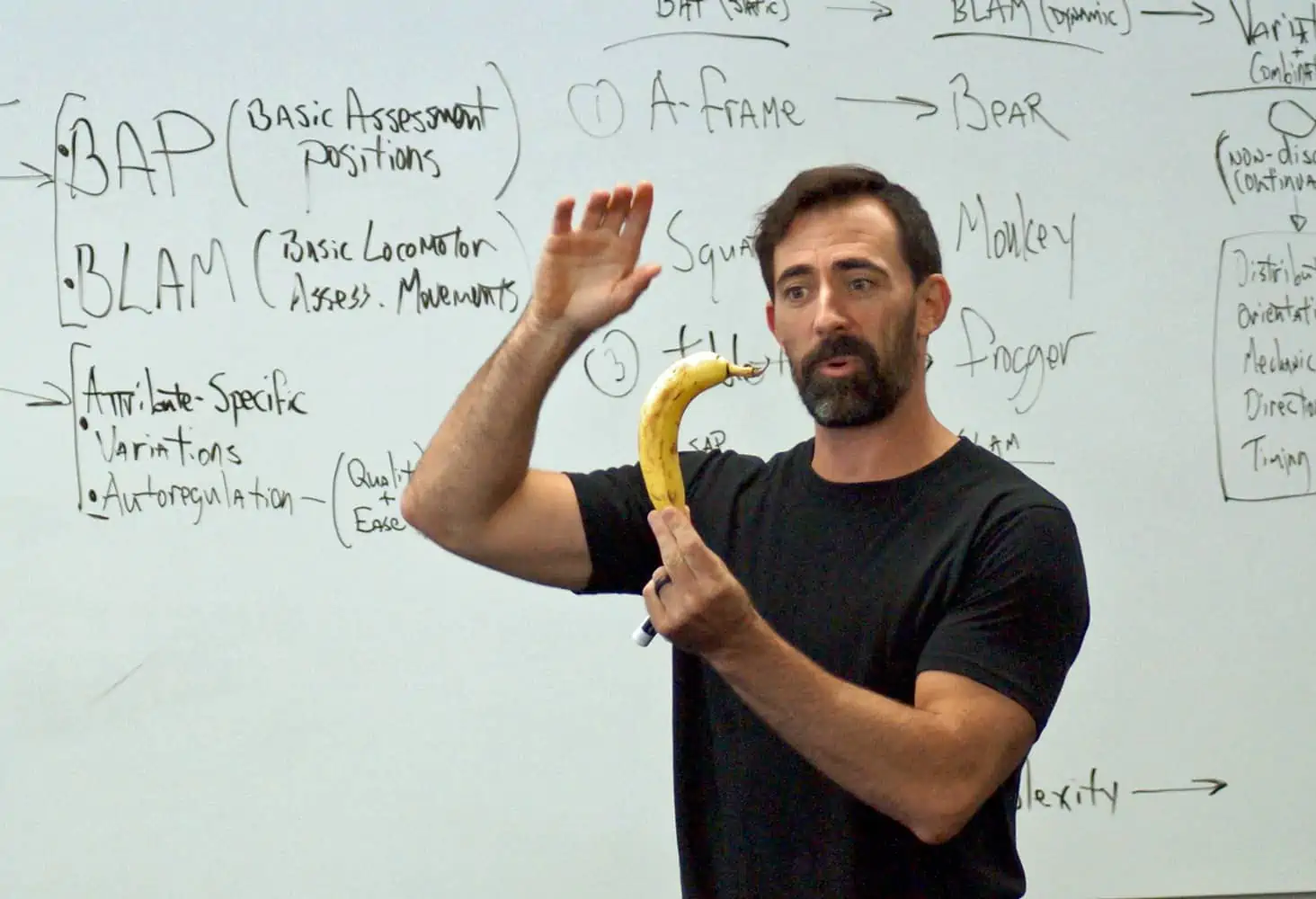

Our clients like to joke that they’ve spent years practicing just four moves.
They’re not wrong. Bear, Monkey, Frogger, Crab. That’s the foundation of Elements, and that’s what you see when you watch someone do it.
Some of those positions will look familiar if you’ve done yoga, martial arts, or gymnastics. They should look familiar. They’re foundational human movement patterns.
 Wiser humans than I have extolled the virtues of simplicity.
So I’m not gonna try and convince you it’s a unique strategy we’ve devised to make our programs more effective with less mental overhead.
It’s just kind of shocking to me how rare this kind of thinking is in health and fitness.
The four movement families in Elements were chosen as the result of decades of training, clinical practice, and hands-on work with thousands of clients. Ryan trained in competitive gymnastics in the US, then spent years studying martial arts in Japan. Jarlo has been treating patients as a licensed physical therapist for over 25 years.
The three of us have coached and refined this material for over a decade.
What we distilled is the common thread across every discipline we’ve studied: the movement patterns that show up in gymnastics, martial arts, dance, rehab, and sport conditioning because they develop the same fundamental capabilities your body needs to do everything else well.
We filtered down hard to what was universally useful.
Then we built a system to teach it. That system is what’s working beneath the deceptively simple surface of all our programs.
The Process of Mastery Begins with Basics
Here’s what people expect: a basic crawling exercise that’ll be easy for anyone who’s reasonably fit.
But then you try it, and your shoulders feel a load they’ve never handled in this position. Your wrists are working at angles they don’t see in a bench press or a barbell row. Your core is stabilizing in a way that a plank doesn’t demand because you’re actually moving, shifting weight from one side to the other, coordinating arms and legs in a pattern that should be simple and absolutely is not.
A client who had trained in Shaolin Kung Fu for over ten years wrote that the Bear revealed movement restrictions and weaknesses he hadn’t even realized he’d grown used to.
A guy who came from years of barbell training said it took him weeks to stop muscling through the movement and actually find the control.
That’s the basic Bear. Here’s what it becomes inside Elements:
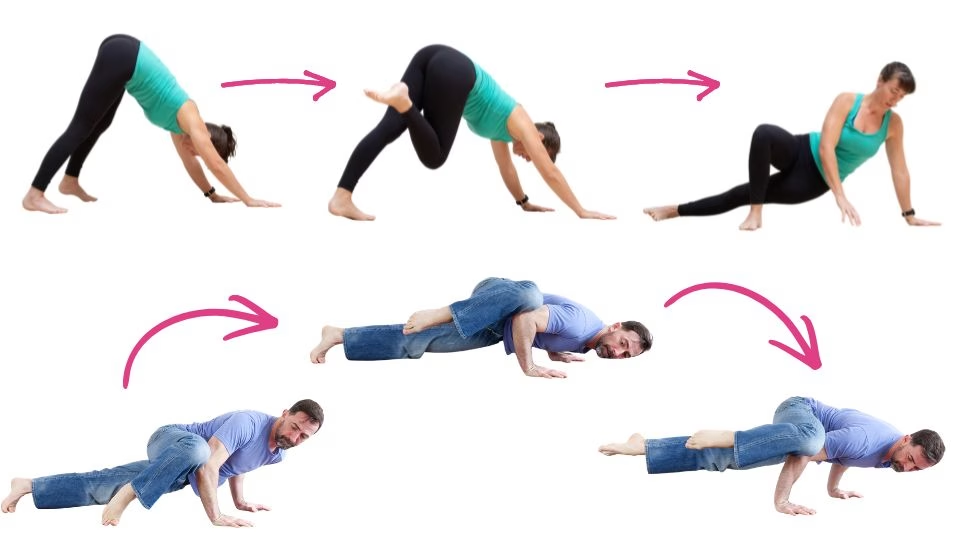
Each variation shifts the emphasis.
Bent-arm Bear loads the shoulders differently. Cross-stepping demands rotational control through the spine. The Spiderman float asks for a level of single-arm stability that will humble people who are strong by any conventional standard.
The same depth exists across the other three movements.
Monkey has standard, high, and stalled variations, each working different aspects of lateral movement and hip control. Frogger has the standard form, straight-leg, and weight-shifting variations that change whether the emphasis is on squat depth, core stability, or upper-body loading. The Crab opens up your entire posterior chain in ways that a decade of sitting at a desk has quietly shut down.
And then we take each of those individual movements and teach you transitions between them: the understitch bridging Bear to Crab, combinations that flow between positions, and supplemental exercises like the 3-point bridge that develop capabilities you need for the core movements to work well.
From those “four moves,” it adds up to dozens of distinct exercises organized inside a system that feels simple. The complexity is there. You just don’t have to manage it.
Here’s Ryan walking through all four movements with modifications and a challenge variation for each:
When was the last time you felt like you were getting better at something?
This is something our clients tell us all the time…
You start Elements and the basic Bear feels awkward. Your Frogger squat is shallow. The Monkey makes no sense to your body. You wonder, honestly, if this is going to do anything meaningful.
Three weeks in, it’s shifted, and everything is deeper, stronger.
One client described it this way: the movements felt weird at first and he wondered what the point was. A few weeks in, it began to come together. Your squat gets deeper without you specifically working on squat depth. Your shoulders feel different when you reach for something overhead. You notice, getting out of a chair or picking something up off the floor, that your body just does it. No bracing, no planning, no worrying about that thing in your lower back.
Then you’ll hit a new variation that challenges you. The Spiderman, or the stalled Monkey, or a combination that asks you to coordinate in a way you haven’t before.
And you start to realize that the earlier work was building toward something. The basic movements were teaching your nervous system patterns that these harder variations now rely on. The progression was happening inside the practice, whether you were tracking it or not.
This is what that looks like in real time, going from the basic Monkey and Frogger to stalled variations:
One client who bought Elements with a wrecked shoulder and a reconstructed ACL wrote that after finishing his first round, he had no shoulder pain doing bench press and his knee had regained full movement. He hadn’t specifically rehabbed either one. The training just addressed the underlying movement restrictions that were causing the problems.
A 55-year-old with 25 years of daily yoga and a hip replacement found that Elements helped him fill gaps in mobility and strength that he didn’t even know were missing.
A former competitive athlete in his early 40s who had concerns at first that Elements wasn’t challenging enough and wouldn’t build strength wrote after 2.5 months that his shoulder, elbow, hip, and knee pain had all improved. He hadn’t changed anything else.
These aren’t outlier results.
This is what happens when you train foundational movement patterns with progressive complexity over time.
The program is engineered to make each session productive for where you are right now, and then gradually increase what your body can handle.
You feel it in how you move outside the practice long before you feel it inside it.
One System, Adaptable to Any Level
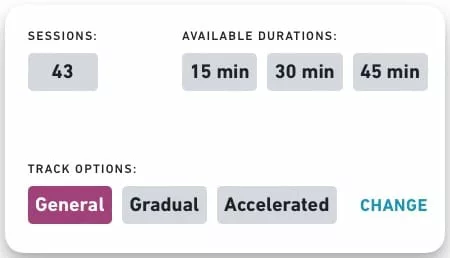
Elements is organized into three tracks: Gradual, General, and Accelerated.
Each one introduces movements at a different rate, starts at a different level, and progresses to a different ceiling.
Two people can start on the same day, choose different tracks, and both be appropriately challenged from session one. The person who has been lifting for fifteen years and the person coming back from a year off the couch are both doing meaningful work.
In Integral Strength, the tracks move from bodyweight to a bar to rings, building strength and then adding leverage and instability.
And the connection also works across programs: crab set-up from Elements builds directly toward L-sit progressions on the floor, bar, and rings in IS.
For perspective, Sequences is built on “just 8” core movements.
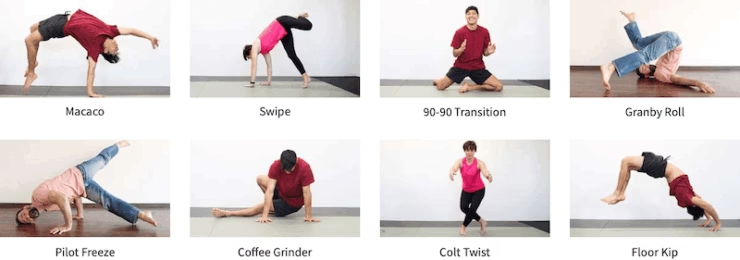
Those 8 movements produce 107 distinct exercises, including 46 combinations and two combined flows, once you count the assistance drills, component movements, and progressive combinations that teach the skills.
A small number of well-chosen movement patterns generates a deep library of training, and the architecture manages the complexity so you can focus on practicing.
Every Session, Coached
The most common thing we hear from clients is some version of “I just follow along and it works.”
That sounds simple. Making it simple was the hard part.
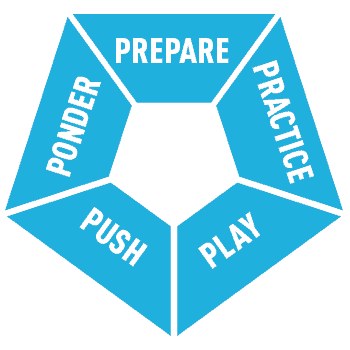 Every session in Elements follows our “5P” Praxis Protocol.
Prep gets your body ready. Practice focuses on the movement skills you’re developing. Push builds strength and stamina. Play gives you time to explore combinations and transitions freely. Ponder is where you check in with yourself and rate how the session went.
That’s five distinct phases in a single session, each with a different purpose, requiring different exercises and different coaching cues.
An experienced coach manages all of that in their head. They watch you move, adjust the plan, choose the right variation, and keep everything moving. Replicating that in software meant building something from scratch, because nothing on the market could handle it.
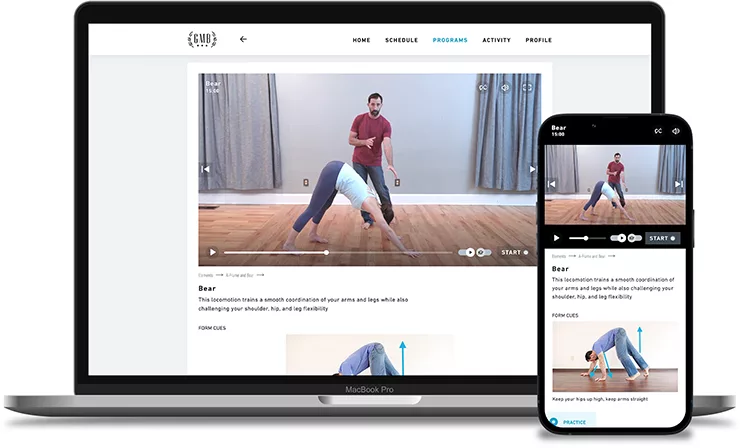
The thinking has already been done. The coaching is built into the session.
You just practice.
There’s Nothing You Need to Add
If you wanted to assemble this yourself, you could go crazy studying exercise variations, self-assessing every movement restriction, and planning an optimal routine.
The information exists, and the rabbit hole goes deep.
What’s not so easy to intuit from random YouTube and Instagram posts is the system that tells you which ones you need, when to use them, and how to put them together into a practice that builds something over time.
It’s ok. We already took care of that for you 🙂
Progress is Simple (if you follow the right system)
Movement complexity is extremely valuable as a training variable.
But complexity you have to manage in figuring out what to practice each day? You’ve got a life and better ways to spend your time.
We spent over a decade building a system that does this. Basic movements, expanded into dozens of exercises and variations, organized across progressive tracks, managed by software that sequences your sessions and adjusts to your self-assessment in real time.
From the outside, it looks like four moves.
From the inside, it’s the most well-organized training you’ve ever done.
Just Hit Start and Go to Work
Four movements. Dozens of variations. Three progressive tracks. Sessions that adapt to your time, your energy, and your ability.
All the complexity managed and our of your way.
Hi, I'm Andy Fossett 👋
A lifelong martial artist and former schoolteacher, Andy's deeply concerned with autonomy and fitness education. As CEO, he's dedicated to providing an open, accessible culture for both clients and staff to enjoy exploring more of what they're truly capable of.
These days he mostly coaches teachers, from GMB Trainers to martial arts instructors around the world. The rest of his time goes to burgers, bourbon, and his wildly off-topic rants on the GMB Podcast.