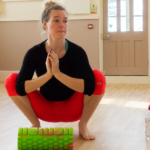
Most adults walking around today have tight hip flexors.
And for the most part, they don’t notice it.
They just feel a little stiff getting out of a car, a little wonky in the lower back after a long day, a little tight reaching back behind them.
The cause is straightforward enough. Hours of sitting, then more hours of sitting, with very little movement that takes the hip flexors out of a shortened position.
Here’s how to actually fix it:
From here, I’ll explain more about why this works and some important tips that make it work better.
Signs You Have Tight Hip Flexors
 Tight hip flexors don’t usually announce themselves with sharp pain. They show up as restriction.
Your stride shortens because your hip won’t quite extend behind you. Bending backward feels stiff. Squatting deep feels off. Sitting cross-legged on the floor feels harder than it should.
Years of sitting will do this to anyone.
Your hip flexors live in a shortened position for hours every day, and your nervous system stops giving you access to the long position because you rarely ask for it. Use it or lose it, in the most literal sense.
Tight hip flexors also commonly tangle up with low back pain. The psoas, one of your main hip flexors, attaches from the front of your lumbar spine, runs down through the front of your hip, and inserts on the top of your femur. When the psoas pulls, it can pull on your spine as well as your leg.
 This goes both directions.
A tight psoas can contribute to low back tightness. Existing low back issues can also create the kind of compensation patterns that leave your hip flexors tight. You won’t know which is causing which from symptoms alone, which is one of the reasons treating hip flexors in isolation often falls short.
The hip flexors connect to a system. Treat the system.
Why Tight Hip Flexors Are Usually Weak Too
A tight muscle isn’t always a strong muscle. People often assume “tight” means “strong and tight,” but in clinical practice, it’s just as common to find muscles that are tight AND weak at the same time.
The hip flexors especially.
Your nervous system limits how far it’ll let you stretch a muscle if it doesn’t trust the muscle to be strong at that length. Push past where you have control and your nervous system pulls you back, often with cramping or sharp tension.
The way through is to build strength in the long position, not just length.
A real approach to tight hip flexors needs three pieces working together: dynamic stretching to access range, strengthening at end range to keep the range, and integrated full-body movement to put it all to use.
Three Things That Actually Fix Hip Flexor Tightness
1. Dynamic Stretching, Not Just Static Holds
Holding a stretch for 30 seconds teaches your nervous system to relax in that one position, and that’s about it. The moment you move, you’re back to your default range.
The held flexibility doesn’t carry over.
Dynamic stretching adds motion. You move into and out of the lengthened position several times, then hold briefly at the end. Combine 30 seconds of movement with 30 seconds of holding and you’ll get significantly more carryover than holding alone.
 The kneeling lunge is one of our oldest examples — and it’s one of the eight movements in our hip mobility routine.
Get into the lunge with your back knee on the ground, square your hips, and gently rock forward and back through the stretch 10 to 15 times. Then settle in for a 20 to 30 second hold.
That’s it.
2. Strengthen the Range You’re Trying to Open
Your nervous system limits how far it’ll let you stretch if it doesn’t trust the strength at that length.
This is one of the reasons stretching-only programs plateau. You build a little range, then your body protects you from going further because the new length isn’t supported by strength.
The fix is to strengthen the muscle in the lengthened position you’re trying to claim. Hip flexors that can hold and produce force at length stay open between sessions instead of snapping back to default.

The Front Scale is one of our staples for this.
You stand on one leg and lift the other straight out in front of you, holding the position. The combination of posture, balance, and active hip flexion at end range challenges the hip flexors exactly where most people are weakest.
It looks simple. It isn’t.
Try it for 10 seconds before you decide whether you need it.
3. Train Hip Flexors Inside Whole-Body Movement
Isolated stretches and isolated strength work both have a role.
The bigger test of hip flexor function is whether they coordinate with everything else. Your hips don’t move in isolation in real life. They work with your spine, your core, your opposite leg, your arms.
Locomotion patterns — crawling shapes like the Crab, Bear, and Monkey — train the hip flexors through their full range while connecting them to the rest of your body’s movement. Each rep is stretching, strengthening, and coordination at the same time.
 The Crab pattern in our Elements program is a good example.
As you push your hips up and travel, the hip flexors of the leading leg get stretched in the lengthened position while still working actively to support the move.
You can’t get that combination from a static stretch.
One More Thing: Stand Up for Your Health
 The most common advice for tight hip flexors — take breaks from sitting — is also the most ignored.
A minute of standing or moving every half hour disrupts the shortening that builds up through a workday. If you can spend that minute on one of the three movements above, even better.
It’s not sexy advice.
But it can be the difference between hip flexors that gradually loosen up and hip flexors that stay stuck.
Free Up Your Hip Flexors
Tight hip flexors are a slow drag on how your body feels and moves.
They get worse with neglect. They get better with consistent work — three approaches on rotation, most days, for as long as you’ve got hips.
Start with the daily hip mobility routine.
Or get Elements to get your whole body strong, loose, and working together like it should.
Elements is our essential total-body practice.
You’ll work hip flexor mobility alongside the strength, control, and locomotion patterns this article is built around, all in one structured program.
Already training and just need the focused mobility component? GMB Mobility is purpose-built for that.

Hi, I'm Jarlo Ilano PT, DPT 👋
Jarlo Ilano, PT, DPT, OCS has been a Physical Therapist since 1998. He earned his Doctorate of Physical Therapy in Musculoskeletal Management from Evidence In Motion, was board certified as an Orthopedic Clinical Specialist with the American Board of Physical Therapy Specialties, and is a certified Therapeutic Pain Specialist through EIM/Purdue University.
In addition to cofounding GMB, Jarlo has been teaching martial arts for over 30 years, with a primary focus on Filipino Martial Arts. He designed our Train Without Pain guide and our knee and shoulder restoration programs.