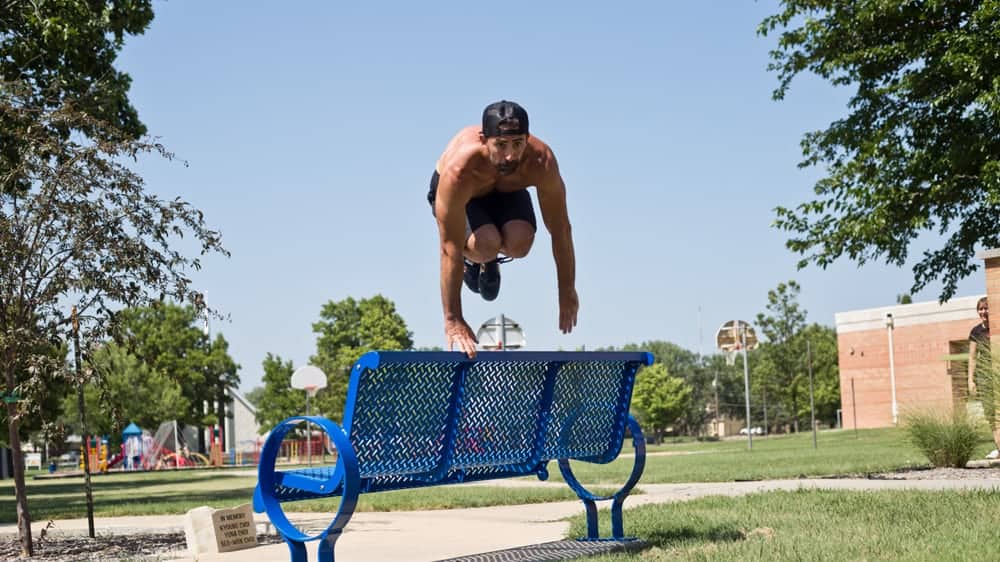

Jumping is a skill, and most adults stopped practicing it somewhere around their last PE class.
That’s a real loss, because a good jump takes strength, mobility, and control and puts them together in one explosive movement. Train it and you build power that shows up everywhere else: running, climbing, hauling groceries up the stairs, moving fast when you need to.
I came up through competitive gymnastics and 40+ years of martial arts, so I’ve done more jumps than I could count. I’m 53 now, with a rebuilt ankle, and jumps are still part of my training. Power fades as you get older unless you keep asking your body to produce it, and jumping is the most direct way to ask.
The catch: you have to practice jumps as a skill. This video shows you how.
Jump Tutorial: How to Jump with the Best Technique
There are plenty of jump variations we could cover, but this video sticks to the most practical ones so you can build up the complexity and power of your jumps over time.
| Jump Variations | Key Points |
|---|---|
| Basic Jump | • Start from a quarter squat position and swing arms up for momentum. • Keep the head in neutral position, and land softly and with control, keeping the knees bent. |
| Precision Jump | • Start on a determined point and look at the target you will be aiming to land on. • Spot the landing point with your eyes and sit the butt back slightly to counterbalance yourself for the landing |
| Broad Jump | • The focus here is opening up the body as much as possible and jumping as far as you can while being able to control your landing. • As you jump, drive the hips forward, open your shoulders overhead, and keep the head neutral. • Land softly with bent knees. |
| Side Jump | • Follow the same cues as the basic jump (starting in quarter squat, lifting arms up overhead, etc), but jump to the side. • Land softly, with knees bent. |
| Single Leg Bounds | • For this moving variation, you'll jump from one leg to the other as you move forward at an angle. • Reach forward and down to the ground as you land. |
| 180-Degree Jump | • Start the same way as you did with the basic jump, but keep your arms overhead and turn your head to turn your body 180 degrees. • Focus on landing in the same spot (just facing the other direction) as your starting position. |
Why You Should Train Your Jumps
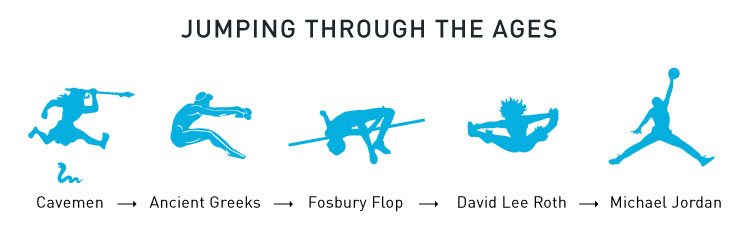
You can see from the extremely historically accurate graphic above that jumping has been kind of a big deal since forever. David Lee Roth built half his stage career on it. But these days, most people only use jumps as a conditioning exercise, and a lot of the benefit gets wasted that way.
Skill-based jump training builds power, precision, and full-body coordination.
That’s obvious if you play basketball or do gymnastics, but the same power carries into plenty of other situations: martial arts, hiking, lifting something in a hurry, catching yourself when you trip.
Power also tends to diminish as we get older unless we train for it specifically. Losing power means losing the ability to do the things you want to do, with ease. And power makes your body a whole lot more resilient when shit happens. Which it will, at some point.
This is why jumps are a fundamental exercise in our Integral Strength program.
Breaking Down Proper Jump Technique
There’s a lot going on in a full-range jump done with precision and power:
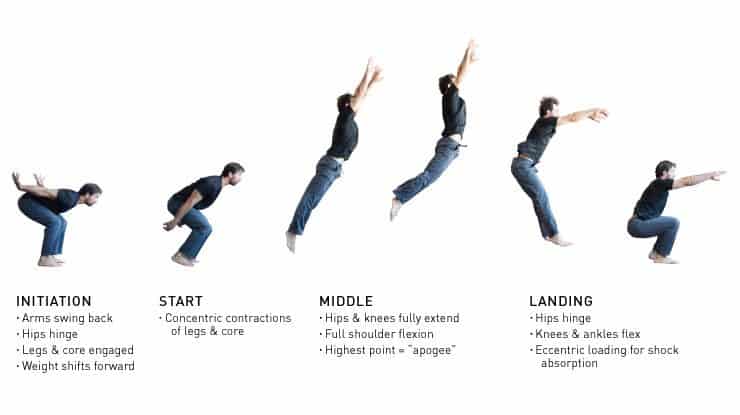
5 Phases of Proper Jump Technique
- Loading: As you prepare to jump, the arms swing back and the hips hinge. The glutes, hamstrings, quads, back extensors, and calves load eccentrically. Your core braces and your weight shifts to the balls of your feet.
- Initiation: Now those loaded muscles fire. The extensors of the hips and legs contract explosively while the hip flexors open up. This combined action of the hips, knees, and ankles is called “triple extension.”
- Extension: In the middle of the movement, the hips and shoulders open as the arms swing up toward the ears to create maximum momentum. At the highest point of the jump, the apogee, your body is fully extended.
- Descent: After the apogee, the body prepares for a controlled landing. The hips hinge, knees flex, and ankles plantarflex.
- Absorption: The landing resembles the start position, but now the eccentric loading absorbs shock. It can help to imagine pulling the ground up into your feet.
That’s a long way from the typical high-rep “finisher” routine, and the difference matters. Skills have complexity by definition, and a full-range jump has plenty of it.
The Golden Rule of Exercise Intensity
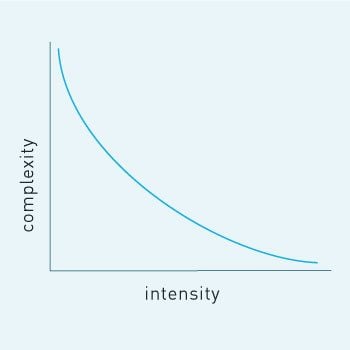
If you’re using jumps as an intense conditioning exercise, you automatically won’t be able to practice them as a complex skill.
The complexity of skills you can safely perform is inversely proportional to the intensity at which you can perform them.
The more complex the movement pattern, the less intensely you can do it without risking injury. And as we’ve shown, good jump technique is plenty complex.
Rep after sloppy rep of box jumps is a recipe for injury, and you won’t build much power that way either. Hundreds of crappy jumps will get you sweaty and out of breath, sure. They won’t make you better at the things jumps are good for.
So it’s worth slowing your roll a bit to get better 🙂
Every Jump Comes Down to Three Things
Six variations, one shared foundation:
- Hinge your hips to initiate the jump
- Swing your arms up for better lift
- Control the landing
Get those three right and every variation gets easier. When a jump feels off, the problem is almost always one of these.
Fixing Your Weak Links
Jumps combine strength, flexibility, and control. You might be able to develop those simply by doing lots of jumps, but it’s not the most efficient path. It pays to assess and address whatever limits you most:
- Limited hinge at the hips: Hip Mobility Routine
- Weak takeoff: Squats and Bodyweight Leg Exercises
- Lack of explosiveness: Hip Strength & Mobility Exercises
- Trouble drawing your legs in on broad jumps: L-sits
- Knee discomfort: Knee Health Exercises
- Wobbly landings: Foot & Ankle Exercises and Locomotive Coordination Drills
Spend time on the one that holds you back most and your jump practice will pay off a lot faster.
Where Jumps Fit in Your Training
Jumping rarely gets its due. Most programs treat it as an afterthought, a way to spike your heart rate at the end of a session and leave you feeling like you got a “good workout.”
Jumps work well inside a workout, but only when you practice them as a skill, and only when the other exercises in the session are chosen to support that skill.
That’s how we program jumps in Integral Strength: integrated, full-body movements arranged so the work you put in transfers directly to everything you do outside your workouts.
Build Power You Can Use Anywhere
Integral Strength trains your jumps alongside complementary skills that build strength, precision, and control for all the things you want and need to do.

Hi, I'm Ryan Hurst 👋
After a training accident ended his competitive gymnastics career, Ryan moved to Japan, where he spent close to 30 years training and competing in judo, kendo, and other martial arts until another injury made him rethink what training is for.
As Head Coach, he leads program design and teaches every week on our YouTube channel. His book, Stay On The Mat Forever, is aimed at helping you keep training for decades. He loves handstands, dogs, and hiking.