
Muscular strength gets all the attention. Your tendons and ligaments mostly get noticed when they start complaining.
That’s a problem, because connective tissue is often less conditioned than muscle for the activities we ask of it, especially for those of us doing repetitive movements under load.
And even if you haven’t had any problems so far, it’s worth taking good care of your connective tissue now. Tendons take longer to bounce back than muscle, so a case of tendonitis can stall your progress for months.
This resource covers basic tendon anatomy, specific exercises for building strength and resilience in key joints, and steps you can take if you’re in pain (including a book recommendation). There’s a lot here, so bookmark this page and use the links below to navigate.
Guide to Tendon Strength & Health
How Tendons and Connective Tissue Work
“Tendon strength” in the vernacular is sometimes used to explain how skinny “wiry” people demonstrate strength on par with, or greater than, someone who is more obviously well-muscled. The assumption is that bigger muscles mean more strength (which is true to an extent), so if a person doesn’t have big bulky muscles, their strength must come from somewhere else.
Hence, we hear talk of “tendon strength.”
And of course, it’s a myth.
Muscles are the body tissues that generate tension and strength, not tendons (or ligaments). Muscular size matters here: a bigger muscle has the capacity to be stronger than a smaller one. But other factors contribute to the demonstration of strength, particularly how adept a person is at a specific feat of strength. And that is directly correlated with how practiced and familiar you are with that demonstration of strength.
What are Tendons?
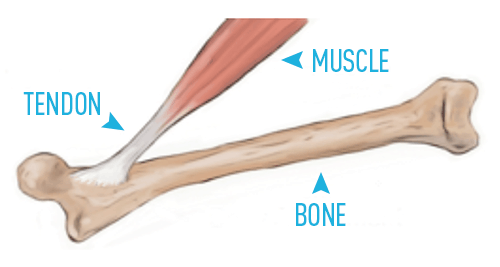
Tendons are connective tissue that attach muscle to bone, as opposed to ligaments which connect bone to bone.
And if that more heavily muscled person were to start learning and practicing how to wield that tool, they would soon attain that skill and perhaps surpass your ability because of the potential of those bigger muscles.
Another reason the “tendon strength” phenomenon persists: tendon injuries are common in sports and repetitive use activities, and they are distinct from muscular strains. So it makes sense to ask whether tendons themselves can be strengthened distinctly from strengthening muscles.
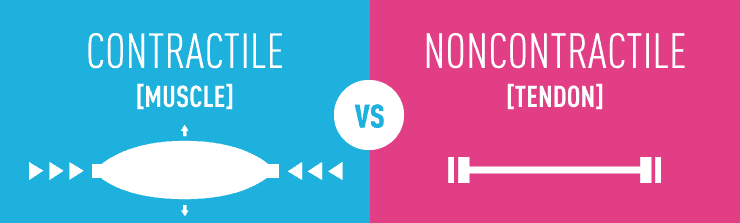
Tendons’ apparent susceptibility to injury comes down to differences in how tendons and muscles are composed. Skeletal muscles are what is known as “contractile tissues”, meaning they can generate movement within themselves (the fibers pull against each other and shorten the overall muscle length). Tendons don’t have that capability. They resist forces but do not generate them on their own.
They are much more than pieces of stiff rope, though. Tendons have elasticity, an ability to stretch, store, and rebound force. Our Achilles tendons have a kind of “bounce,” but this strength is passive: a force has to be applied to them first. In the Achilles’ case, that’s the force from your muscles above and the reactive force from the ground below.
Contractile vs Noncontractile Tissues
Muscles are primarily composed of tissue fibers that can create movement (sarcomeres). Tendons, by contrast, are primarily composed of collagen, a protein that doesn’t create movement but is resistant to both compression and tension (pulling) forces.
Are there different protocols and exercises that would target tendons specifically rather than muscle?
Theoretically yes, but in real world practice this doesn’t really happen.
The same forces and stimulus used to improve muscular strength are what improve tendon strength. Changes in the tendon just occur more slowly, on a timeframe similar to building bone (a bit longer, actually). Changes in muscular strength often outpace tissue changes in the tendon, especially when performance enhancing drugs are involved.
This is seen in the unfortunately common tendon ruptures among anabolic steroid users. Their muscles became capable of generating force greater than the tendon could handle.
This also applies to the common query of whether there are specific ways to strengthen joints, again in distinction from strengthening muscle.
Strictly speaking, the answer is “no.”
But while joint mobility training doesn’t technically strengthen connective tissue, when considering training holistically these improvements can help.
When you improve your range of motion and your control over those ranges of motion, there is a better distribution of forces and tension through your joints. This, along with muscle strengthening work, produces healthier and stronger joints.
How Do You Strengthen Tendons?
It would be facetious to give the too simple advice of “just train your muscles and you’ll be fine” when answering the question of how to improve tendon strength. It’s a legitimate question and there are absolutely ways to address that concern.
As discussed above, we have to ask what people are actually referring to when they ask about tendon strength. It’s a fair bet they really want to know how to be more resilient and stronger at their joints, both to be less prone to injury and to perform better in the physical activities they enjoy.
Framed that way, it’s a great question, and an easier one to answer usefully. A couple of concepts will help us get to the practical tips.
Movement Variability for Joint Health
Being conditioned to perform a variety of movement patterns is an important key to physical autonomy.
Our bodies, in their efficiencies, generally conserve and distribute resources as dictated by our environment, a term I’m using as the milieu of everything our bodies experience. What we habitually do physically, our diets, the climate where we live. Our bodies (and minds) will always “regress to the mean”. The path of least resistance is the most efficient use of our body’s resources, and homeostasis is the ever-present goal.
This, like most complex things, can be both good and deleterious. Good for the economical maintenance of steady health and performance, because it generally takes larger perturbations in our environment to change our bodies.
We know the stimulus for building strength, improving mobility, or increasing stamina has to be above a certain threshold. And in the other direction, tissue breakdown and injuries have to be significant as well to disrupt this balance. But it also means that we are nearly always dancing on the edge of improvement or breaking down.
In training for health and fitness, improvements and injuries are different sides of the same scale.
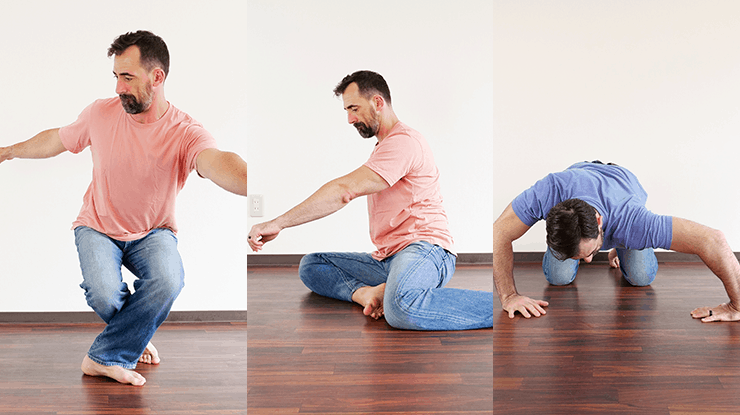
This is why play and exploration in the many different ways we can move has been an ongoing motif in the GMB Method. The more movement variability we have and condition ourselves to perform, the more our bodies build tolerance to the many different physical forces we encounter, and those forces become much less disruptive and injurious.
You do have to be a specialist to be excellent at something, but it can be a detriment to your overall health and well being. The vast majority of us are nowhere close to the level of professional athletes, so we shouldn’t get hung up on optimizing. Get to a decent level of comfort in a variety of movements and you’ll be much better off than trying to get exceptional at one or two patterns.
That serves your health and fitness across the totality of your life, well beyond any weekend competition.
Developing Healthy Joint Alignments
It’s best, in both health and performance, to distribute and create forces with the body as one unit.
Martial arts, throwing sports, and weightlifting seem very different, but at their core they all demonstrate the importance of body alignment and proper technique. These are paramount for the best expression of your strength and power. Small deviations and “leaks” in your alignment are essentially a waste of your energy.
These alignments and good form also tend to be most advantageous for receiving forces. Overuse and repetitive strain injuries at the tendon (and ligament) come from a combination of decreased conditioning of the tissues and poor ergonomics, which I’ll define here as movement efficiencies. I say a combination because you really can train yourself for anything. There are plenty of heavy work laborers and professional athletes who sustain and perform well in “poor postures” simply because they’ve conditioned themselves to do so over a long period of time.
But less than ideal alignments and movement inefficiencies tend to catch up with you as time goes by, and “the bills come due” in the form of nagging injuries and pain complaints.
Improved alignments also go hand in hand with tolerating changes in speed. Sometimes things happen fast! Conditioning yourself to maintain good body alignments while progressively adapting to faster speeds is a significant part of being resilient to stress and strain.
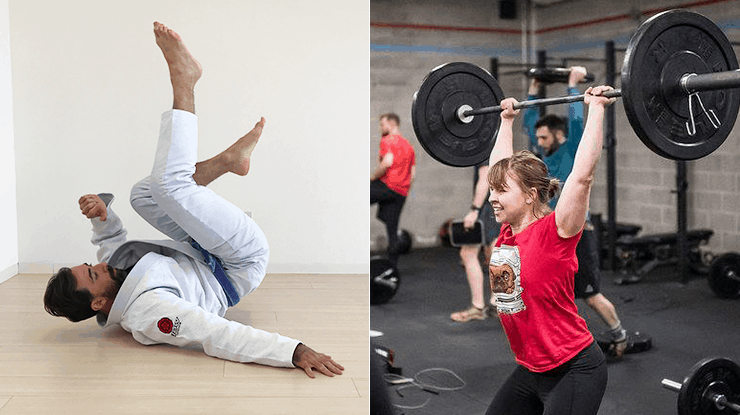
We can train these qualities in a multitude of ways, and good athletic and sport training employs these principles as part of a well-built program:
- Heavier progressive loading (weights, advanced bodyweight exercise)
- Technique/form drills (martial arts stance training, sport specific technique drills)
- Dynamic variable speed training (gradually progressive plyometrics, bounding, jumping)
These types of training are likely very familiar to you if you’ve done any sport training, whether they were sprinkled in randomly or (hopefully) part of a well thought out progressive training regimen. So with all this said, I posit that a variety of training methods is best for tendon health and strength.
As with all good fitness programming, it very much depends upon your current condition (your training status and injury status and history).
If you are nursing an injury and currently have pain or conditions such as tendonitis, you should approach your exercise regimen much differently than if you are feeling great with several months of consistent good training behind you. To make this more useful and less convoluted, let’s start with some examples for the latter, and assume you aren’t dealing with any significant tendon/joint issues.
If you are, feel free to head over to where we discuss dealing with Pain & Tendonitis.
Exercises for Shoulder Connective Tissues
Shoulder complaints were extremely prevalent in my years of practicing physical therapy.
Rotator cuff and bicep tendons, A-C joint ligaments, and other tissues in this complex joint all experience stresses from both sports and everyday activities such as reaching and lifting overhead. Aside from traumatic injuries, the most common cause of complaints was an inability to tolerate these repetitive stresses. People were simply not conditioned enough for the activities they wanted or needed to do.
Once basic strength was improved, we moved on to exercises like the ones below.
Shoulder Swings
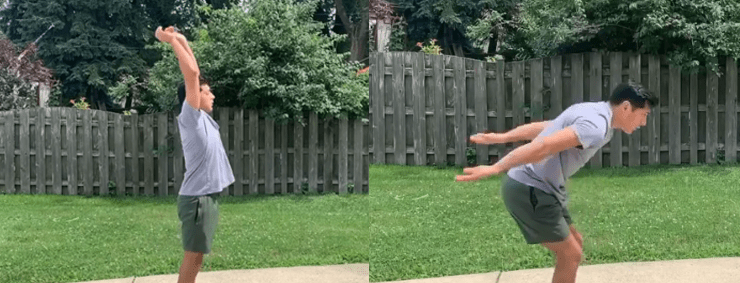
These movements are a good demonstration of introducing ballistic work while emphasizing the concept of appropriate body alignments. I was reminded of these, and incorporated them into my training last year, through the instruction of my baguazhang teacher Carsten Stausberg.
When you perform these, use your lower body and trunk to drive the speed of the swinging, and relax your shoulders and arms. Start at slower speeds and increase very gradually. This is necessary to prevent strains and sprains, and also because you need repetition and practice to find the alignments that are best for your body and its current condition. For both of these reasons, forcing yourself does no good at all!
- Both hands swinging up overhead
- One hand swinging up overhead
- One hand swinging at angle to side and behind
- One hand swinging at angle in front and to the side
Start with slower velocities for 1 to 2 sets of 10, and progress to faster swings for 2 to 3 sets of 20 each.
Hanging Side to Side Swaying
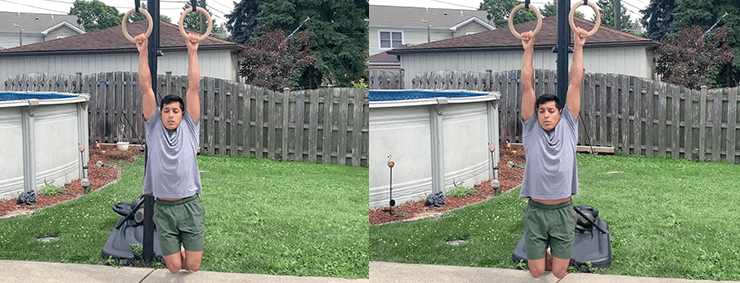
Here you are working on traction loading on the tissues of the shoulder in a combination of vectors (straight down to the ground and laterally). Again, start with less intensity and time. A good rule of thumb is to do half as much as you think you can! It’s much better to do less and then gradually increase than to overdo it and hurt yourself.
Start with your feet on the ground (or other solid supportive object) to take some of your weight off, and with 1 to 2 sets of 20 seconds. Progress to faster swinging with more of your weight and longer times of 2 to 3 sets of a minute.
Pushup Plyometrics
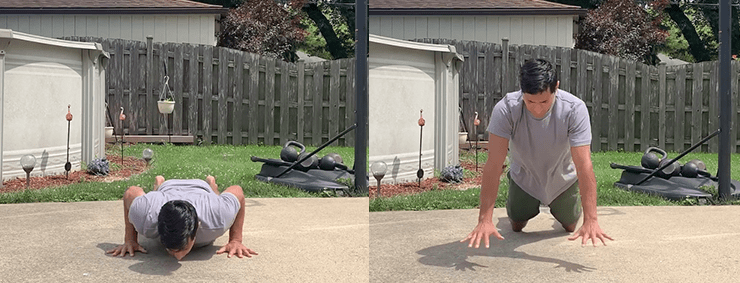
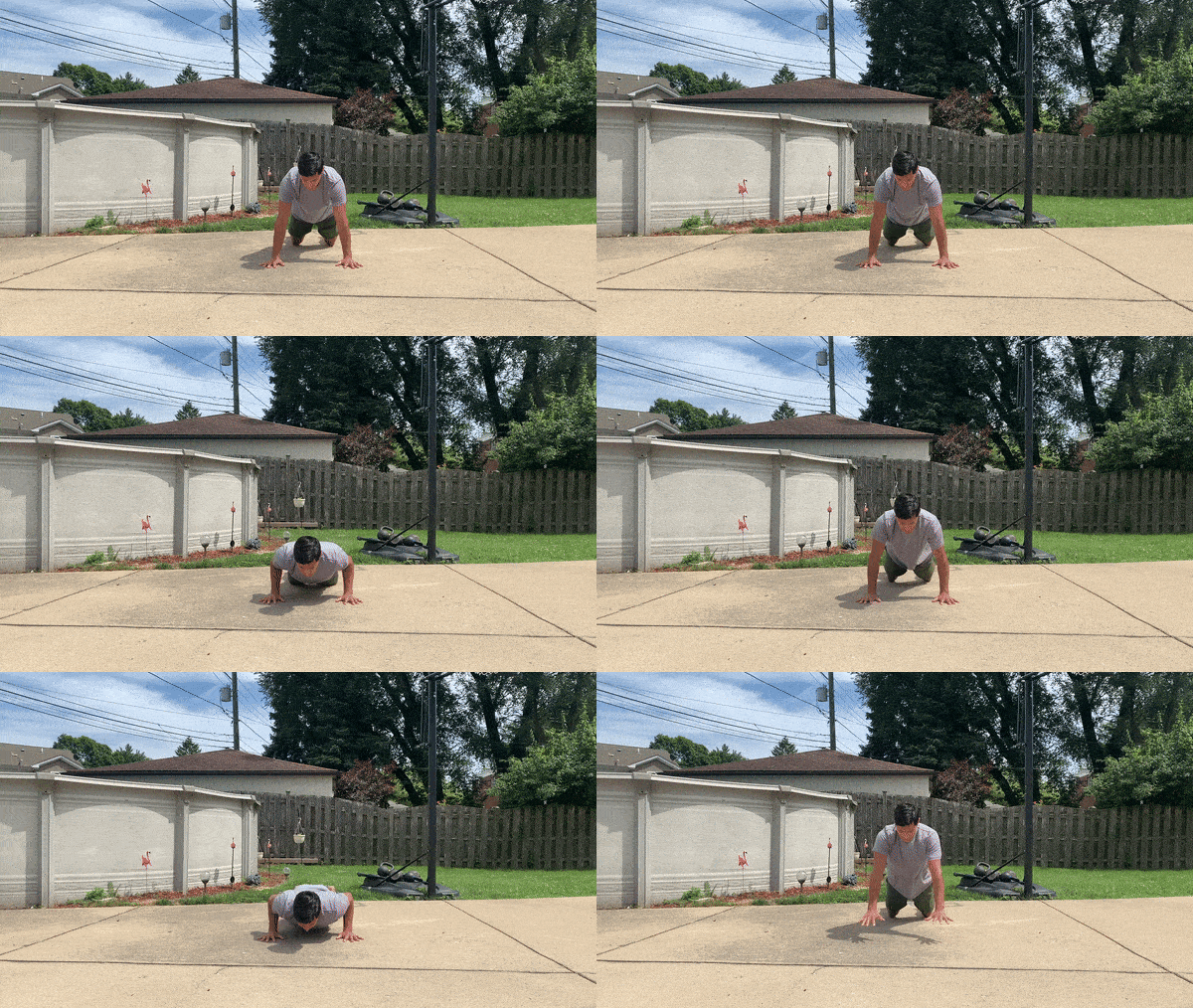
These are classic exercises intended to improve upper body power and speed, and they also have the benefit of improving your tolerance for speed changes and your understanding of alignments.
- Both hands
- One hand
As always, the caveats of gradual progressions in speed, intensity, and volume should be heeded. And though you may be able to do them from a full push-up position, I’d recommend for the purposes of tendon strengthening that you do these from the knees. This will allow you to do more repetitions and modulate your intensity so you can feel and learn from the movement much better.
Start with slower velocities for 1 to 2 sets of 5 and progress to faster for 2 to 3 sets of 10.
🎙️ Related Podcast: Shoulder Mobility for Less Pain
Exercises for Preventing Wrist and Elbow Tendonitis
Wrist and elbow complaints are incredibly common, and I think they’re a big part of the reason people ask about improving tendon/ligament strength. Lingering pain in these areas is so disruptive!
Backhand Weight Shifts
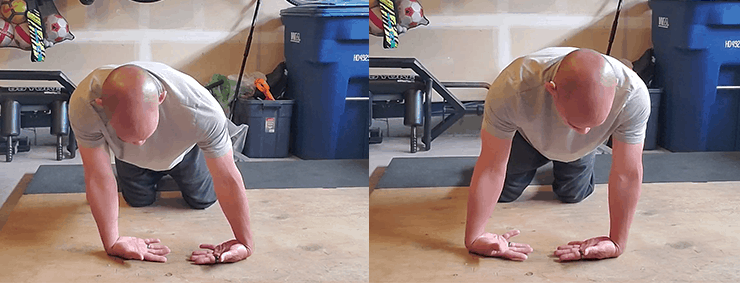
The wrist and elbow are intimately connected, so this positioning affects both. The wrist extensor complex is implicated in “tennis elbow” (lateral epicondylitis). Use padding as necessary and shift your weight back toward your hips more at first, then gradually increase the weight through your hands. Concentrate on how you feel during the holds and the weight shift, and be ready to constantly adjust as needed.
There’s a fine balance between stimulation and overdoing it. This takes trial and error, but it’s a great lesson that applies to all of your training in general. Use this exercise as an opportunity to learn!
Start with less weight on your hands for 1 to 2 sets of 20 seconds and progress to more weight for 2 to 3 sets of 1 minute.
Wrist Flexor Plyometrics
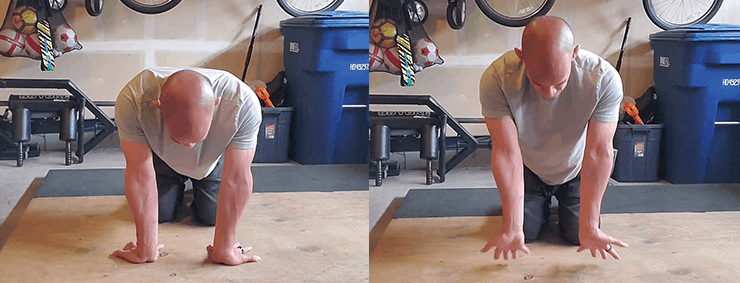
This exercise works on the wrist flexor complex. This is associated with medial epicondylitis, the so-called “golfer’s elbow” and a common area of complaint in people who begin to do more pull-up training than they are conditioned for.
Emphasize landing and pushing off your fingertips with control.
Start with less weight on your hands for 1 to 2 sets of 5 and progress to more weight and 2 to 3 sets of 10.
Pronated Drop and Grab
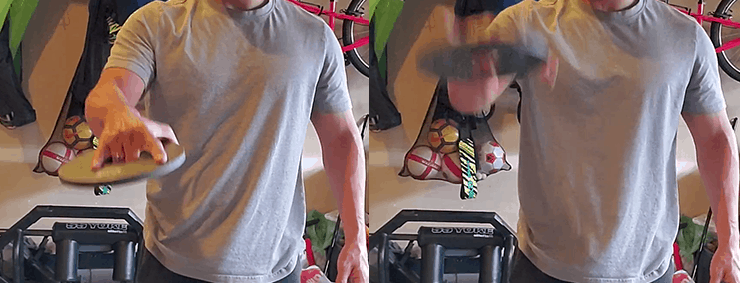
This is another classic exercise that is helpful for improving wrist extensor complex load and speed tolerance. You can use anything from a weight plate to a weighted ball. But definitely start lighter than you think!
Start with less weight for 1 to 2 sets of 5 and progress to more weight and 2 to 3 sets of 10.
Pushup Plyometrics
The same pushup plyometrics described above are also effective for the wrists and elbows.
🎙️ Related Podcast: Exercises for Wrist Strength
Exercises for Knee and Ankle Tendon Strength
Achilles and patellar complaints are also very common, especially in people getting back into (or overdoing) activities that involve running and direction changes, like soccer and basketball. There is tremendous benefit to conditioning the tissues to handle loads in various positions with increased speeds.
⚠️ This cannot be repeated enough: these exercises need to be incrementally progressed and very likely at a slower pace than you’d like!
When we share movements and exercises similar to these on social media, there are invariably comments such as “my knees would explode if I did this!” Well then you probably shouldn’t be doing this exactly as shown. There’s a context for every exercise, and perhaps a particular one isn’t applicable to you but will be very useful for someone else.
Bouncing Split Squats
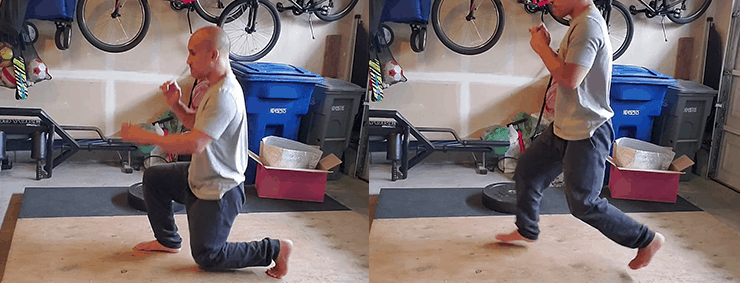
Begin with an even weight distribution, but as you get used to the movement, shift more onto the back leg. This places more force on one knee and ankle.
Start with less weight on the back leg for 1 to 2 sets of 5 and progress to more weight shift and 2 to 3 sets of 10.
Hop, Stop, and Drop
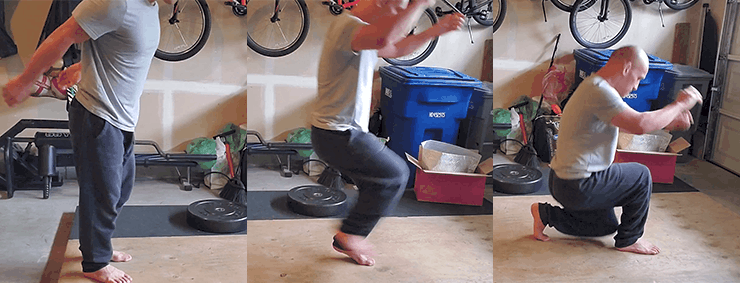
This is an example of a movement that shows the interplay between muscle and connective tissue in demonstrating resilience and durability. Which, notwithstanding the actual biology of tendon strength, is I think what people are getting at when they ask about developing tendon/ligament strength.
It’s actually a simple movement: do a small jump, land on the ball of your foot, and drop down to place your knee on the ground. But there’s a lot in there!
Can you control the landing on your foot? Are you wobbly at your knee and/or ankle? Are you retaining your balance? Can you control the descent to place your knee on the ground gently?
This exercise is a good barometer of your lower body’s capability to maintain appropriate alignments and control under load and speed.
Start with shorter and slower hops, and perhaps don’t drop your knee down all the way to the ground, for 1 to 2 sets of 5. Progress to longer and faster hops for 2 to 3 sets of 10.
Ankle Bounces
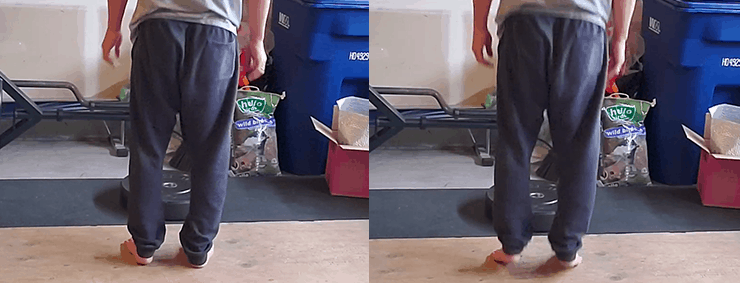
Ankle sprains and tendon problems are invariably the result of decreased tolerance for repetitive loading and speed changes. Which exactly describes the running and cutting back and forth that happens in nearly all sports.
These ballistic exercises allow you to modulate loading and speed so you can concentrate on how the alignments feel and how your body reacts to them.
- Standing on ground: both legs, one leg
- Standing on elevation: both legs, one leg
Start with 1 to 2 sets of 10 to 15 and progress to 2 to 3 sets of 20 to 30.
🎙️ Related Podcast: Ankle & Foot Health
Overcoming Tendonitis: What If You Are in Pain?
The previous exercises are examples of the types of exercises that are useful for improving your whole body resilience, particularly at the muscle/tendon system, and integrating appropriate alignments with progressive movement variability and speed tolerance.
But what if you are injured or in pain? Though you could do some of them with adjustments in intensity, it’d be better to start with fundamental rehabilitation style training and progress from there.
This is covered in depth in Overcoming Tendonitis.
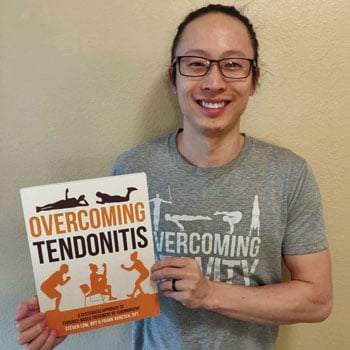 Steven Low is well known in the bodyweight fitness community for his work in Overcoming Gravity, which is often referred to as a seminal text on everything bodyweight exercise. It’s a massive book that earns its popularity with personal trainers, coaches, and just plain exercise geeks!
Low and his colleague Frank Skretch bring that same attention to detail to connective tissue health in this book, which is essential reading if you are experiencing tendonitis symptoms and want to get out of pain.
It’s relatively slim at 124 pages (not including bibliography and notes), but those 124 pages are packed with information. In fact, it can be daunting to someone without a scientific or medical background.
The book is meant to address the many aspects of a complex condition, which makes it necessarily technical. You don’t need to be a health care professional to read it, but in my opinion the “layman” reader should feel free to skim through the denser parts and focus on the overall points and the exercise and treatment suggestions. Rehab professionals and personal trainers who specialize in this type of work would benefit greatly from reading it thoroughly, cover to cover.
A nice option would be for clients to suggest or purchase the book for their health care provider and/or personal trainer.
The book begins with an important overview of how to read research in general, which is necessary when looking at things with the evidence-based mindset. This is another complicated subject, but knowing the fundamentals allows the reader to understand which studies and research would be meaningful to them. That goes well beyond tendonitis, and in my opinion, being even just a little literate in this would improve everyone’s lives.
They then go into the history and current knowledge of tendonitis/tendinopathy, the myths surrounding the condition, and the details of how to approach exercise and training. These are the technically dense topics I mentioned earlier, and again, it wouldn’t hurt to skim through them if you feel overwhelmed.
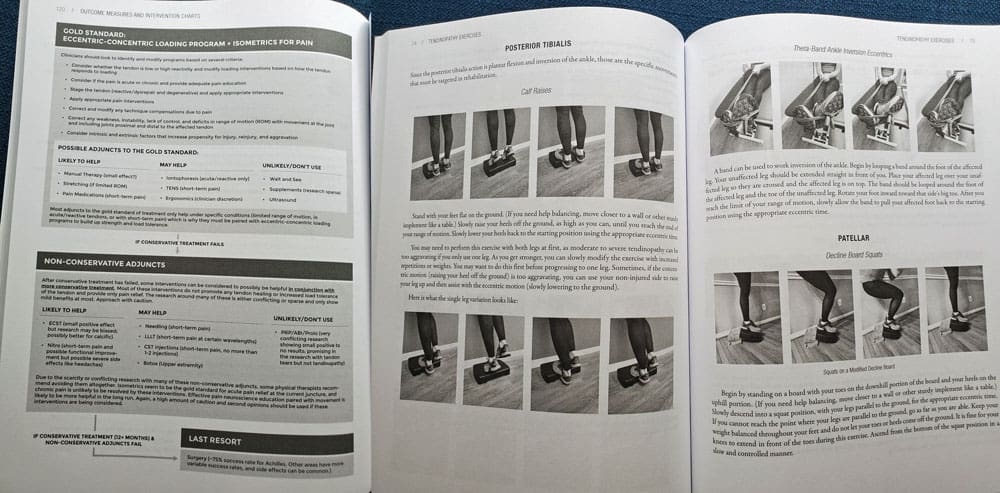
The rest of the book is where you’ll learn exercises, their progressions in a good rehabilitation plan, and a great review of other therapeutic interventions such as injections, laser therapy, and others.
The authors have provided an excellent and thorough compendium here, and in my opinion it’s worth more than the price of the book. The development of a rehab plan requires a lot of trial and error and continual assessment, but the text gives you a great blueprint to guide you (or your trainer/therapist).
I won’t list everything in this part of the book, but I do want to talk about an incredibly important topic it also covers, one that came up in my podcast conversation with Steven as well: pain. The pain science and education of the last twenty years has dispelled a lot of myths we carry with us, and has helped so many people finally break free from their own cycle of pain.
Breaking Free from Chronic Pain
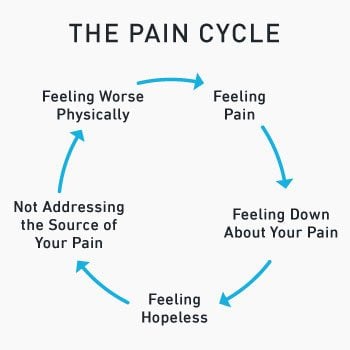 I’ve written before about the complexity of chronic pain, and one aspect that can’t be repeated enough is the fact that tissue damage does not necessarily correlate with pain. I know this is absolutely counterintuitive when we first hear it. It was to me when I first learned it! But there are a multitude of studies that show this over and over again.
People with minimal or no complaints at all have MRI reports of clearly degenerative spines and scans of frayed tendons hanging on by a thread. The other side of this is when people have debilitating pain but their x-rays and scans reveal no damage.
One thing to get out of the way: this does not mean that pain is all in your head. That framing is false and unhelpful. It simply means that pain does not go hand in hand with tissue damage.
Pain exists and we know it exists. There is clear evidence of nervous system increased sensitivity. With ongoing pain, these sensitivities can occur both in the nerves at the site of pain (peripheral sensitization) and in how our brains react to inputs (central sensitization), where what should be an innocuous sensation is interpreted as very painful. This is shown in functional MRIs where areas of the brain “light up” when a person experiences pain, even long after the injury has healed.
Take an ankle sprain, for example. At the time of injury, certain pain receptors multiply, and their inputs begin to outnumber others, such as temperature and movement. The system becomes more sensitive to that input whenever it happens. It’s a bit like turning up a microphone so that your voice is super loud when you talk into it.
This is very real and very much not “all in your head.”
I feel that this is a very empowering thing to know, as it allows us not to get hung up on the damage shown in our x-rays or MRIs, or when doctors tell us our joints are “bone on bone.” That may be so, but it does not consign us to never-ending pain.
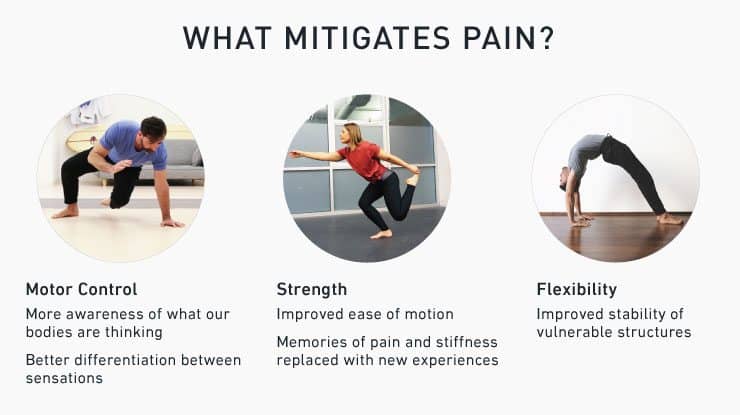
And perhaps that’s the primary benefit of this book: to show the research and the experience that has taken even people with very damaged tendons out of their pain and back to the activities they love. What a wonderful thing.
To take this back to advice on what to do if you have tendon issues: the exercises we shared above are best for when you have no current problems, or when you’re at the point where you can do more without flaring up your symptoms. They are a great segue to participating in more intense training.
If you are currently in pain and don’t have that tolerance yet, start with a progressive rehab plan that often begins with isometrics and lighter load, which then increases in intensity and variability. Overcoming Tendonitis is a great resource for that if you are not already under the guidance of a health care professional.
🎙️ My Conversation with Steven Low on Overcoming Tendonitis
Here’s my full conversation with Steven, covering the myths around tendonitis, chronic pain as a habit your nervous system builds, and how to get back to training after a flare-up. We took questions straight from our clients, and Steven’s answers draw on the same research and clinical work that went into the book.
More podcast episodes here.
Resources for Overcoming Joint & Tendon Pain or Injury
Over the years, we’ve created detailed guides to restoring healthy, pain-free function to all the major joints in the body.
Detailed Joint Health Guides
- Neck Exercises for Pain & Tension
- Strength & Mobility for Shoulder Pain
- Guide to Addressing Elbow Pain
- Spinal Health & Mobility Exercise
- Hip Exercises for Power & Mobility
- Exercises for Knee Pain
- Guide to Healthy Feet & Ankles
- 💌 Get a downloadable version of all these guides sent to your email
And if you’re dealing with persistent soreness in your joints, I highly recommend picking up Overcoming Tendonitis.
Take Care of Your Connective Tissue Before It Complains
It’s natural to focus on strength and skills. We can see and feel those.
We can see our muscles growing and feel the difference when we pick up something heavy or move quickly. We can see ourselves performing skills and feel that they get easier with practice.
But with our tendons and ligaments, the only way we know they’re falling behind is when we notice pain, and by then, we’re already behind the eight ball. Since tendon pain can take a long time to recover from, it pays to address tissue health before you develop a progress-killing case of tendonitis.
The exercises in this article will help.
Another way to keep your joints healthy is to include regular connective tissue exercise for all your major joints in various ranges of motion. Our Resilience program is one option.
Systematically Protect Your Joints From Common Injuries

Hi, I'm Jarlo Ilano PT, DPT 👋
Jarlo Ilano, PT, DPT, OCS has been a Physical Therapist since 1998. He earned his Doctorate of Physical Therapy in Musculoskeletal Management from Evidence In Motion, was board certified as an Orthopedic Clinical Specialist with the American Board of Physical Therapy Specialties, and is a certified Therapeutic Pain Specialist through EIM/Purdue University.
In addition to cofounding GMB, Jarlo has been teaching martial arts for over 30 years, with a primary focus on Filipino Martial Arts. He designed our Train Without Pain guide and our knee and shoulder restoration programs.