
You already know sitting all day isn’t great for your body. The research keeps going back and forth on exactly how bad it is, but nobody’s claiming it’s good for you.
Knowing that doesn’t solve much. You’ve still got to go to work tomorrow.
What actually helps is understanding what goes wrong when you sit for hours, and knowing what to do about it. Most advice on this topic either sells you a $1,500 treadmill-desk setup or shrugs and says sitting’s fine, actually. The useful answer lives between those, and it’s simpler than you’d think.

In this article I’ll walk through what desk work actually does to your body, three strategies that address it, and a simple six-exercise routine you can do right at your desk whenever you’ve got ten minutes.
What desk work actually does to your body
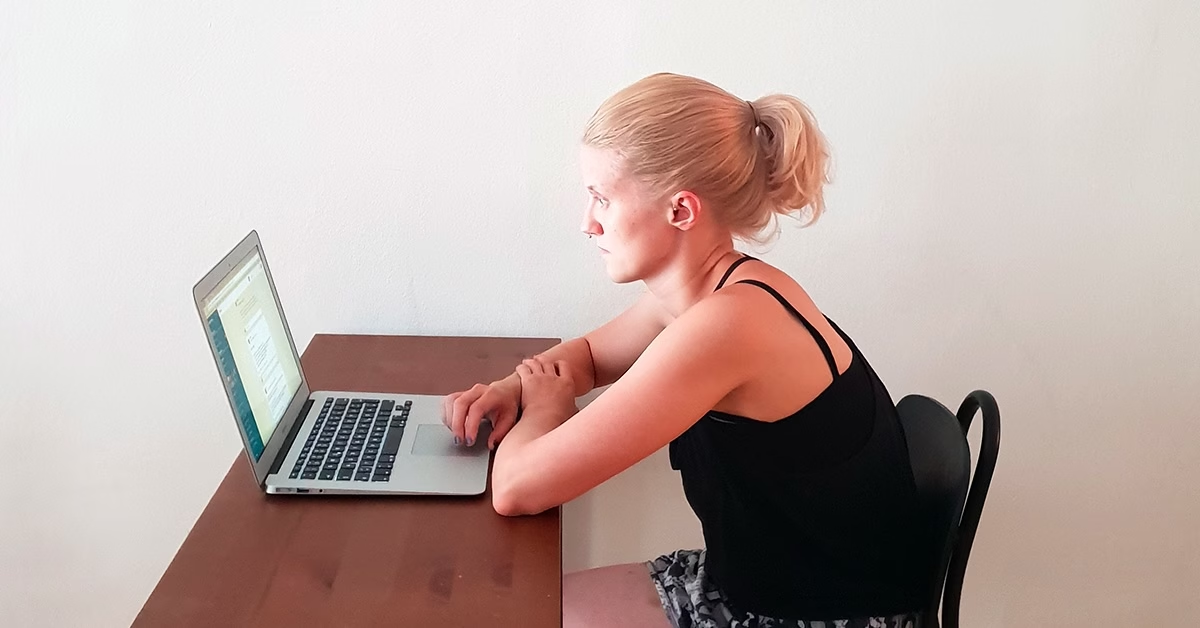
Your body adapts to what you do. Sit with your hips bent, shoulders rolled forward, and your head pushed toward a screen for eight hours a day, and those positions slowly become your default. The same adaptability that lets you build strength and skill in the gym also works in the other direction, just as reliably, toward the position you spend most of your waking hours in.
 Three things tend to suffer:
Range of motion. Tissues adapt toward whatever length you hold them at. Hip flexors, pecs, the muscles along your spine. Over years, all of them shorten toward the position they spend the most time in. You don’t wake up one morning stiff. It’s more like you notice, at 42, that you can’t sit cross-legged on the floor like you used to.
Strength. Your body is pragmatic about what it keeps. If you’re not regularly asking your back, hips, and legs to produce force across a full range, you lose the capacity you had. Strength is also what stabilizes your joints, so losing it often shows up as pain before it shows up as weakness.
Motor control. This one sneaks up on people. The movement patterns you built playing sports as a kid don’t stick around on their own. Without practice, they decay, and things that used to feel effortless start to take conscious effort.
I’ve seen this pattern in the clinic thousands of times. Someone comes in for knee pain, or a cranky shoulder, and when I ask about their day it’s eight to ten hours at a desk. The pain is real, but the root cause is a decade of adult life spent in one position. You can’t separate one from the other.
The good news: the same adaptability works both directions. Move more, move in more varied ways, and your body re-learns pretty quickly. That’s the whole premise of what comes next.
Three strategies that actually work
You don’t need a treadmill desk or a three-hour daily stretching routine. You need three things, done reasonably well:
- A consistent movement practice, even a small one
- Targeted work on whatever’s bothering you most
- More movement, and more varied movement, throughout your day
All three are doable without quitting your job or buying expensive equipment. Here’s how each one works.
1. A consistent movement practice
The single biggest lever is training your body regularly across strength, flexibility, and motor control together. You need something broad enough to counter the narrow position your job puts you in.
Most workouts are pretty one-dimensional. You run, or you lift, or you do HIIT. Stretching, if it happens at all, is an afterthought.
Those all have value, and none of them alone covers what a desk worker actually needs.

What you want is a practice that actively maintains range of motion, trains the deep stabilizers that keep joints healthy, and asks your body to coordinate in multiple directions.
That’s what our Elements program is built to do, and it’s the one I’d recommend to most desk workers.
One example is Kamomi, a graphic designer who came to us after 30 years at a desk.
She had back pain, shoulder pain, and neck pain, and had pretty much written off ever doing anything physically interesting again. Her Elements practice cleared up most of the long-standing stuff within a few weeks, and it became the foundation for a much more active life. She’s training martial arts now, which she couldn’t have imagined when she started.
2. Address your biggest restriction
Everyone starts from a different place, and there’s usually one area giving you the most grief. For desk workers it’s almost always one of four: hips, mid-back, shoulders, or wrists.
Start with those links.
Add one of those short daily routines for whichever one is bothering you the most, and stick with it for a few weeks.
Most people notice real progress quickly.
A full program with assessments and corrective exercises, written specifically for desk-related posture issues. Click here for details.
If you want a more structured, book-length approach to desk-work posture specifically, I co-wrote Overcoming Poor Posture with Steven Low for exactly this.
It’s a quick read with a full program and self-assessments plus corrective work, aimed at people dealing with the downstream effects of desk posture.
It’s a useful supplement if you want a dedicated deep-dive on posture.
3. More movement throughout the day
 There’s a concept in the research called NEAT, which stands for Non-Exercise Activity Thermogenesis. Clinical-sounding name for all the small movement you do outside your training time. Walking, fidgeting, standing up, climbing stairs. The research on this is reasonably consistent: more is better, up to a point.
More isn’t the only variable though. Variety matters at least as much.
- More walking = good
- More walking, squatting, hanging, reaching, and carrying = better
A few that work in most office environments:
- Shift between sitting and standing regularly. Doesn’t have to be fancy. A box or stack of books on your desk works. Just once an hour has been shown to meaningfully reduce the risk of musculoskeletal problems.
- Use work blocks. Set a timer for 25 to 45 minutes, focus hard with no distractions, then take a 5-minute break and actually move during it. We do this at GMB and it works as a productivity hack too. Search “pomodoro” in your app store if you want a timer app with this built in.
- Rope in a coworker. Walking meetings, lunch walks, a quick stretch routine together in the breakroom. If you’ve got someone game for it, the consistency goes way up.
- Do ordinary tasks on the floor. Folding laundry, reading, phone calls. Find positions where you can keep your back reasonably straight, and switch them up.
- Try different ways to stand up. No hands. One hand. From cross-legged. From a deep squat. Get weird with it. That’s free motor control training.
That’s five ideas.
If you want more to pick from, we put together a reference list of 57 ways to work movement into your day without adding hours to your schedule.
A 6-exercise routine you can do at your desk
Here’s a short routine that hits the places desk work tends to hit hardest: shoulders, upper back, hips, and some of the strength you tend to lose when you sit for a living. Also good as active recovery if you’re training on the side.
You’ll need a desk and a chair. That’s it. Ten minutes, start to finish.
1. Chest Opener
- Sit toward the front edge of the chair. Reach your hands back to hold the sides of the chair.
- Pull your elbows backward and squeeze your shoulder blades together as you bring your chest forward. Look straight ahead, not up.
- Scoot forward or back on the chair until the stretch lands in the right place.
- Repeat 10 times, then lift your chest and hold for 15 seconds.
2. Upper Thoracic Extension
- Sit toward the front edge of your chair. Place your elbows on the desk in front of you with your back flat before you start.
- Press your elbows into the desk and scoop your chest up and forward.
- Rock back and forth through the motion to find where it works best for you.
- Repeat 10 times, then hold the end position for 15 to 30 seconds.
3. Office Chair Dips
- Hold the front edge of the chair so your butt is off the seat, feet planted firmly on the floor.
- Bend your elbows with them pointed straight back. Keep your chest lifted.
- Lower your butt toward the floor, then press back up. Look straight ahead the whole time.
- Repeat 10 times.
4. Hip Flexor Stretch
- Shift your body to one side of the chair and extend that leg behind you so your knee rests on the floor.
- You’ll be in a supported lunge: front leg bent to 90 degrees, back leg extended, one hip supported by the chair.
- Put your hands on your hips. Lift your chest. Squeeze your rear glute to tuck your pelvis underneath you.
- Hold 30 seconds, then switch sides.
5. Rocking Squat
- Squat down as low as you comfortably can. You don’t need to go as deep as Jeff does in the video, so don’t force it.
- Hold your desk for support. Rock forward onto the balls of your feet, then back onto your heels into the squat.
- Letting your back round a little as you rock back is fine.
- Repeat 10 times.
6. Side-to-Side Desk Squat
- Stand in front of your desk with your feet wider than shoulder-width.
- Hold the desk for support. Lean your body to one side and bend that knee into a squat while keeping the opposite leg straight.
- Press your hands into the desk to come back up, then switch sides.
- Repeat 10 times per side.
Routine summary
For reference, here’s the full routine at a glance:
| Exercise | Sets/Reps |
|---|---|
| 1. Chest Opener Chair Exercise | 10 reps, followed by a 15-second hold |
| 2. Upper Thoracic Extension | 10 reps, followed by a 15-second hold |
| 3. Office Chair Dips | 10 reps |
| 4. Hip Flexor Chair Stretch | Hold for 30 seconds on each side |
| 5. Rocking Squat Desk Exercise | 10 reps |
| 6. Side to Side Desk Squats | 10 reps on each side |
If you’re short on time on a given day, the fastest version that still gets most of the benefit is the chest opener, the upper thoracic extension, and the hip flexor stretch. Those three alone take about three minutes and hit the biggest desk-work trouble spots.
Also worth a look: a quick 5-minute routine specifically for hunched posture.
How to actually use this
The best time to do the routine is whenever you can fit it in. Lunch break works. Between work blocks works. One chest opener on an audio-only call works.
Frequency matters more than duration here, and frequency gets easier when you lower the bar for what counts. Setting a timer on your phone is the simplest way to make it stick. Two or three reminders a day, and you just do whatever exercises make sense in that moment. Within a week you’ll feel a real difference by the end of the workday.
And if you’ve got a small patch of floor near your desk, most of our programs are easy to work in from the office too. Fifteen minutes of something like Elements will do more for how your body feels and moves than any ergonomic chair on the market.
Build a Strong, Mobile Body Without Quitting Your Desk Job

Hi, I'm Jarlo Ilano PT, MPT 👋
Jarlo Ilano has been a Physical Therapist (MPT) since 1998 and was board certified Orthopedic Clinical Specialist (OCS) with the American Board of Physical Therapy Specialties. He’s undergone extensive postgraduate training in neck and back rehabilitation with an emphasis in manual therapy along with being certified as a Therapeutic Pain Specialist by EIM/Purdue University.
In addition to cofounding GMB, Jarlo has been teaching martial arts for over 30 years, with a primary focus on Filipino Martial Arts.