
If you ask people what would help them hit the next level in their sport or activity, most will say something like strength or explosiveness. Many of them would benefit a lot more from working on their flexibility.
Flexibility is a force multiplier.

Without sufficient flexibility, doing this will be a lot more difficult.
If you practice a martial art, CrossFit, or a physically creative sport like climbing or surfing, you’ve probably seen what I’m talking about. Flexible people use the strength they have through wider ranges of motion, so they can do things other people just can’t.
Lower body flexibility is a real challenge for most people. In over 25 years as a physical therapist and 15-plus years building GMB, I’ve watched it get worse, not better. People come in with injuries and pains tied to tight hips and legs more often than ever.
Most of these issues trace back to the same pattern: people focusing on strength while ignoring lower body flexibility. Ratcheting up your strength without working on hip and hamstring mobility is a recipe for tweaked backs, knees, and hamstrings.
One of the most effective ways to improve your leg and hip flexibility is to train for the good-old-fashioned splits.
In this article, I’ll show you stretches you can use to train your front and side splits, so you can develop the freedom of movement you need for your next level of performance.
Why You Should Train for the Splits (Even if You Have No Interest in Ever Doing the Splits)

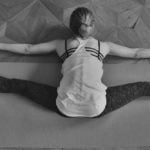
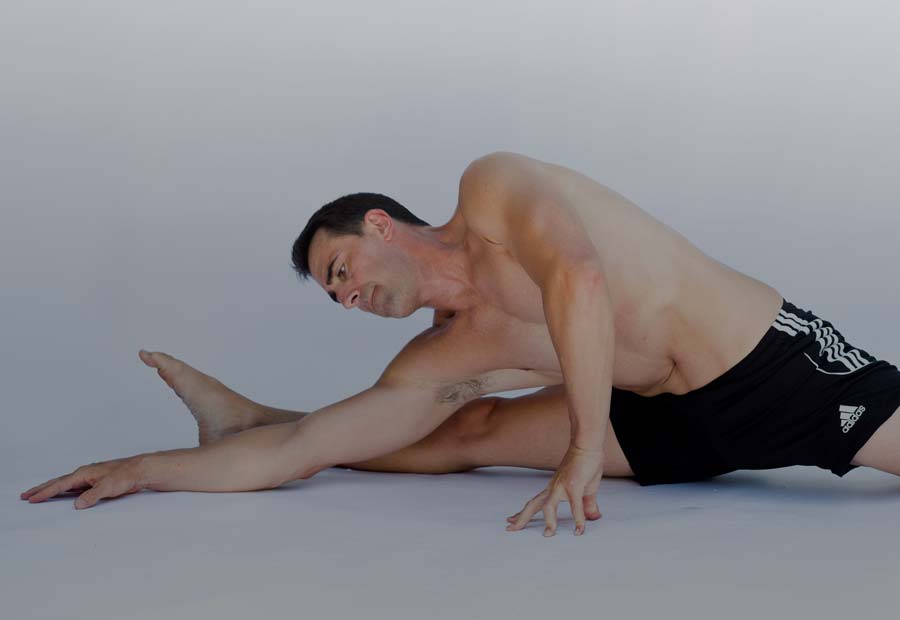
Unlike this gymnast, you probably don’t need to be able to do the splits. But training for them can help in other ways.
The splits are a level of flexibility very few people actually need. If you’re a dancer, gymnast, or figure skater, then yes, full splits are part of your sport.
For most people, the splits aren’t the goal.
The reason to train for them anyway: the stretches that build splits flexibility are also the stretches that fix the hip and hamstring tightness most adults walk around with. The stretches I’ll show you for both the side and front splits will improve your daily flexibility whether or not you ever drop into a full split.
For a clinical look at why hip mobility matters this much for everyday movement, see Understanding Your Hips.
Most splits tutorials take one of two approaches:
- A random series of a dozen stretches with no clear progression, or
- “Just get into the splits and hold it for as long as possible.”
Neither one is targeted or sustainable, and if you’ve tried tutorials like that in the past, you might be ready to write off splits training entirely.
The stretches below are different. They target the most commonly troublesome areas, and they use a gentle, progressive approach that actually builds usable range over time instead of forcing you into positions you can’t control.
Side Splits: 4 Stretches to Open Up Your Hips
 Full side splits — also called center splits or middle splits — are something very few people can do (Van Damme being a notable exception, of course — see the Volvo ad).
The process of training for them, though, will make a significant difference in your hip mobility regardless of whether you ever achieve the full position.
The stretches below specifically target the areas that are most commonly tight, both for splits progress and for everyday movement.
A regular practice at moderate intensity beats sporadic intense sessions every time. Work just at the edge of discomfort on the following stretches as close to daily as possible until you start feeling changes in your hip mobility. Once you have a baseline, you can drop the frequency.
If you need to back up and work on basic hip mobility first, our hip mobility routine is a good starting point.
Work at your own pace. Kirsty is very flexible, so she’s demonstrating these stretches at a high level. Use a range of motion that’s comfortable for you.
| Exercise | Key Points | Do This |
|---|---|---|
| Kneeling Lunge A | • Maintain a flattened lumbar spine (posterior pelvic tilt). • Keep the front leg foot out far enough so that when you shift forward, your knee is in a comfortable position. • Keep hips and shoulders square. • Dynamic action is either: - Straightening back knee and lengthening heel backwards. Upper body is still and stable. - Engaging hip flexors by pulling your knee into the ground. | 3 rounds: 10 contractions followed by a hold of 15-45 seconds. |
| Frog | • Careful about possible knee strain, adjust knee/calf angle as needed. • Dynamic action is squeezing knees together into the ground | 3 rounds: 10 contractions followed by a hold of 15-45 seconds. |
| Pancake | • Bring legs apart wide. Back tall and upright. Hinge forward at the hips. • Dynamic action is pushing heels down into the ground and knees together while rocking forward and back (hip hinge). You can also try keeping your hands flat in front of you and contracting abdominals, as if you are trying to do a "sit up" in that position. | 3 rounds: 10 contractions followed by a hold of 15-45 seconds. |
| Cossack Squat | • Go into a wide stance, and lower down into a squat, keeping one leg straight. • Keep your body upright and the toes of your straight leg pointing up. Push your hips forward to keep yourself upright. • Dynamic action is pushing your heel down to the ground and attempting to get up. | 3 rounds: 10 contractions followed by a hold of 15-45 seconds. |
In the video, you can see Kirsty go through the four stretches, then move into the full side splits position using the same contract-relax routine.
Front Splits: 3 Stretches to Help You Move Better
 Same principle for front splits: random stretches won’t get you far. The stretches that target what’s actually holding you back will.
For most activities, the full front splits aren’t necessary. The stretches Kirsty demonstrates below will improve your hamstring and hip flexor flexibility, which carries over to anything that requires extending your leg behind you — running, kicking, climbing, walking up stairs without compensating.
Our protocol also builds active control in the new ranges, not just passive flexibility. So you’ll get more flexible AND you’ll be able to use that flexibility under load.
| Exercise | Key Points | Do This |
|---|---|---|
| Kneeling Lunge A | • Maintain a flattened lumbar spine (posterior pelvic tilt). • Keep the front leg foot out far enough so that when you shift forward, your knee is in a comfortable position. • Keep hips and shoulders square. • Dynamic action is either: - Straightening back knee and lengthening heel backwards. Upper body is still and stable. - Engaging hip flexors by pulling your knee into the ground. | 3 rounds: 10 contractions followed by a hold of 15-45 seconds. |
| Hamstring Variations | • Arched back in extension, hinge forward at the hip, pull upper body over the leg. • Dynamic action is pushing heels and back of the knee into the ground, arching chest, whilst hinging at the hip. | 3 rounds: 10 contractions followed by a hold of 15-45 seconds. |
| Kneeling Lunge with Foot Hold | • Keep your legs wide apart for stability. • Tuck your pelvis under while keeping your chest up. • Dynamic action is pushing the knee into the ground and foot into the hand. | 3 rounds: 10 contractions followed by a hold of 15-45 seconds. |
In the video, you can see Kirsty go through the three stretches, then move into the full front splits position using the same contract-relax routine.
Freedom of Movement Will Up Your Game
Flexibility training is one of the most underrated levers for anyone serious about their sport.
As you train your splits, watch how you can apply your strength through wider ranges of motion. New positions become available. Old movements feel easier.
The same is true beyond your legs and hips. Improved flexibility in your shoulders, back, neck, ankles, and the connective tissues that link them up pays off across everything your body does.

Flexibility also protects you from some injuries — overstretching during a fall, sudden range demands during sport, the kind of trauma that takes you off the floor for weeks. The work you do on the mat keeps you off the rehab table.
Effective flexibility training is more than a series of stretches, though. It’s combining the right methods, applied consistently, in a structured progression. Our clients use Elements as the foundation for that work — full-body practice that builds the hip mobility, hamstring range, and spinal motion that splits training (and most sports) actually requires.
A client named Jin Wa wrote to tell us GMB “helped me work into a full squat, something I’ve never been able to do, in about a month of training.” That kind of progress comes from consistent practice in the right method, not from chasing the splits.
Hip mobility, hamstring range, and spinal motion built into a structured program you can return to as a long-term practice.
Already training regularly and want focused mobility work for splits progression? GMB Mobility is purpose-built for that.

Hi, I'm Jarlo Ilano PT, DPT 👋
Jarlo Ilano, PT, DPT, OCS has been a Physical Therapist since 1998. He earned his Doctorate of Physical Therapy in Musculoskeletal Management from Evidence In Motion, was board certified as an Orthopedic Clinical Specialist with the American Board of Physical Therapy Specialties, and is a certified Therapeutic Pain Specialist through EIM/Purdue University.
In addition to cofounding GMB, Jarlo has been teaching martial arts for over 30 years, with a primary focus on Filipino Martial Arts. He designed our Train Without Pain guide and our knee and shoulder restoration programs.