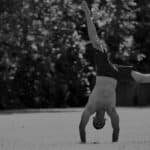
The Monkey 🐵 is the side-to-side animal. It builds strength and control moving laterally, which is a direction almost nobody trains and most of us are weak in. Watch a monkey move across the ground and you’ll see what easy lateral power looks like. That’s what we’re after.
The Monkey is a locomotion movement, which just means moving your whole body through space. Like the Bear and Crab, it’s one of the “animal” movements used in gymnastics, martial arts, and calisthenics. It might look like play, and it is, but there’s a lot going on under the surface.
I still train BJJ, and the times I get stuck are almost always when I have to move sideways under load and my hips don’t want to cooperate. The Monkey is the cleanest way I’ve found to build that. You’re loading your arms and shifting your hips through a squat, over and over, and your body learns to move laterally with some authority.
How To Do The Basic Monkey
The most common mistake here is making the movement bigger than it needs to be, kicking the legs way out behind you. Keep your feet close to your hands instead. Watch how GMB Trainer Eduardo lifts his hips and keeps everything compact in the demo below.

- Step 1: Start in a squat with your hands reaching to one side, one hand outside your foot and the other just inside your foot.
- Step 2: Shift your weight onto your hands, pulling yourself toward the side you’re reaching.
- Step 3: With your weight on your hands, pick up the back foot (the one opposite the direction you’re heading) and hop it over so your hands are out in front of you again.
Monkey Walk Variations For More Strength And Body Control
Below you’ll see 4 variations of the Monkey we use in our programs.
- Basic Monkey – straight arms, bent legs, lateral movement
- Long Leg Monkey – straight arms and straight legs
- Monkey 180 – straight arms, bent legs, lateral movement, twisting your body with each rep
- Long Leg Monkey Into Deep Squat – straight arms and straight legs, into a deep squat position
Which one you work on depends on what you need. If shoulder strength is the limiter, the basic Monkey will feel better than the Monkey 180. If hip mobility is holding you back, the Long Leg Monkey is a better place to spend your time.
Get comfortable with the basic Monkey first, then start exploring the others to build more strength and flexibility.
What If I Can’t Do The Monkey Like They Do In The Videos? 🤔
The thing I hear most is “I can’t squat all the way down, so I can’t do the Monkey.” Not true. A full squat is nice to have, but you can start without one, and working the Monkey is part of how you build it.
Here’s GMB Trainer Verity showing a way to modify it:
Stick with the modified version and your squat depth will come. To speed that up, our squat tutorial builds the strength and flexibility directly.
The Monkey asks for some shoulder strength and hip mobility. If either one is the limiter, spend time with the Bear for your shoulders and our hip mobility routine for the rest, then come back to it. And if your wrists complain, our wrist routine will sort that out.
Monkey Exercise Variations And Benefits
| Variation | Benefits |
|---|---|
| Basic Monkey | • Scapular strength through concentric and isometric protraction and concentric ad isometric depression • Rotator cuff strength to control eccentric internal rotation and concentric and isometric external rotation • Spinal strength for eccentric and concentric side-bending, and isometric extension and flexion • Spinal mobility into side-bending and rotation • Abdominal strength in flexion, rotation and side-bending • Hip mobility into flexion and abduction • Hip strength of flexion, abduction, adduction and external and internal rotation |
| Long Leg Monkey | • Everything from Basic Monkey + the following: • increased action for hip strength and mobility |
| Straight leg monkey, starting and returning to deep squat | • Everything from Basic Monkey + the following: • increased action for hip strength and mobility |
| Monkey 180 | • Everything from Basic Monkey + the following: • increased emphasis on motor control and coordination |
The Monkey takes full-body strength and coordination, mostly because that lateral pattern is unfamiliar territory for most of us. It strengthens your spine, upper back, and shoulders, and the side-bending and rotation build real strength through your midsection. Your hips get worked through flexion and rotation in both directions, which is where a lot of that new mobility comes from.
Get comfortable with the Monkey and it carries straight into the Crab and Frogger, and it makes you more agile everywhere else you move.
Here’s GMB Trainer Rebecca Jennifer Rashkin working a Monkey flow that helps prep for handstand practice:
Adding The Monkey Walk To Your Training
The Monkey teaches your upper and lower body to move laterally in rhythm, which sets you up for skills like tumbling and cartwheels, and for keeping your balance when you end up somewhere awkward.
Anytime your sport asks you to move side to side or change direction in a hurry, whether that’s on the mat, the court, or the dance floor, the cross-body coordination and hip range you build here is what carries you.
The Monkey is one of four animal movements that, practiced together, build a base of strength, flexibility, and control that makes everything else you do feel easier. You learn it once, and you keep it.
That’s what Elements is for.
Build a Foundation You Can Rely On at Any Age
With Elements, you’ll get strong, flexible, and capable using the Bear, Monkey, Frogger, and Crab, so you can move well without restriction.

Hi, I'm Ryan Hurst 👋
After a training accident ended his competitive gymnastics career, Ryan moved to Japan, where he spent close to 30 years training and competing in judo, kendo, and other martial arts until another injury made him rethink what training is for.
As Head Coach, he leads program design and teaches every week on our YouTube channel. His book, Stay On The Mat Forever, is aimed at helping you keep training for decades. He loves handstands, dogs, and hiking.