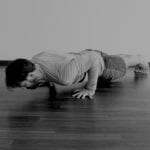
Ammar Rajab spent almost a decade afraid to trust his own body.
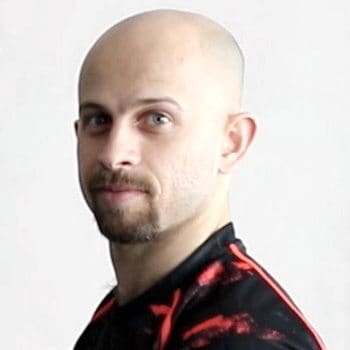
Ammar went from a decade of injury-driven fear to becoming a certified GMB Trainer.
Before the injury, he was always deep in something physical. Kung Fu, gymnastics, soccer, Brazilian jiu-jitsu — and those were just the ones he took seriously. Being active was the baseline of his life.
Then he tore his ACL and damaged the cartilage in his knee. And for the next ten years, the worry about getting hurt again kept him on the sidelines.
If you’ve ever had an injury that technically healed but left you second-guessing every movement — that hesitation before you jump, the flinch when you plant and twist, the slow erosion of confidence in what your body can handle — you know what Ammar was dealing with. Multiply it by a decade.
At 34, a father of two in Bahrain, he decided he was done being fragile. He found Integral Strength, and it turned out to be exactly what every other program he’d tried wasn’t.
Why Nothing Else Worked
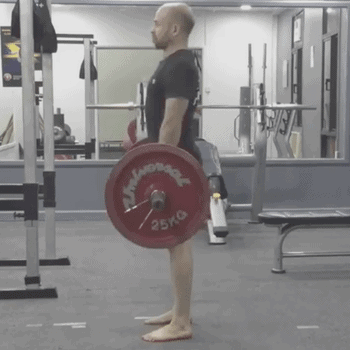
It took years of trial and error before Ammar found a strength program that matched his actual needs.
Ammar didn’t sit around for ten years doing nothing. He tried to fix it. That’s what made the whole thing so frustrating.
He started with bodybuilding — the default answer when someone says they need to get stronger. More muscle, more reps, more sets. “I felt like I was heavier, but unable to move better,” he said. Bigger muscles didn’t translate to a body he could trust.
He missed the freedom of running, jumping, and moving the way he used to. So he tried parkour and freerunning. Then calisthenics. He got pretty far with both, but kept getting injured. The cycle was maddening: build up, break down, start over, build up, break down again.
The problem wasn’t effort or dedication. The problem was that none of these approaches addressed what was actually broken — his joints, tendons, and connective tissue hadn’t been systematically prepared for what he was asking his muscles to do.
What Integral Strength Did Differently
“Integral Strength has a combination of strength and mobility and stretches, and it improved my core a lot, which helped me to be more stable. The program helped me by preparing my body gradually — the joints, tendons, and ligaments, along with the nervous system and muscles — through strength, flexibility, and motor control, and a gradual progression of difficulty and volume.”
That’s the key distinction. Most strength programs treat strength as an isolated variable — how much can you lift, how many reps can you do. Integral Strength builds strength as part of a system: mobility through the ranges you’re strengthening, motor control so your body can actually use that strength in unstructured situations, and progressive loading that gives your connective tissue time to adapt alongside your muscles.
For Ammar, that meant the L-sit work strengthened his core in ways that stabilized his whole body. The shrimp squat rebuilt his knee confidence through controlled, progressive loading. The bridge press-up opened his shoulders and spine. Each skill addressed a specific gap in his foundation while building toward real capability.
He worked through Integral Strength alongside Elements, and the combination gave him what a decade of other approaches hadn’t: a body that felt resilient instead of fragile.
“In many traditional programs they focus on strength training and resting — that’s it. No mobility, no stretching and no mindfulness of movement at all. And this is why people get injuries, because of the poor programming. In contrast, Integral Strength is designed to enable you and make you strong, not just in your muscles, but also in your joints, tendons, ligaments, and nervous system.”
What Opened Up After the Foundation Was Built
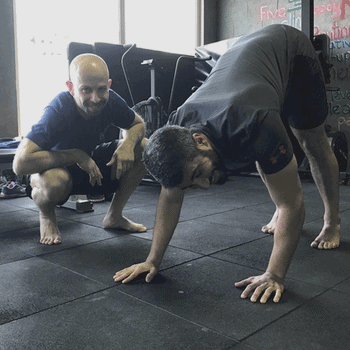
Ammar teaching at a GMB workshop — something he does regularly now.
Once Ammar stopped cycling through injuries, everything changed.
He went through our rigorous GMB Trainer Apprenticeship and became a Certified GMB Trainer. He nailed his handstand and started working toward a handstand push-up. He went deeper into rings training. He’s now teaching the same approach that rebuilt him to other people.
And his biggest motivation for all of it is straightforward: “To build the strength and mobility to play with my kids, play football, practice BJJ, and do some skills.”
That’s the whole point. Strength training that exists in service of the life you want to live — playing with your kids, doing the sports you love, trusting your body when it matters.
Ammar spent a decade stuck in a cycle of building up and breaking down because every program he tried built strength without building the foundation underneath it. Integral Strength broke that cycle by treating strength, mobility, and motor control as parts of the same system.
If you’ve been through your own version of that cycle — getting strong enough to get hurt, recovering, getting strong enough to get hurt again — the issue probably isn’t your effort. It’s the approach.
Build Strength Your Body Can Actually Use
Integral Strength develops practical strength alongside mobility and body control, so you build a resilient foundation for everything you want to do.
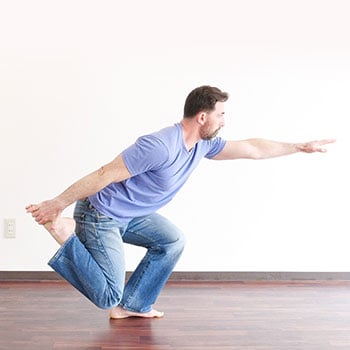

Hi, I'm Andy Fossett 👋
A lifelong martial artist and former schoolteacher, Andy’s deeply concerned with autonomy and fitness education. As CEO of GMB Fitness, he’s dedicated to providing an open, accessible culture for both clients and staff to enjoy exploring more of what they’re truly capable of.
He's best known for his wildly off-topic rants on the GMB Podcast and spends the majority of his time eating burgers, sipping bourbon, and reading books.