
Every body has history.
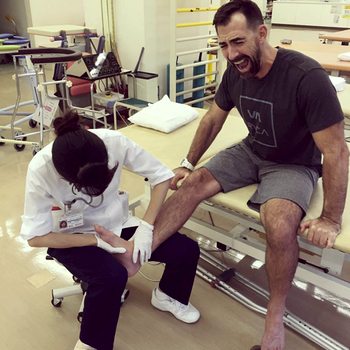 Mine includes a SLAP tear repair in the shoulder, meniscus surgery on the right knee, a broken ankle a couple years back, daily neck strain from desk work plus phone use, and a stretch of back stiffness that showed up out of nowhere when I moved back to the US from Japan after nearly 30 years of sitting on the floor every day.
Your body has its own history, from the decades of accumulated habits, injuries, repetitive motions, and just ongoing stress from daily life.
Below, I’m going to show you exactly what I do every day to keep all that in check – in less than five minutes.
It covers my back, shoulders, hips, and the general ability to do the stuff I want to do in my life.
Here’s my daily maintenance routine:
The four movements are bear, monkey, frogger, and crab. One minute each, four minutes total.
Below I’ll break down what each one does, why I picked it for the specific area, and the variations I use to actually train it.
But first, the “not stretching” question, because every video in this series has the same answer.
Why “not stretching”
Stretching has its uses. It’s just not great for what we’re trying to achieve here.
When your back tightens up after a day of sitting, stretching feels good for ten minutes and then everything locks right back up.
The tightness isn’t really about short muscles. Your nervous system is guarding your spine because you’ve been in one position so long that your body has decided the safest thing to do is restrict movement.
Pulling on it doesn’t tell your brain anything new.
What does work is whole-body movement that gives your nervous system fresh information. “We can rotate. We can support load in this position. We can transition between shapes.”
Suddenly, your body lets go because it has a reason to.
If you wanna understand how stretching actually works and what it’s great for, we wrote up the full case here.
For managing your body’s history, three things have to keep working together:
- Strength in the muscles around the joint, so the joint isn’t doing the work the muscles should be. Practical strength training is the starting point.
- Integrity in the bones and connective tissue, because tendons and ligaments take time to adapt and they’re what hold the joint together under load. Tendon strength and bone health are the slow part of the equation.
- Neurological control, so you can move into and out of positions without your nervous system firing pain signals as a precaution. Pain isn’t damage, and understanding the difference changes how you train.
There’s more your body needs than this (good food, sleep, real life movement, all the obvious stuff). But for keeping past injuries quiet and old joints moving, these three are the lever.
⚠️ If you have active pain right now: follow the 3 of 10 protocol for training through injuries.
OK, so you’re not me. Your body’s history isn’t the same as mine.
Here’s breakdowns for each move and what they’re good for…
Bear for a Tight Back
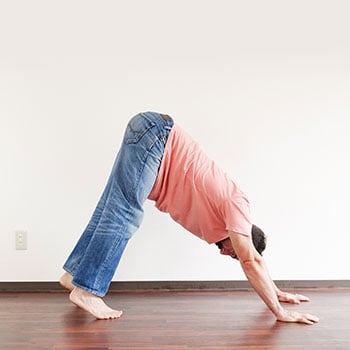
The bear walk is the A-frame position (hands and feet on the floor, hips up, shoulders pushing away from the ground) in motion. Not quite a downward dog. It’s a position where your spine actually has to move through different shapes while the rest of your body holds you up. That’s why it fixes what stretching can’t.
After almost 30 years in Japan where I sat on the floor every day, I came back to the US and started getting back stiffness I’d never had before. All the driving and chair-sitting was the obvious culprit.
The bear walk is what brought my back back.
Three progressions:
- Basic bear walk. Forward, backward. The spine moves through a slightly different position with every step while the rest of the body holds you up. This is the reset.
- Cross-step bear walk. Same setup, but the feet cross inward past each other. Forces lateral sway through the lower back and hips. Most people never get this direction from any other activity.
- Twisting bear. Add rotation. Step a hand and foot forward on the same side, drop the heels, rotate the whole body. This is the big one, because rotation is the direction your back has been missing the most.
If your wrists feel it on these (or any of the moves below): that’s normal early on, and they’ll adapt with practice. If you want to speed that adaptation up, or you already have wrist issues you’re working around, here’s how we build wrist strength and mobility.
You can do the basic bear walk as one minute of the daily four-minute routine. Or if your back is the main thing you’re working on, do all three for one minute each, two or three times a week as a dedicated back session.
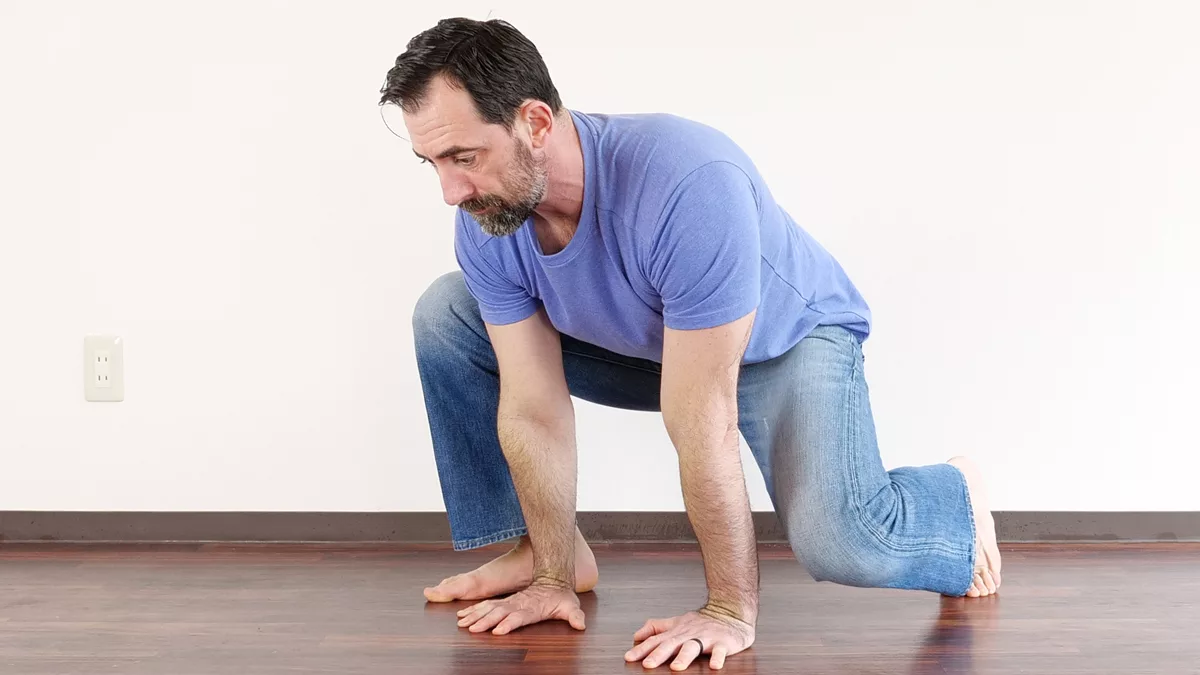
Monkey for Cranky Knees
A lot of “knee problems” are actually cause by restrictions in the hips or ankles.
I’ve had meniscus surgery on my right knee, and a few years ago I broke my ankle, which still affects my ability to get my heel all the way to the floor on that side. I can’t fix either of those things. What I can do is squat in a way that doesn’t ask the knee to do what the hips and ankles should be doing.
Three progressions:
- Monkey set-up. Squat down, hands on the floor, rock side to side. The hands take the load while you find a depth your knees actually like. This is the first thing we have people do in Elements.
- Basic monkey. Place hands, load them, hop the feet forward into a squat, return. Keep your hip height consistent the whole way. Going up and down is where knees get cranky.
- Long-leg monkey. Extend one leg as you sit into the squat. Now the hips and ankles have to do real work, and the knee gets to move through a range it can actually handle.
The basic monkey is the one I include in the daily four-minute routine. If knees are your main issue, do all three progressions for 30 seconds to a minute each, three rounds, twice a week as a focused knee session.
Your knees probably aren’t the problem. If they are, this is how to start to address it.
Frogger for Hip and Leg Function
We’ve talked about the sitting-rising test before and even done a (very) detailed research review on the role of exercise in longevity.
The frogger train every part of your leg and hip function to ensure long-term capability on and off the floor.
Three progressions:
- Floating tabletop. Hands and knees down, round the back, hover the knees an inch off the floor. Hold up to 30 seconds. This is the strength base the whole sequence runs on.
- Walking frogger. From the floating tabletop, walk one foot at a time forward into a squat, hands back down, walk back. The transition pattern your body needs for getting up and down off the floor.
- Full frogger. Both feet move at once. Push from the hands, pull the feet forward into a squat. The full expression of the transition.
The full frogger is what I do in the daily four-minute routine. If floor transitions are what you’re working on specifically, do 30 seconds of floating tabletop followed by one minute each of walking and full frogger, three rounds, twice a week.
This is one of the four foundation movements Elements is built around. It works because it isn’t a strength move, a mobility move, or a control move. It’s all three at once, which is what your body actually needs to use them in real life.
Crab for a Stiff Neck
Between the computer, the phone, the steering wheel, and (in my case) a child who treats my neck like a pull-up bar, my shoulders spend almost all day locked forward. The neck takes the rest of the load.
Stretching the neck for two minutes does nothing about the eight hours of slumping that put it there.
This does:
Three progressions:
- Crab setup. Sit on the floor, hands behind hips with fingers facing out to the sides, push the hips up. Hold 15 to 30 seconds. Most adults haven’t been in this position since childhood and feel it immediately in the chest and shoulders.
- Crab walk. Same position, in motion. Step a hand, step a foot, the shoulder blades have to stabilize through a range they almost never see.
- Three-point bridge. Fingers facing back this time, one arm up. The supporting shoulder externally rotates and pushes the hips high. Builds the strength your neck has been compensating for.
The crab walk goes in the daily four-minute routine. For a dedicated neck and shoulder session, hold the crab setup for 10 to 15 seconds, then do the crab walk and three-point bridge for up to a minute each, three rounds, twice a week.
Keep your head neutral on all of these. The moment your chin tucks, your neck locks back up.
This Is One Slice of the Practice
These four movements (bear, monkey, frogger, crab) are the foundation patterns Elements is built around – I’ve covered maybe about 5% of the program here…
People sometimes look at a routine like this and think it’s too simple to actually work. That apparent simplicity hides a lot of details below the surface. Getting those details out of your way is the point.
Daily practice on movements your body actually needs is what changes the way you feel and move. Complexity isn’t an asset.
Build the Foundation, Keep the Body You Have
Or just grab the cheatsheets
If you’d rather start tomorrow morning with the routines from this series printed out, we put them all in one place.

Hi, I'm Ryan Hurst 👋
After a training accident ended his competitive gymnastics career, Ryan moved to Japan, where he spent close to 30 years training and competing in judo, kendo, and other martial arts until another injury made him rethink what training is for.
As Head Coach, he leads program design and teaches every week on our YouTube channel. His book, Stay On The Mat Forever, is aimed at helping you keep training for decades. He loves handstands, dogs, and hiking.