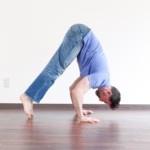

Your wrists need preparation, not protection.
Whether you’re working on push-ups, climbing, grappling, or wrestling around with your kids on the floor, your wrists do the work. Most of us never train them until something hurts.
A few minutes a day of focused work builds wrists that hold up to whatever you throw at them.
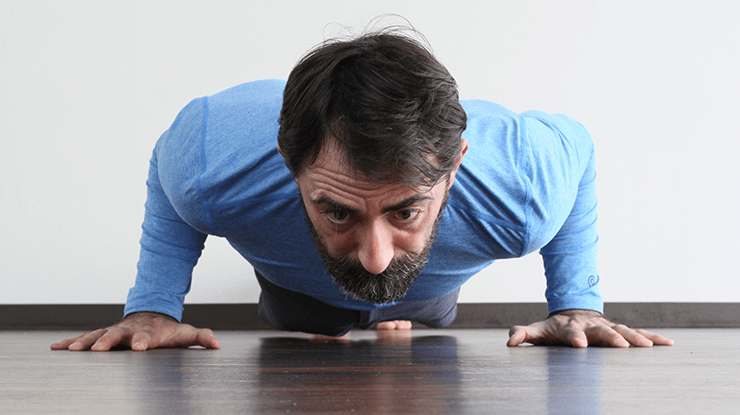
Why Wrist Strength and Mobility Matter
- You use your wrists for everything. Typing, lifting, gripping, training. Stiff or weak wrists make daily life harder than it needs to be.
- Your upper body depends on them. Push-ups, planks, dips, and most floor work all run through the wrists.
- Modern life uses them without preparing them. Typing and scrolling don’t load your wrists. They just keep them busy.
Most adults go years without bearing real weight through their hands. Then a house project, helping a friend move, or a few weeks of push-ups exposes the gap, and the wrists get the blame.
The wrists aren’t broken. They’ve just never been trained.
You don’t need to be a circus performer or a strongman to benefit. You need wrists that handle weight, change angles, and support the activities you actually want to do.
Injured or Just Hurting?
Two options most people consider: wait it out, or see a professional. (And yes, see a professional if your problem doesn’t improve or gets worse.)
There’s a third option: train your wrists yourself with a few minutes of focused work each day.
I’ve used these exercises with hundreds of physical therapy patients over the years. A client of ours, a sports orthopedic surgeon, has been using them with his patients too:
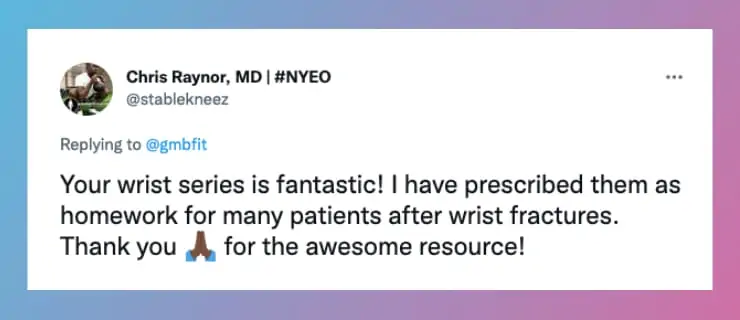
We’ve since updated the routine with more variable and active loading. Before the routine, a quick look at why these exercises do what they do.
A Brief Look at How Your Wrists Work
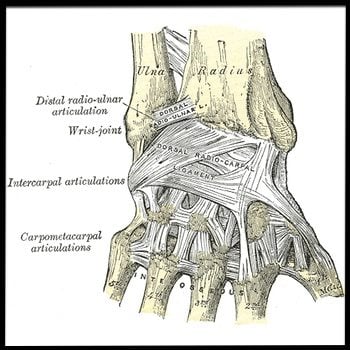
The wrist is a complex little system: ten bones, multiple ligaments, and a web of muscles working together to handle load and create movement.
- The radius and ulna (your forearm bones) connect to eight small carpal bones.
- Connective tissue holds the joint stable. It needs progressive loading to get stronger, not just stretching.
- Forearm muscles control wrist flexion, extension, and side-to-side movement. Rotation (supination and pronation) actually comes from the elbow, not the wrist.
A few minutes a day of patient, progressive work builds resilience and strength through the whole system. No fancy tools. No hours in the gym.
The Wrist Strengthening Routine
The Full Routine
| Exercises | |
|---|---|
| 1. Wrist Shakes | • Simply shake your wrists out for 10-15 seconds (like a Polaroid picture just as Andre 3000 so eloquently said in Hey Ya). |
| 2. Wrist Circles | • Bring your hands up with your elbows close to your body, making fists. • Rotate your wrists in a circular motion. • Try to keep your palms facing downward to maximize range of motion. • 5 to 10 reps each direction. |
| 3. Close/Open | • Quite simple, make a fist and open! • Squeeze hard and relax fully. • 10 repetitions. |
| 4. Elbow Rotations | • Palms facing forward, rotate your elbows in and out • Work on keeping your hands flat, and rolling your elbow pits forward. • 5 to 20 repetitions. |
| 5. Finger Slides | • Palms flat on the ground, pinch your fingers and thumb together while sliding on the ground. • Open them up, again sliding to use the friction as a light resistance. • 5 to 20 repetitions. |
| 6. Finger Pulses | • Put your hands flat on the ground, splaying your fingers as wide as you can. • Pull your palms off the ground, keeping the top part of your hand and your fingers pressed into the ground. • 5 to 20 repetitions. |
| 7. Palm Heel Up Side to Sides | • Make sure your hands are flat on the ground with fingers spread out. • Lift the heel of your hands up off the ground. Then push your hands into the ground while focusing on the knuckles, and go side to side. • If this position is tough, bring your hands closer to your body. 5 to 20 repetitions |
| 8. Wrist Side to Sides | • Have your fingers facing towards the sides as you lay your palms flat. • Rock side to side. • Up to 20 repetitions. |
| 9. Backward Facing Wrist (Palms Down) Pulses | • Place your hands out in front of you, rotating your wrists around so that your fingers are facing your knees. • Start with your fingers closer to your knees (this is easier than further away). • Keeping your palms flat on the ground, shift your body back toward your heels, then forward toward your hands. • Make sure your elbow pits are facing forward and pulse forward for 5 reps, holding for 10 to 20 seconds on the 5th rep. |
| 10. Rear Facing (Palms Up) Pulses | • Start with the back of your hands on the floor, fingers pointing toward your knees. • Make sure your elbow pits are facing forward and pulse forward for 5 reps, holding for 10 to 20 seconds on the 5th rep. |
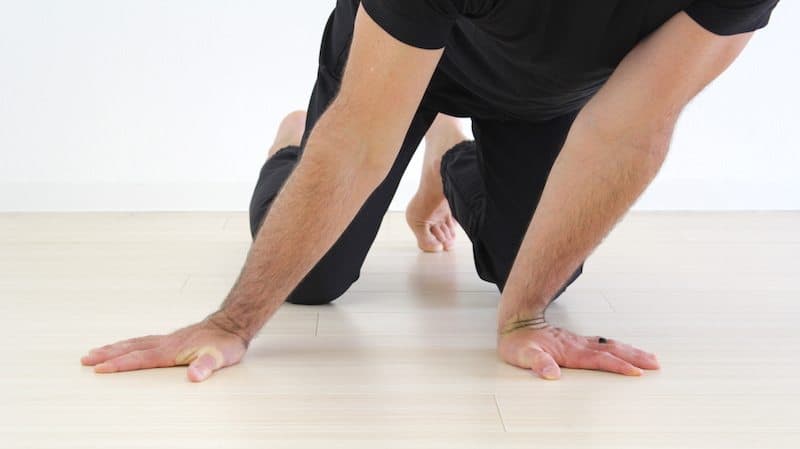
| 11. Forward Facing Wrist Pulses | • Start with your hands flat on the floor in front of you with fingers facing forward. • Make sure your elbow pits are facing forward and pulse forward for 5 reps, holding for 10 to 20 seconds on the 5th rep. |
| 12. Plank Circles | • Start on hands and knees with palms flat and fingers facing forward. • Shift your weight to make circles around your hands. • Make it more challenging as needed by increasing the distance between your knees and hands. Eventually going up into the push-up plank position. • 5 repetitions in each direction. |
This routine works on its own. If you’d rather have wrist work built into a full movement practice instead of running it as a separate session, that’s what Elements is for.
Wrists Hurt During Push-Ups or Crawling? Try These 5 Fixes
If you’re newer to ground-based work like push-ups, planks, or any of our locomotion drills (Bear, Monkey, Frogger), your wrists will feel it. That’s not a sign something’s wrong. You’re loading them in ways modern life never asks of them.
Pushing through the discomfort is how you get sidelined. Adjusting and training smart is how you build wrists that handle the work.
Five small adjustments make a big difference:
1. Adjust Your Hand Angle
Your hands don’t have to be glued to one position. Turn them slightly outward or inward and find the angle that feels best for your wrists today. Some people prefer fingers pointing slightly outward. Others rotate inward. Small tweaks change which structures take the load.
2. Shift Your Weight Back
The more your shoulders stack directly over your wrists, the more weight you dump onto them. A full plank loads the hands more than a knee plank for exactly this reason.
If your wrists feel jammed up, you’re probably leaning too far forward. Shift your hips back slightly and the strain drops fast.
3. Use Your Whole Body
Locomotion isn’t a hand-and-arm endurance test. Engage your legs. Keep your hips active. Push through your feet, not just your hands. Your hands provide balance and contact, not 100% of your bodyweight.
4. Build Up Gradually
Start with shorter sets and lower pressure. Take breaks. Shake out your hands, do some quick mobility work, and come back to it. Your wrists strengthen the same way the rest of your body does: with consistent, progressive load over time.
5. Keep Training
Avoiding wrist-loading work doesn’t fix the problem. It guarantees the gap stays where it is. The wrists need to do the work to get stronger at the work.
That’s exactly what Elements is built around: closing the weak links so your body stops holding you back.
Bonus Wrist Challenges (For When You’re Ready)
These are optional. They’re here if you want to push further once you’ve built a base.
Weighted Implement Wrist Exercises
Use a heavy stick, club, or hammer. First sets hold the implement at the bottom. Second sets hold it at the top.
1. Forward/Backward Wrist Deviations
- Keep your wrist flat. Rock the implement forward and backward with a strong grip.
- 5 to 10 reps.
2. Side-to-Side Wrist Deviations
- Keep your wrist flat. Rock the implement side to side with a strong grip.
- 5 to 10 reps.
3. Wrist Circles
- Strong grip throughout the motion.
- 5 to 10 reps.
Hanging Wrist Exercises
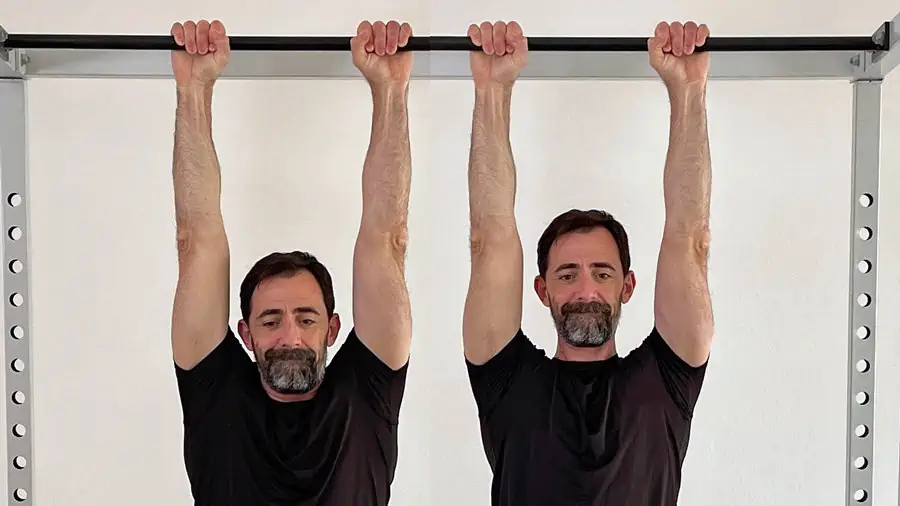
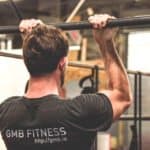
On the left, a relaxed passive hang. On the right, lats engaged for an active hang.
Passive to Active Hang
- Hang onto the bar and relax into the stretch. Then gradually pull up and down with straight arms.
- Auto-regulate and do what feels good.
Don’t push into painful positions. Back off and try an easier version if something hurts. Building strong wrists is a process. Practice these moves regularly at your own level and you’ll get there.
How GMB Programs Build Wrist Strength Into Your Practice
That’s a comprehensive routine. If you tried to bolt it onto a full training plan as a separate session, it’d start to feel excessive. That’s the wrong way to use it.
Adding more isolated exercises is the most common mistake people make for wrist work, or any other body part. Workouts balloon. Practice gets diluted.
We solve this by integrating wrist work directly into our programs. You build stronger, more resilient wrists as part of your regular practice, not as a separate task.
Why Your Wrists Struggle With Ground Work
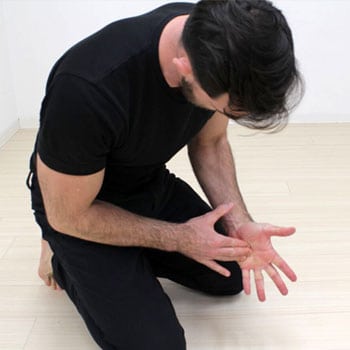
If your wrists are already tender, the last thing you want is to overload them. The balance is real: do enough to make progress without flaring things up.
Here’s the truth about ground-based movement like our locomotion drills: the wrists are the weak link for most beginners. They would be even more so if you jumped straight into an hour of crawling work.
That’s why our programs use progressive wrist prep at every stage. Instead of overloading you upfront, we build wrist capacity gradually through prep, practice, and play. Over time, the wrists handle more without breaking down.
The Two Strategies That Make This Work
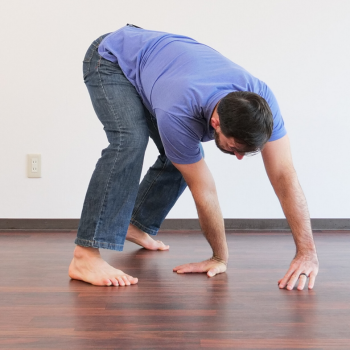
Every GMB program teaches two key strategies:
- Autoregulation. You’re not pushing to your max every day. You adjust intensity and volume based on how your body performs and feels that day. This matters most when your wrists are sensitive.
- Timed sets with breaks. Our sets are time-based instead of rep-based. You rest as needed inside the set without pausing the clock. This gives you space to recover and modulate strain instead of grinding through.
You can’t force progress. We can’t say that enough.
This approach lets your wrists adapt gradually instead of getting hammered session after session.
How Each Phase Builds Wrist Capacity
In daily GMB practice, wrist strengthening is woven into the flow:
- Preparation Phase. Active dynamic loading and movement prep before locomotion work.
- Practice Phase. Strength and control through drills like Bear, Monkey, and Frogger, applying real-world movement patterns.
- Play and Push Phases. Challenging the wrists in more demanding variations, always within a framework of control and exploration.
By the time you’ve moved through a few cycles of practice, the wrists hold up to the workouts and start asking for more.
Wrist Routine FAQ
What if these exercises are too uncomfortable for me?
Why do my wrists hurt during push-ups?
Do push-ups actually strengthen wrists?
These feel pretty easy. What more can I do?
How should I add this to my other training?
Wrists That Handle Whatever You Ask of Them
Feeling restricted from the activities you want to do is a terrible feeling. You want a body you can trust, with wrists that don’t show up as the limiting factor.
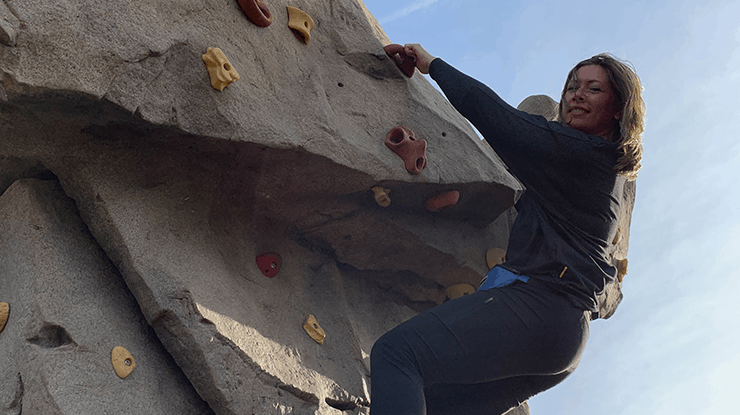
When your body moves without restrictions, you’re free to do the things you want to do. Climb a mountain, get on the floor with your kids, build a deck on a Saturday. The point isn’t the activity. It’s having a body that says yes to it.
Better total-body movement spreads load across the system, so the smallest joints stop carrying the heaviest cost. That’s why wrist problems often improve in Elements without dedicated wrist work.
Build Wrists That Hold Up
Help your upper body move as a connected system, so pressure spreads instead of dumping into one joint.

Hi, I'm Jarlo Ilano PT, DPT 👋
Jarlo Ilano, PT, DPT, OCS has been a Physical Therapist since 1998. He earned his Doctorate of Physical Therapy in Musculoskeletal Management from Evidence In Motion, was board certified as an Orthopedic Clinical Specialist with the American Board of Physical Therapy Specialties, and is a certified Therapeutic Pain Specialist through EIM/Purdue University.
In addition to cofounding GMB, Jarlo has been teaching martial arts for over 30 years, with a primary focus on Filipino Martial Arts. He designed our Train Without Pain guide and our knee and shoulder restoration programs.