
Progress feels good! (Duh…)
There’s a particular satisfaction in watching the numbers go up. More weight, more reps, faster times, better marks in whatever you’re tracking. For a while, that feedback loop keeps you honest and motivated.
And then, eventually, it doesn’t.
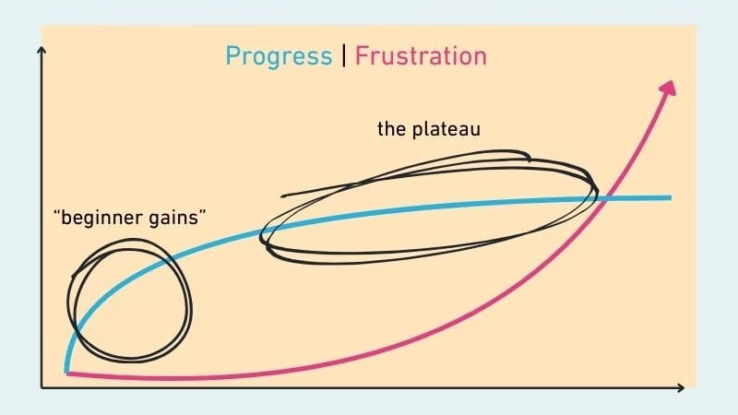
Beginner gains are real, and they’re generous. Early in your training, almost anything works. You get stronger, move better, feel better, and the metrics confirm it.
But that phase doesn’t last forever… It might be months, it might be years — and at some point the line stops going up the way it used to. You’re still showing up, still doing the work, but the progress feels murkier. Less legible.
We call that the plateau, and it’s frustrating as hell!
This happens to almost everyone who trains seriously long enough. It’s not a character flaw, and it’s not a sign that you’ve hit some kind of genetic ceiling. In most cases, it just means you’ve outgrown your measurement system.
Thais article is gonna teach you a better one.
🎙️ It’s All In Your Head: Embracing Subjectivity in Your Training
Ryan and Andy first talked about the subjective nature of training and need to a more nuanced method of tracking progress in this pod from way back in 2019…
What Your Rep Count Is Actually Measuring
You don’t count punches in boxing.
The winner isn’t whoever threw the most punches. The winner is whoever hit with the right amount of force, at the right time, to the right target, while the other person was trying to do the same thing back.
The quality and timing of each punch matters enormously.
The total count tells you almost nothing.
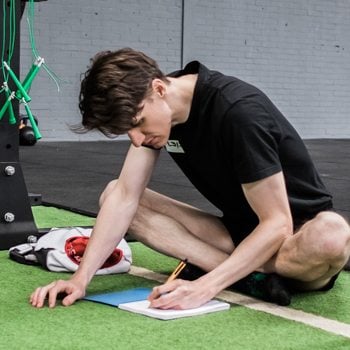 This seems obvious when you say it out loud. But most people keep a log of their push-up numbers, and… absolutely zero tracking of quality.
To be clear: rep counting isn’t wrong. It’s the right tool for certain things.
Barbell training, where each repetition is mechanically similar and quality can be held relatively constant, is a case where rep counts carry real information.
But the moment you move into skill-based training — anything where movement quality varies, where coordination is part of what you’re developing, where the goal is owning a movement rather than just completing it — the rep count starts hiding as much as it reveals.
A push-up done with controlled tempo and full range of motion is not the same thing as a push-up done fast with compromised depth. They both count as one rep. The number hides the quality and value of the work.
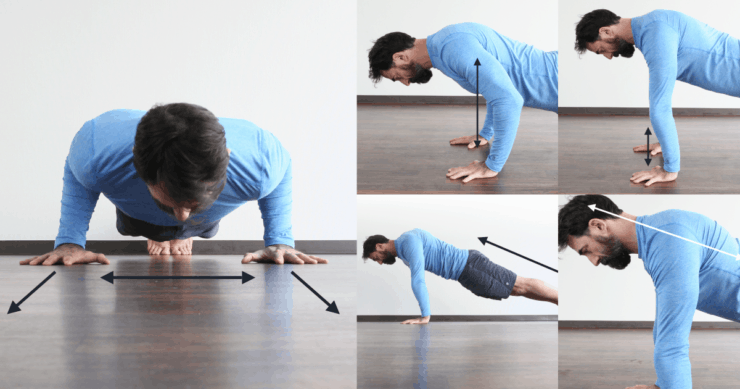
(We’ve written more about this specifically in the context of timed sets vs. rep counts — that piece goes deeper on the mechanics of why we structure practice the way we do in our programs.)
The problem that develops over time is this: you can get very good at hitting numbers while the underlying capability you actually want — movement quality, body ownership, real-world strength — lags behind.
The plateau is invisible at this level of granularity.
What’s Missing: Your Subjective Experience Is Data
Subjective measurement sounds like a consolation prize. “If you can’t count it, at least pay attention to how it feels.” That’s not what this is.
Your subjective experience of a movement is real information. It’s just information you haven’t been trained to read.
Think about what it actually feels like when a movement goes well versus when it doesn’t. There’s a difference between a set that feels solid and controlled and one where you’re grinding through the last few reps with form you’re not proud of. You know the difference.
You just haven’t been treating that knowledge as trackable data.
We do:
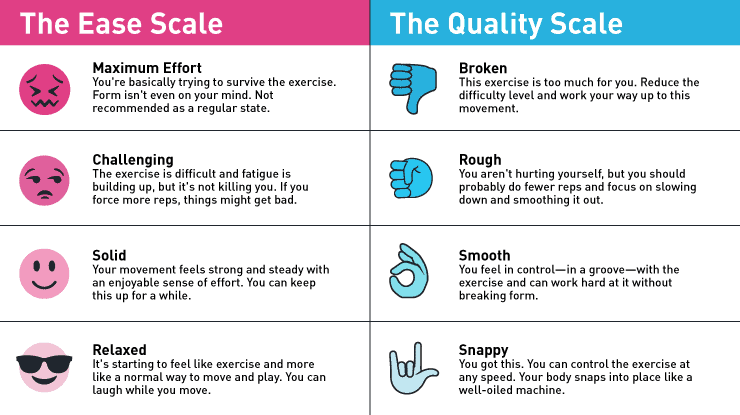
In Elements and across our other programs, we’ve built a system around two subjective markers: Quality and Ease.
Quality is the proportion of your movement that actually matched what you were going for — the cues you’re working with, the range you’re aiming for, the control you’re developing.
Ease is different. It’s how much the movement felt owned versus merely completed. A great athlete doesn’t look like they’re working hard — Michael Jordan’s jump shot was described as poetry, not as evidence of supreme effort. That effortlessness is the goal of practice. Rating ease keeps you oriented toward that goal rather than toward the effort itself.
These aren’t soft metrics. You can learn to be very precise with them. And over time, they reveal something a rep count never will.
What Progress Really Looks Like
Here’s the thing about tracking quality subjectively: the graph doesn’t go up and to the right.
It goes up, then comes back down, then up further, then back down, like sine wave:
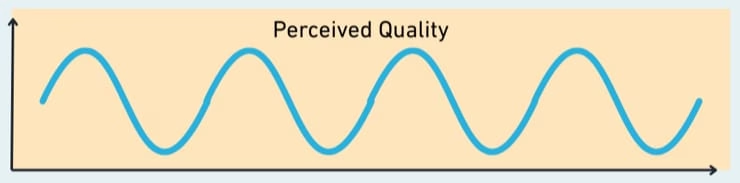
This is not failure. It’s just what skill acquisition looks like.
When you first learn a movement, everything feels rough or broken. You practice, things smooth out, eventually something clicks and it feels snappy.
Done, right?
Except then you refine a detail — you notice something in the cues you hadn’t been attending to, or the movement gets harder and the quality drops back to rough. You’ve raised your standards. The wave troughs because your awareness has grown, not because you’ve regressed.
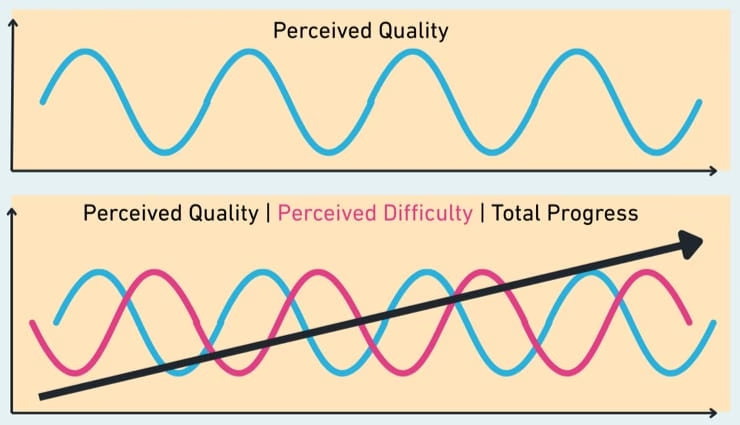
This is a profound reframe for experienced trainees.
If you’ve been tracking only objective metrics, a plateau reads as stagnation. If you’re tracking quality and ease alongside it, you see something different: a moving target, a rising standard, a practice that’s still alive.
One of our clients, a competitive Kendo practitioner who also races bikes and swims open water, put it well: after starting Elements, he wrote that he’d learned what “physical autonomy” actually meant — “increased joint mobility, motor control in every range of motion, coordinated strength.”
Another client, Steffen, came in with over ten years of Shaolin Kung Fu. He expected to find the program easy or at least familiar. Instead: “The new positions, angles, twists, and strength work revealed movement restrictions and weaknesses I hadn’t even realized I’d grown used to.” He wasn’t weaker than he thought. He was unaware of things his training hadn’t made visible.
That’s the sine wave in action. Higher standards expose things that were hidden.
How the Praxis Method Is Built Around This
This isn’t a philosophy we bolt onto the outside of the training. It’s the structural logic behind how Elements and the rest of our programs are designed.
- Timed sets instead of rep counts.
- Autoregulating intensity based on your actual capacity on a given day.
- A session structure that emphasizes mindful attention and exploration.
- Dedication reflection on your experience at the end of each session.
All of it is built on the premise that your subjective experience of movement is the most reliable signal you have about what’s actually developing.
The rep count tells you what you did.
Quality and ease tell you whether your nervous system is learning.
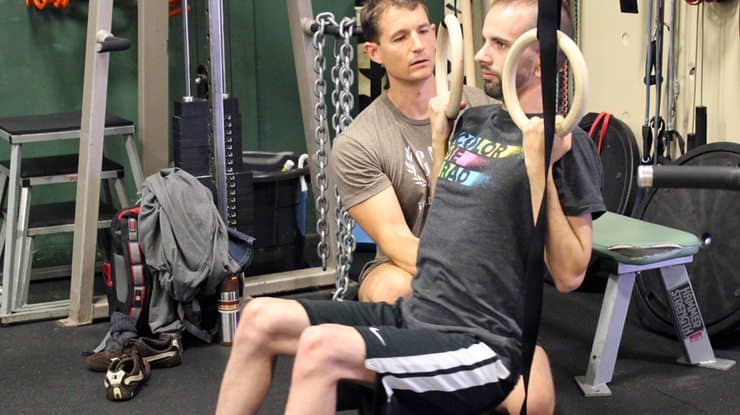
A client named Ryan, who came from a background of traditional strength and kettlebell training, described it this way: “The focus is on form and tempo versus reps and weight. With GMB’s programs I continue to learn what I need to work on. I apply their method and with focused attention my weaknesses and restrictions begin to shift.”
Branden, who also came from kettlebells and strength training, noticed something small that most people would dismiss. In the A-frame position — the foundational shape at the start of Bear — his right heel finally touched the ground. He wrote: “It’s a small improvement, but still cool to see.”
Here’s Scott, 57, a lifelong competitive runner who’d stopped running daily fifteen years earlier. Two months into Integral Strength, working about thirty minutes a day: “It’s been a long time since I’ve felt ‘normal’ in my body. Getting up in the morning feels like just getting up in the morning.”
These aren’t metrics you can put in a training log.
But they matter.
End Your Training Plateau with Better Metrics
When a plateau hits, the instinct is to just do more.
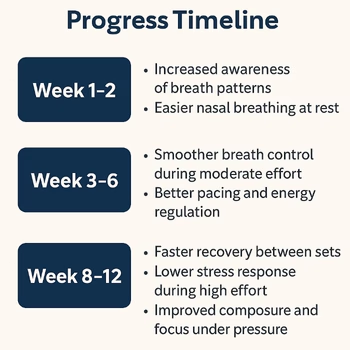
Here’s what progress looks like from a breathing perspective.
It’s often subjective.
And when you tune into a broader signal, your feedback loop works better – you can see and understand what’s really happening in your training.
Rep counts and load numbers are useful, but they measure the output of training, not the quality of the skill being built. Tracking quality and ease doesn’t replace quantity. It sits alongside them and fills in what they miss.
Over time, the combined picture becomes far more useful.
Break Your Plateau with an Approach that Honors Your Full Experience
The Praxis Curriculum programs are built around this principle from the ground up. We suggest starting with Elements:
If you’ve hit a wall in your current training and want to know what you’ve been missing, it’s a good place to start.
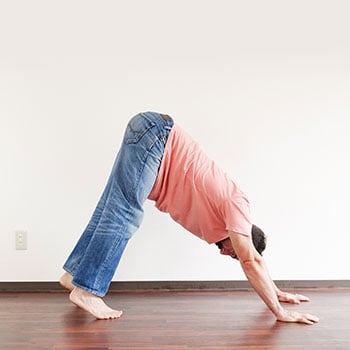

Hi, I'm Andy Fossett 👋
A lifelong martial artist and former schoolteacher, Andy’s deeply concerned with autonomy and fitness education. As CEO of GMB Fitness, he’s dedicated to providing an open, accessible culture for both clients and staff to enjoy exploring more of what they’re truly capable of.
He's best known for his wildly off-topic rants on the GMB Podcast and spends the majority of his time eating burgers, sipping bourbon, and reading books.