“Good form” starts more arguments than almost anything else in training, and the two loudest camps are both wrong.
One camp says form barely matters. Add weight, push harder, the results take care of themselves.
The other camp says every movement has exactly one correct version, usually demonstrated by someone with ideal proportions and a decade of practice, and anything short of that is sloppy garbage.
 Put those two positions on a bell curve and they sit way out on the skinny tails, the far edges where almost nobody actually lives.
You’re in the fat middle.
So is everyone you train with.
So are we.
That middle is where good form lives, and it’s grey on purpose.
Good form is a range. It’s wide, because your body gets a say, and it has hard edges, because some things are dangerous no matter who you are.
When people say they want perfect form, what they usually mean is they want to match a photo. A particular person, a particular frame, paused at the prettiest moment.
That person doesn’t have your shoulders, your injury history, your proportions, or your hours on the mat. You’re chasing the output of a body that isn’t yours.
What good form actually does for you
Form is a set of levers. Pull a different one and the movement does something different to you.
That’s the entire reason to care about it, and it has nothing to do with looking impressive.
Let’s look at the hollow body hold:

Two people can be in what looks like the same position, but one has the lower back pressed flat to the floor and the other is letting it arch up. Same exercise on paper. Completely different demand on the body.
One small cue decides whether the move trains what it’s supposed to train or quietly does almost nothing.
Then there’s where the load pushes on your joints.
Tuck your elbows on a push-up and point them back toward your feet instead of flaring them wide, and the work shifts off the shoulder joint and onto the muscles built to handle it. Flare them and the joint takes the job the muscle should be doing.
Run that pattern for a few years and the aches arrive right on schedule.
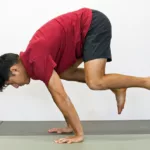
Form also decides how safe a joint is. Some people can’t get their hands flat with fingers pointing forward in an A-frame or a crab, because their wrists or shoulders won’t allow it yet. Turn the fingers out and the same position becomes available and safe.
A coach reading a rulebook calls that an error. A coach reading the person in front of them calls it correct, and works to avoid a problem down the road.
Form changes how much of one attribute an exercise costs you. Practice a handstand with your belly to the wall instead of your back, and you spend far less attention on balance, which frees you up to build a straight line you can actually feel. Spend less on one thing so you have something left to build another.
Neither one is wrong – in fact, we recommend both!
And form sets up the movement that comes next. We turn the fingers out in the crab partly because that’s the hand position you’ll need later when you support yourself in an L-sit. Get comfortable there now and the harder skill already feels familiar when you arrive.
Every one of those is about what the rep is doing to you. That’s the only thing worth arguing over.
Your good form is personal, and it keeps moving
Since form is a range, the real question is where your spot in that range sits. The answer shifts with a handful of things about you:
- Experience. A beginner and a ten-year mover need different cues for the same drill.
- Strength. What’s safe under load changes as you get stronger.
- Mobility. The position your joints allow today sets your starting point.
- Proportions. Long femurs and short femurs do not squat alike.
- Injury history. An old shoulder rewrites what good looks like for you.

Watch three people squat and you’ll often see three different shapes, all of them correct. This is why the internet can argue about the squat until the heat death of the universe and never settle it.
Some insist the feet point straight ahead, others want them turned out. Some demand a flat back the whole way down, others shrug at a little rounding at the bottom. Some tell you to sit back into your heels, others to stay over the middle of the foot. Every one of those camps is right, for someone. The mistake is assuming their someone is you.
Your good form also moves over time. Get stronger, build skill, change your goals, and the right version of a movement changes along with you. The form that fits you this year can be a stepping stone you’ve left behind by next year.
So a useful first move: of those five variables, which one is most true of you right now? The deskbound lifter and the ex-gymnast share a squat in name only. Knowing which description fits you is the start of knowing what your good form looks like.
“Make it pretty,” and why we coach in guardrails
Ryan tells people to “make it pretty,” and it’s easy to assume that’s referencing aesthetics.

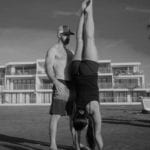
Here’s a great example from Yuval Ayalon, a master hand balancer who is constantly working on making his handstand prettier.
It’s shorthand for “make this your best current attempt at the right version of the technique for you, today.”
We say pretty because it’s a word a human can act on. The literal version is a mouthful nobody can hold in their head mid-rep.
Efficient movement tends to look good as a side effect, so “pretty” works as a rough mirror for whether you’re moving well, as long as you remember the look is the byproduct and the goal is the movement.
That’s the internal guardrail. The specific cues we give are the external ones.
A guardrail keeps you off the cliff. It doesn’t tell you which lane to drive in, how fast to go, or where to point the car.
We coach form the same way, because the grey middle can’t be legislated down to one correct line. We fence off the dangerous edges, the shrugged-and-flared shoulder, the collapsed spine under load, and then we leave you room to find the version that works for your body.
That’s also how we think about cues in general.
This is the upgrade on the old idea of good form. You’re not memorizing a fixed shape and grading yourself against it. You’re building the skill of finding and adjusting your own form as your body and your goals change.
That skill is the real prize, and it’s the one thing a rulebook can never hand you.
You can only focus on one thing at a time
Even once you know the right guardrails, you can only hold so many of them in your attention at once.
One, maybe two. Fewer still when you’re winded or starting to fatigue, which is exactly when form tends to fall apart.
Pile on six cues and you accomplish nothing, because you can’t act on six things and end up acting on none.
So we run coaching through the theory of constraints. With limited attention and limited training time, you aim your focus at the one cue most likely to make the biggest difference, and you let the rest wait.
The art is finding the cue that fixes several things at once.
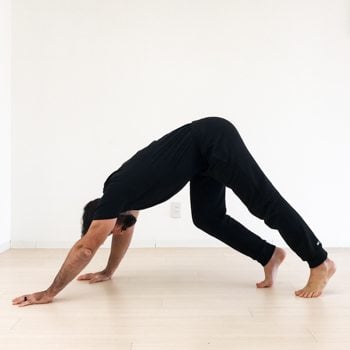
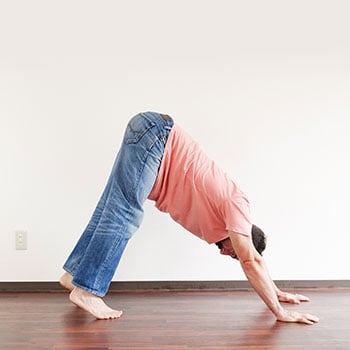
In the A-frame, we say two words: butt up. Push your hips toward the ceiling and watch what else falls into line.
Your shoulders elevate. Your arms lock out. Your pelvis tilts. Your legs lengthen and your heels settle toward the floor. Your core switches on. One cue, six corrections, and you never had to think about any of them.
The cue also has to be something you can feel.
“Externally rotate your scapula” means nothing to someone who hasn’t spent years building that kind of body awareness. “Drive your heel into the floor” works, because you can feel your heel. “Land quietly” beats a five-point checklist on jump mechanics, because a person trying to land without a thud will sort out most of the mechanics on their own.
This push-up video is a clean demonstration of the whole idea. The same two cues, shoulders pulled back and down, elbows tucked, carried across every variation from a floor hold all the way to a handstand push-up.
We do this for every single exercise we teach in every single program.
We haven’t just coached a lot of people, we have a massive data set from clients who are using our programs, so we can see what works over time.
And it helps make “good form” a lot simpler when you already know which details matter most.
Why this is hard to pull off alone
Knowing all of this and applying it to yourself are two different jobs, and the gap between them is wider than people expect.
Three problems show up the moment you try to coach your own form.
 You can’t see your own blind spots. You feel like your shoulders are down and your elbows are tucked. Whether they actually are is information you don’t have from the inside. Filming yourself against a clear technique reference helps. An outside set of eyes helps more.
You can’t tell which of your possible cues matters most. You might have five things that could be better. The theory of constraints says you work the one with the biggest payoff first, but ranking them means seeing the whole picture, and you’re stuck inside your own. Pick wrong and you spend weeks polishing something that wasn’t holding you back.
And the right cue keeps moving. The thing that mattered most last month gets solved, and now a different constraint is the one in your way. Good self-coaching means re-checking your baseline, dropping down a level when your form starts to break, and giving yourself room to make honest mistakes while a new pattern settles in. That’s a lot to run on yourself, in your own head, with no outside reference.
None of this means you can’t improve on your own. It means the work is real, and a system built to walk you through it saves you years of guessing.
We coach for the long game
Every cue we choose runs through the same filter: autonomy, longevity, fun.
You’re not training for a panel of judges, so we choose cues that keep you training. When a cue buys a bigger number today at the cost of your shoulders in ten years, we don’t use it. We pick the form that keeps you capable and keeps you able to do more of what you actually want with your body, the kind of thing that stays fun instead of grinding you down.
That’s where both halves of this pay off. Dial in the right cue and the exercise works better the very next time you do it. That’s the quick win. Build the skill of finding and adjusting your own form, and it compounds, because every movement you pick up from here gets easier to coach yourself through.
 The model in the photo was always a distraction. Good form comes down to three things you can do yourself: know where you are, choose the one thing that matters most right now, and adjust as you change.
That’s a skill. Like any skill, you build it in order.
That order is what our curriculum is built to give you, and Elements is where it starts.
Elements is the first phase. We assess where you actually are, then hand you the movements and the cues that build real body awareness, the kind that lets you feel when your form is breaking down so you can adjust it yourself. It’s the front door to everything that comes after, and it’s where the skill of self-coaching begins.
Build the Awareness to Coach Yourself
With Elements, you’ll build the strength, flexibility, and body control you need for the activities you love, through assessment and targeted exercises that teach you to feel your own form.
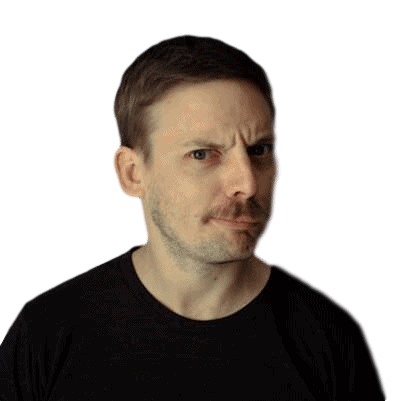
Hi, I'm Andy Fossett 👋
A lifelong martial artist and former schoolteacher, Andy's deeply concerned with autonomy and fitness education. As CEO, he's dedicated to providing an open, accessible culture for both clients and staff to enjoy exploring more of what they're truly capable of.
These days he mostly coaches teachers, from GMB Trainers to martial arts instructors around the world. The rest of his time goes to burgers, bourbon, and his wildly off-topic rants on the GMB Podcast.