The Frogger teaches you to generate power from the ground up. You push through your hands, lift your hips, and move.
That connection between your upper body and your hips is the engine behind almost every athletic thing you do, even if the movement itself looks like a goofy hop.
The Frogger is a locomotion movement, which just means moving your whole body through space. Like the Bear and Crab, it’s one of the “animal” movements used in calisthenics, gymnastics, and martial arts. It might look like play, and it is, but there’s real athletic work happening underneath.
I came up as a competitive gymnast, so I have a soft spot for the Frogger. It’s a close cousin of the movements that eventually become handsprings and handstand work. You don’t need any of that to get value out of it. But the same thing that makes a Frogger work, pulling yourself forward with your arms and torso while your hips follow, is the foundation those bigger skills are built on.
💡 To learn more about these benefits, check out our locomotion page.
How To Do The Basic Frogger Movement
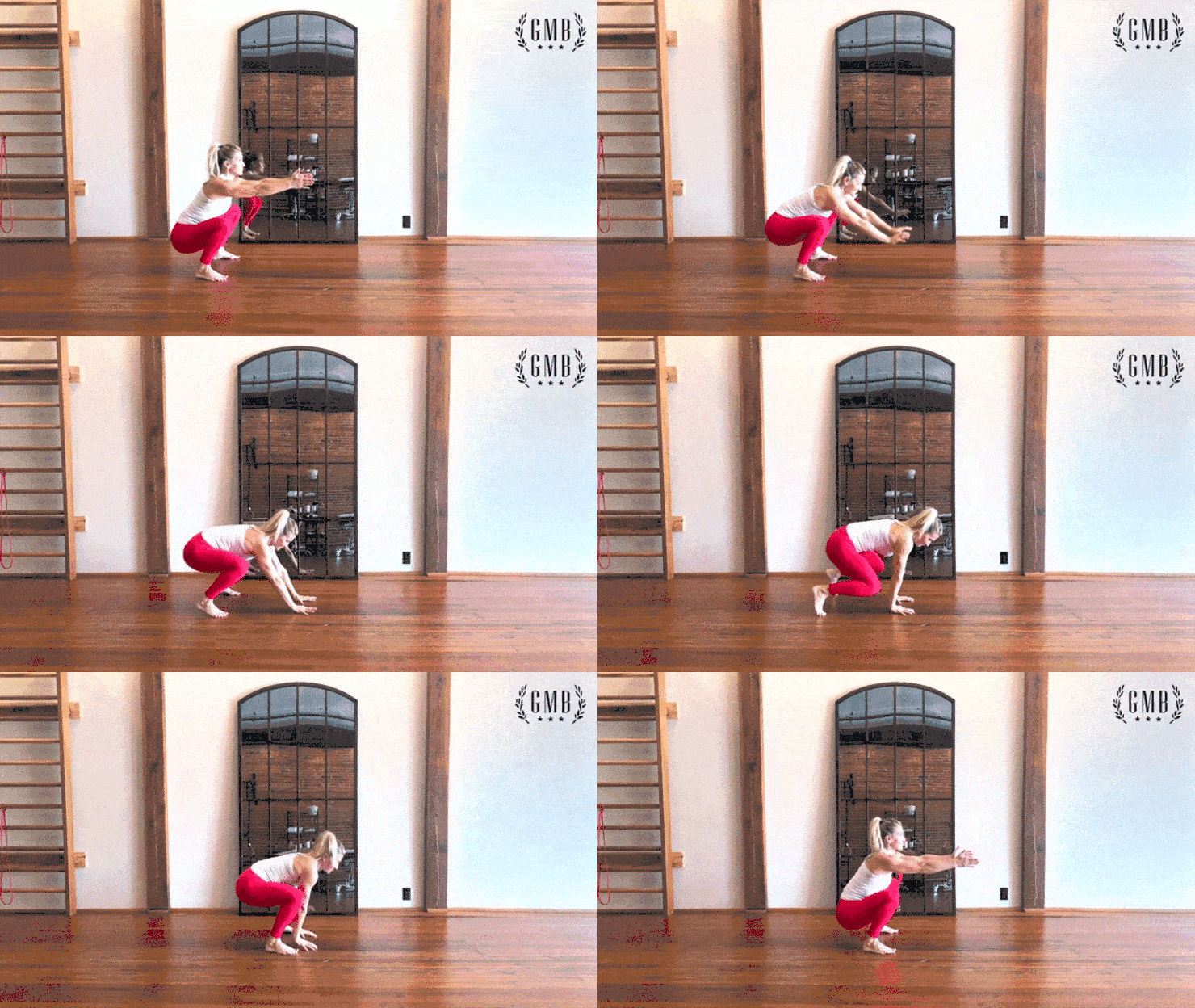
- Step 1: Start in a squat with your hands out in front of you.
- Step 2: Reach forward and place your hands flat on the ground, palms down.
- Step 3: Shift your bodyweight forward onto your hands.
- Step 4: Pull yourself forward with your arms and torso, then hop your feet up toward your hands and back into the squat.
Frogger Exercise Variations For More Strength And Body Control
Below you’ll see 5 variations of the Frogger we use in our programs, plus an intro movement (the floating table top) to help you prep for the exercise.
- Floating Table Top – straight arms and bent legs
- Basic Frogger – straight arms and bent legs pulled up toward your body
- Slow Toe Pull Frogger – straight arms, bent legs, sliding toward your hands
- Sumo Frogger – wide stance, straight arms, requires more groin flexibility
- Straight Leg Frogger – straight arms, straight legs, requires strong shoulders and flexible hamstrings
- High Frogger – straight arms, lots of shoulder load, good for handstand prep
No single variation is better than another. You’ll get more out of one or another depending on what you need. If shoulder stability is your limiter, the basic Frogger will support your weight more easily than the Slow Toe Pull or Straight Leg version. If you want to build up your elbows and shoulders, the Slow Toe Pull Frogger is where to spend your time.
As the basic Frogger gets comfortable, use the variations to add upper body strength, control, and hip flexibility.
Notes on the Frogger
The most common mistake is trying to push off with your legs. Don’t. The Frogger works when you pull yourself forward with your arms and torso, then hop your feet back under you into the squat. Lead with the pull, and let the hop finish it.

What If I Can’t Do The Frogger Like They Do In The Videos? 🤔
Same thing comes up with the Frogger as the Monkey: people figure they need a full squat before they can start. You don’t. If anything, doing the Frogger is part of how your squat opens up, so starting now with a little less depth works in your favor.
Here’s GMB Trainer Verity showing how to modify it:
When you’re ready to build more depth directly, our squat tutorial will get you there.
The Frogger also needs some shoulder and core stability to support your weight out front. If that’s the part that’s missing, work the Bear first to learn how to brace and hold yourself up. And if your wrists hurt, our wrist routine has you covered.
Frogger Exercise Variations And Benefits
| Variation | Benefits |
|---|---|
| Basic Frogger | • Scapular strength through concentric and isometric protraction, eccentric and isometric retraction, and eccentric control of elevation • Rotator cuff strength to control eccentric internal rotation and concentric, isometric external rotation • Spinal strength for isometric extension, rotation, and flexion • Hamstring and calf flexibility • Increase in hip strength and mobility |
| Slow Toe Pull Frogger | • Elbow strength • Spinal strength and controlled mobility • Hamstring and calf flexibility • Improvements in abdominal and spinal stability |
| Sumo Frogger | • Elbow stability • Knee stability • Spinal strength for isometric rotation, extension, and flexion • Increase on hip mobility and strength through abduction and flexion |
| Straight Leg Frogger | • Rotator cuff strength • Knee strength • Spinal strength and controlled mobility • Increase in hip mobility |
| High Frogger | • Elbow strength • Rotator cuff strength • Spinal strength • Improvement in motor control and coordination |
The Frogger is a full-body movement, so there’s a lot going on at once. You’re building shoulder strength and mobility, adding back strength and spinal flexibility, and teaching your body to balance on your hands and feet so you can move where you want without overthinking it.
Get comfortable moving like this and it pays off in your full-body strength and control across everything else you do.
Here’s GMB Trainer Verity running a little flow built from moves you’ll find in our Elements program:
How To Train The Frogger
The Frogger opens up your hips and glutes while building a strong upper back and shoulders. Practice it regularly and you’ll find deep squats and single-leg work get more accessible, and balancing on your hands starts to feel a lot less intimidating.
It’s also a great opener. A few minutes of Frogger loosens your ankles and hips before you go running, jumping, climbing a wall at the gym, or throwing high kicks at the dojo.
The Frogger is one of four animal movements that, practiced together, build a base of strength, flexibility, and control that makes everything else you do feel easier. You learn it once, and you keep it.
That’s what Elements is for.
Build a Foundation You Can Rely On at Any Age
With Elements, you’ll get strong, flexible, and capable using the Bear, Monkey, Frogger, and Crab, so you can move well without restriction.

Hi, I'm Ryan Hurst 👋
After a training accident ended his competitive gymnastics career, Ryan moved to Japan, where he spent close to 30 years training and competing in judo, kendo, and other martial arts until another injury made him rethink what training is for.
As Head Coach, he leads program design and teaches every week on our YouTube channel. His book, Stay On The Mat Forever, is aimed at helping you keep training for decades. He loves handstands, dogs, and hiking.