You have probably heard that your knees should never travel past your toes when you squat, because it puts too much stress on the joint. That claim has been repeated on forums, in comment sections, and across social media for as long as those things have existed.
So should you actually keep your knees behind your toes when you squat?
In one word: no.
There is nuance worth understanding, though. The knee needs to be conditioned to handle the position, the same way you would not throw yourself into a handstand push-up without building up to it first.
As a physical therapist, I have had this conversation with a lot of patients who walked in convinced that letting a knee pass a toe was the thing that hurt them. Usually it was not. The “knees over toes is dangerous” idea does hold for people working around an overuse injury, a previous impact injury, or something structural like meniscus damage or arthritis. In those cases, caution is warranted and you should be careful.
For most people, it is a myth. Let me show you what the research actually says, why your anatomy matters, and how to build a squat that works for your body.
In the video below, Ryan and I break down why letting your knees move past your toes is not the problem people make it out to be, and why it can take time to build the strength and mobility to squat deep without discomfort.
Skip to the section you want: 💯 The Truth About ‘Knees Over Toes’ | 🦵 Anatomical Differences | 📐 Knee Position And Alignment | 🤸🏼♀️ Healthy Movement = Moving In Different Directions | ❓ Understanding Misalignment | ⚠️ Got Knee Problems? Be Cautious! | 🏋️♂️ Build Your Squat With Elements
There is No Magical Rule For Where The Knee Should Be During A Squat
Contrary to what some armchair experts claim, there is no single perfect squat form, and no ideal way to keep your knees from moving over your toes, especially if your anatomy is built for it.
Knees Moving Past The Toes In Real Life
Watch a baby squat down to pick something up and you will see it happen with zero effort. There are a few reasons for that.
- It is a movement that comes naturally to us, thanks to how we are built.
- Their joints are still very supple, so they have an enormous range of motion.
- They have not spent years sitting in chairs in a fixed position yet.
People have squatted for millennia. Long before chairs, cars, and couches, we squatted to rest, cook, work, and relieve ourselves.
You have probably seen the so-called Asian squat. Here is what it looks like:
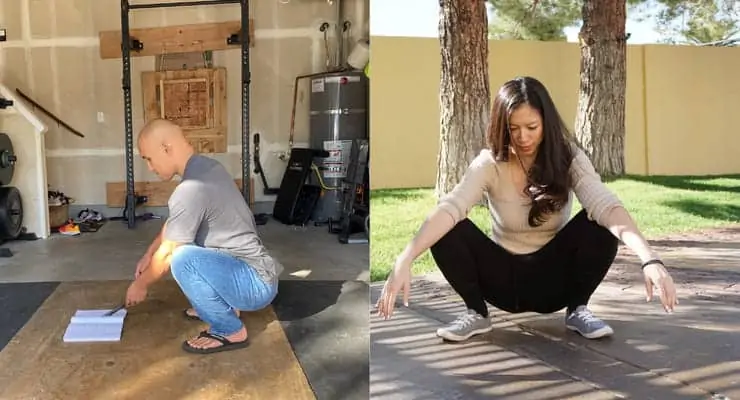
Notice how far his knees travel out over his toes. If that position looks hard, you are probably short on the mobility to be comfortable there. That is trainable. It just takes practice.
Travel anywhere people grew up squatting instead of sitting and you will see folks of all ages hang out in that position for long stretches without a second thought.
Here is another one, the Olympic squat:
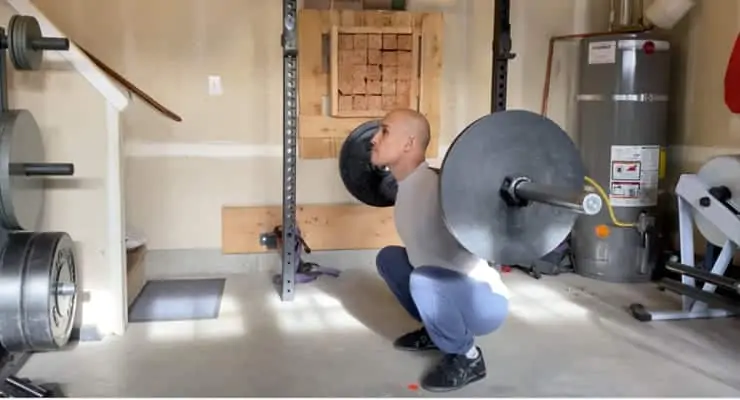
Plenty of people who believe knees should never pass the toes will look at this and call it an injury waiting to happen.
With the right conditioning, enough mobility, and enough strength, it is not harmful to the knee. Done well, it strengthens it.
Key Takeaways:
- Squatting low is a natural movement, though it may not feel natural if you are out of practice or spend most of your day in a chair.
- You can build toward a deeper squat by training mobility and strength together, which is exactly what we map out in Elements.
What Does The Research Say?
A common fear is that the deep squat damages the knee and raises injury risk. The research does not support that for healthy, conditioned people.
When you get good instruction, take sensible precautions, and progress the squat without grinding through pain or forcing a range you do not have, you tend to be fine. One review put it plainly: “contrary to commonly voiced concern, deep squats do not contribute increased risk of injury to passive tissues” [1].
In the clinic, I see the opposite problem far more often than I see knees wrecked by squatting. People tell you that knees past the toes overload the joint. That can be true if you lack the mobility to get there cleanly. But if you do not have the range, say in your feet and ankles, your body compensates, and that shifts more stress to your hips and lower back as you fight to stay balanced [2].
That alone is a good reason to build the mobility and strength to let the knees track forward naturally. It spreads the load instead of dumping it on one joint.
Conditioning matters most for long-term knee health. Conditioning here means how prepared your body is to do a movement, or hold a position, for a given length of time.
If you are not used to sitting in a deep squat, you will not last long there before fatigue and discomfort set in. Practice the position over time and you adapt to it.
The more you practice, the more conditioned you become.
Key Takeaways:
- The research tells us knees traveling past the toes is not harmful if you are uninjured and have the mobility to squat well.
- You can condition and strengthen your knees, and the muscles around them, to move better and squat comfortably.
We’re All A Little Bit Different
Anatomy varies more than most people expect, and it changes what a good squat looks like for you.
Have a look at these three different squat positions:
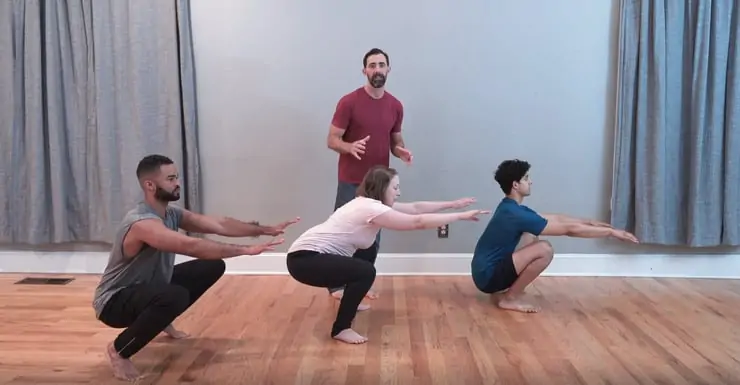
Note: those are three squat styles from the squat assessment module in Elements. If you want to dial in your own squat with control, that program will walk you through it.
Some people have long femurs and short torsos. Others have long torsos and short femurs. Most of us land somewhere in the middle.
You also may not have the mobility right now to squat without your heels lifting, or without sticking your hips back and reaching your arms forward to keep from tipping over.
Those anatomical differences shape how you naturally squat.
So a near-perfect squat for you can look completely different from someone with slightly different limb lengths.
This is why I never get hung up on one picture-perfect squat for everyone. The goal is the form that is right for your body and what it can do today.
Key Takeaways:
- Your anatomy differs from everyone else’s, so your squat may not look like the ones pictured here.
- Squat only to a depth that is comfortable and pain-free. To go deeper over time, train your mobility and strength.
Thinking About Knee Position And Alignment
We have used cues like “keep the shin vertical” in the past, and that is not terrible. But for some people it simply is not possible. Their limb lengths mean the knees will travel over the toes, sometimes more than the next person’s.
What actually matters when you squat is that your heels stay flat on the floor and where your hips sit in relation to your upper body. If you have to throw your hips way back and reach your arms out front to keep from falling, that usually points to a limitation in mobility or strength.
Different movements also call for different positioning to stay balanced.
The pistol squat, for example, takes a lot of balance, so you naturally sit back over the heel to stay upright.
The shrimp squat is the opposite. You carry more weight over the midfoot because you are holding your free leg behind you.
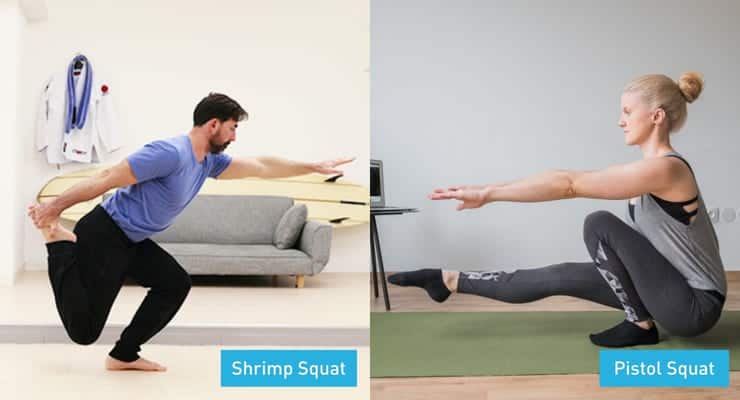
Have a look at our breakdown of the shrimp vs. pistol squat.
Nothing is wrong with the knee position in either one. Different movements just ask you to adapt where you are in space so you do not tip over.
Key Takeaways:
- Your knee position varies depending on which squat you are doing.
- To stay balanced, it is normal for your knees to pass your toes, and that is fine as long as you are uninjured and not fighting a mobility limitation.
Healthy Movement = Moving In Various Directions With Control
You have probably seen our coaches play around with movements that look odd at first. They look unusual because most of us never train in those positions, so we lose access to them.
Someone with years of gymnastics and martial arts behind them can let a knee travel well past the toes under full control, because they have deliberately worked those ranges for a long time.
It is easy to get locked into one rigid way of squatting, especially under a barbell. Your knees get stronger and more durable as you improve hip and ankle mobility and build strength across a variety of positions, not by avoiding them.
Now there is one distinction worth making clear.
Transient Positioning Is Not The Same As Chronic Misalignment
You have seen people online freeze a frame and diagnose everything wrong with someone’s movement from a single photo.
For instance:
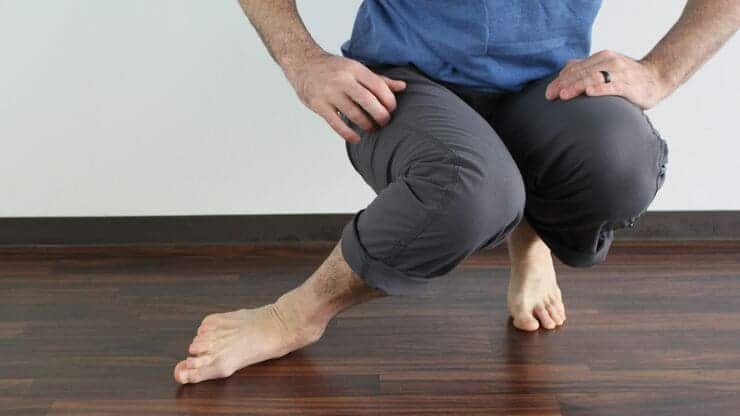
That is a still of Ryan transitioning, under control, into another movement. The knee looks misaligned in the frame, and it is completely fine, because it is controlled and momentary.
A still photo cannot tell you whether a position is controlled, loaded sensibly, and pain-free. Movement is the context. Held briefly, under control and without pain, that “misaligned” knee is healthy movement, and it comes back to the individual’s anatomy, ability, and training history.
Key Takeaways:
When you transition from one movement to another, your knees will often pass through positions that look “misaligned” in a photo. That is part of healthy movement. With the strength, mobility, and control to move well, you should have no trouble moving in all directions.
Have Existing Knee Problems? Be Cautious
If you have an injury, arthritis, tendinitis, or anything that limits your range or causes pain, you have to be careful. Do not force your way into a deep squat. You will likely aggravate the issue and push back the day you can squat comfortably.
If you are dealing with a fresh injury, read what to do right after you get hurt and follow that advice. Once you have recovered, work back into range with care and patience. Getting hurt again is the last thing you want, so ease back in and take your time.
That said, if you are reading an article about whether knees over toes is okay, you are probably in good shape to start working on a squat that fits your body.
Most of the time, the limitations and minor aches that show up in the squat trace back to a shortage of three things:
- Strength
- Control
- Flexibility
Train those in isolation and you leave progress on the table. Train them together and the squat takes care of itself. That is how we built Elements: the exact progressions and instruction to ease you into the best squat for your body, and you gain a good deal more than just a great squat along the way.
The thing to remember is that you start where you are. Then you keep working until you are satisfied, and then you keep going.
Build a Great Squat With a Foundation in the Basics
With Elements, you will build a foundation of strength, flexibility, and control over 8 weeks, setting yourself up for a lifetime of staying fit and active.
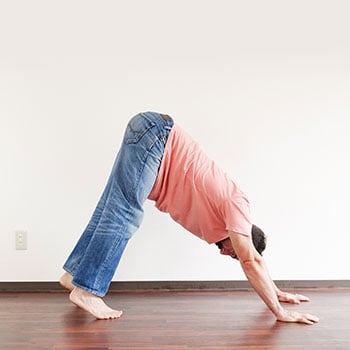

Hi, I'm Jarlo Ilano PT, DPT 👋
Jarlo Ilano, PT, DPT, OCS has been a Physical Therapist since 1998. He earned his Doctorate of Physical Therapy in Musculoskeletal Management from Evidence In Motion, was board certified as an Orthopedic Clinical Specialist with the American Board of Physical Therapy Specialties, and is a certified Therapeutic Pain Specialist through EIM/Purdue University.
In addition to cofounding GMB, Jarlo has been teaching martial arts for over 30 years, with a primary focus on Filipino Martial Arts. He designed our Train Without Pain guide and our knee and shoulder restoration programs.